World Heritage Identification Number: 902
World Heritage since: 1999
Category: Cultural Heritage
WHE Type: Historic Cities & Urban Areas
Transboundary Heritage: No
Endangered Heritage: No
Country: 🇷🇴 Romania
Continent: Europe
UNESCO World Region: Europe and North America
Map
The Historic Centre of Sighişoara: A Medieval Gem in Transylvania
The Historic Centre of Sighişoara, inscribed as a UNESCO World Heritage Site in 1999, stands as a testament to the rich history and cultural diversity of Transylvania. Founded by German craftsmen and merchants known as the Saxons, this medieval town has played a pivotal role in the strategic and commercial landscape of Central Europe for several centuries.
Situated in Mureș County, Romania, Sighişoara boasts a unique urban fabric that seamlessly blends defensive fortifications with residential and commercial areas. The town's layout, characterized by narrow, winding streets and intimate squares, offers visitors a glimpse into the daily life of its medieval inhabitants.
One of the most striking features of the Historic Centre of Sighişoara is the Church on the Hill, a significant architectural landmark that dominates the city skyline. Built mainly in the 14th and 15th centuries on earlier foundations, the church showcases predominantly Gothic architecture, with later smaller additions reflecting Renaissance and Baroque influences. Its prominent position above the town and its long construction history contribute to the distinct appearance of the building and its ensemble.
The Church on the Hill (Biserica din Deal) is not only one of the most important religious monuments in Sighişoara but also one of the major Gothic churches of Transylvania. Situated near the historic School on the Hill, it offers panoramic views of the town and surrounding landscape, its elevated placement making it visible from a considerable distance in almost every direction.
In addition to the Church on the Hill, the Historic Centre of Sighişoara is home to numerous other historical monuments, including the Clock Tower — historically the gate tower and main entrance to the upper city — the Covered Staircase leading to the Hill, and several surviving guild towers. These structures serve as reminders of the town's past glory and offer insights into the lives of its medieval inhabitants.
The Historic Centre of Sighişoara also bears witness to the life of Vlad the Impaler, the infamous ruler who inspired Bram Stoker's Dracula character. According to local tradition, Vlad III was born in a house within the citadel, now known as the Vlad Dracul House, and is said to have spent his childhood in Sighişoara before ascending to power as the Voivode of Wallachia. Today, his birthplace functions as a restaurant and a small museum/tourist attraction.
When you look at it all together, the Historic Centre of Sighişoara represents a unique blend of history, culture, and architectural beauty. As a UNESCO World Heritage Site, it invites visitors to explore its cobblestone streets, historic buildings, and captivating stories, offering a glimpse into the rich tapestry of Transylvanian history.
UNESCO Description of the World Heritage Site
Founded by German craftsmen and merchants known as the Saxons of Transylvania, Sighişoara is a fine example of a small, fortified medieval town which played an important strategic and commercial role on the fringes of central Europe for several centuries.
UNESCO Justification of the World Heritage Site
Criterion (iii): Sighisoara is an outstanding testimony to the culture of the Transylvanian Saxons, a culture that is coming to a close after 850 years and will continue to exist only through its architectural and urban monuments.
Criterion (v): Sighisoara is an outstanding example of a small fortified city in the border region between the Latin-oriented culture of central Europe and the Byzantine-Orthodox culture of south-eastern Europe. The apparently unstoppable process of emigration by the Saxons, the social stratum which had formed and upheld the cultural traditions of the region, threatens the survival of their architectural heritage as well.
Encyclopedia Record: Church on the Hill (Sighișoara)
The Church on the Hill is an architecturally significant church located in Sighişoara, Mureș County in Romania. This church is the most important monument of religious architecture in Sighisoara and is one of the great churches of Transylvania, being the third largest. Located at an altitude of 429 meters, on the Hilltop School, the church dominates by its massiveness the entire city and it is visible from a great distance almost from all directions. Most researchers believe that a number of architectural details such as slightly misaligned position of the bell-tower and choir demonstrate an evolution in stages, over several centuries, in the construction of this church.Additional Site Details
Area: 33 hectares
Number of Components: 1
(v) — Outstanding example of traditional human settlement
Coordinates: 46.21777778 , 24.79222222
Image
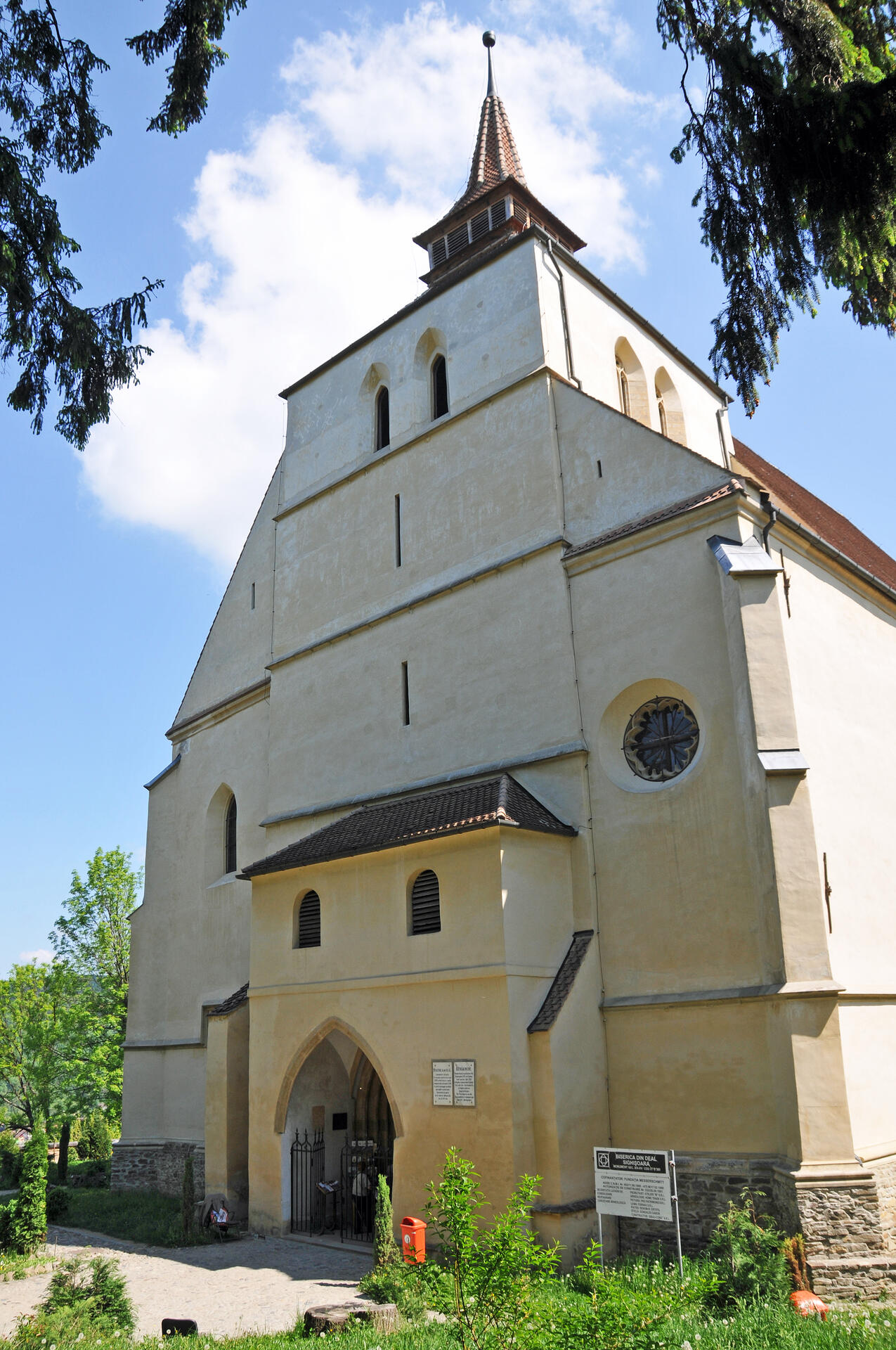
© Dennis G. Jarvis, CC BY-SA 2.0 Resized from original. (This derivative is under the same CC BY-SA license.)
World Heritage Research
Discover scientific research and academic studies that deepen our understanding of Historic Centre of Sighişoara from its history and significance to its conservation, management, and contemporary challenges.
-
The Geometric System of the Nave Vault of the Church on the Hill of Sighişoara
Contrary to established theories, the construction of Gothic net vaults does not always begin with a predefined rib system plan. A geometric analysis of Sighişoara's Church on the Hill reveals that late Gothic architecture can integrate principles of unity and division while also embracing separation and addition, even in structures linked to the Landshut guild. This study challenges the assumption that orderly initial conditions are prerequisite for net vault design by employing point cloud-based methods to dissect the nave vault's geometry.
JOBBIK, E., & KRÄHLING, J. (2023). The Geometric System of the Nave Vault of the Church on the Hill of Sighişoara. Studia Universitatis Babeș-Bolyai Historia Artium, 7–43. https://doi.org/10.24193/subbhistart.2023.01
View Publication Record | Read Publication -
The Church on the Hill in Schäßburg/Sighişoara. A Jewel of Architecture and Art-History on a Marginal Spiritual-Liturgical Existence
The Church on the Hill in Sighișoara stands as a testament to architectural and art-historical significance while facing challenges due to its marginal spiritual-liturgical existence. Originally a key liturgical space for the Evangelical community, its reduced membership post-1989 led to alternative uses. However, its inclusion in the UNESCO list has transformed it into a major tourist attraction, drawing culture enthusiasts and offering contemplative organ concerts. Despite the pandemic's impact on tourism, the church is now regaining its liturgical purpose, balancing historical preservation with contemporary cultural and spiritual needs.
Fröhlich, H. B. (2021). The Church on the Hill in Schäßburg/Sighişoara. A Jewel of Architecture and Art-History on a Marginal Spiritual-Liturgical Existence. Review of Ecumenical Studies Sibiu, 13(2), 256–267. https://doi.org/10.2478/ress-2021-0024
View Publication Record | Read Publication