
World Heritage Identification Number: 444
World Heritage since: 1987
Category: Cultural Heritage
WHE Type: Buildings & Architectural Ensembles
Transboundary Heritage: No
Endangered Heritage: No
Country: 🇲🇦 Morocco
Continent: Africa
UNESCO World Region: Arab States
Map
Architectural Marvel: The Ksar of Ait-Ben-Haddou
The Ksar of Ait-Ben-Haddou, nestled in the foothills of the Atlas Mountains in Morocco, stands as a testament to the rich architectural heritage of North Africa. This remarkable fortified city, inscribed as a UNESCO World Heritage Site in 1987, offers a unique glimpse into the ancient traditions and lifestyles of the region's inhabitants.
More to come…UNESCO Description of the World Heritage Site
The ksar, a group of earthen buildings surrounded by high walls, is a traditional pre-Saharan habitat. The houses crowd together within the defensive walls, which are reinforced by corner towers. Ait-Ben-Haddou, in Ouarzazate province, is a striking example of the architecture of southern Morocco.
UNESCO Justification of the World Heritage Site
Criterion (iv): The Ksar of Ait-Ben-Haddou is an eminent example of a ksar in southern Morocco illustrating the main types of earthen constructions that may be observed dating from the 17th century in the valleys of Dra, Todgha, Dadès and Souss.
Criterion (v): The Ksar of Ait-Ben-Haddou illustrates the traditional earthen habitat, representing the culture of southern Morocco, which has become vulnerable as a result of irreversible socio-economic and cultural changes
Encyclopedia Record: Aït Benhaddou
Aït Benhaddou is a historic ighrem or ksar along the former caravan route between the Sahara and Marrakesh in Morocco. It is considered a great example of Moroccan earthen clay architecture and has been a UNESCO World Heritage Site since 1987.Additional Site Details
Area: 3.03 hectares
Number of Components: 1
(v) — Outstanding example of traditional human settlement
Coordinates: 31.04722 , -7.12889
Image
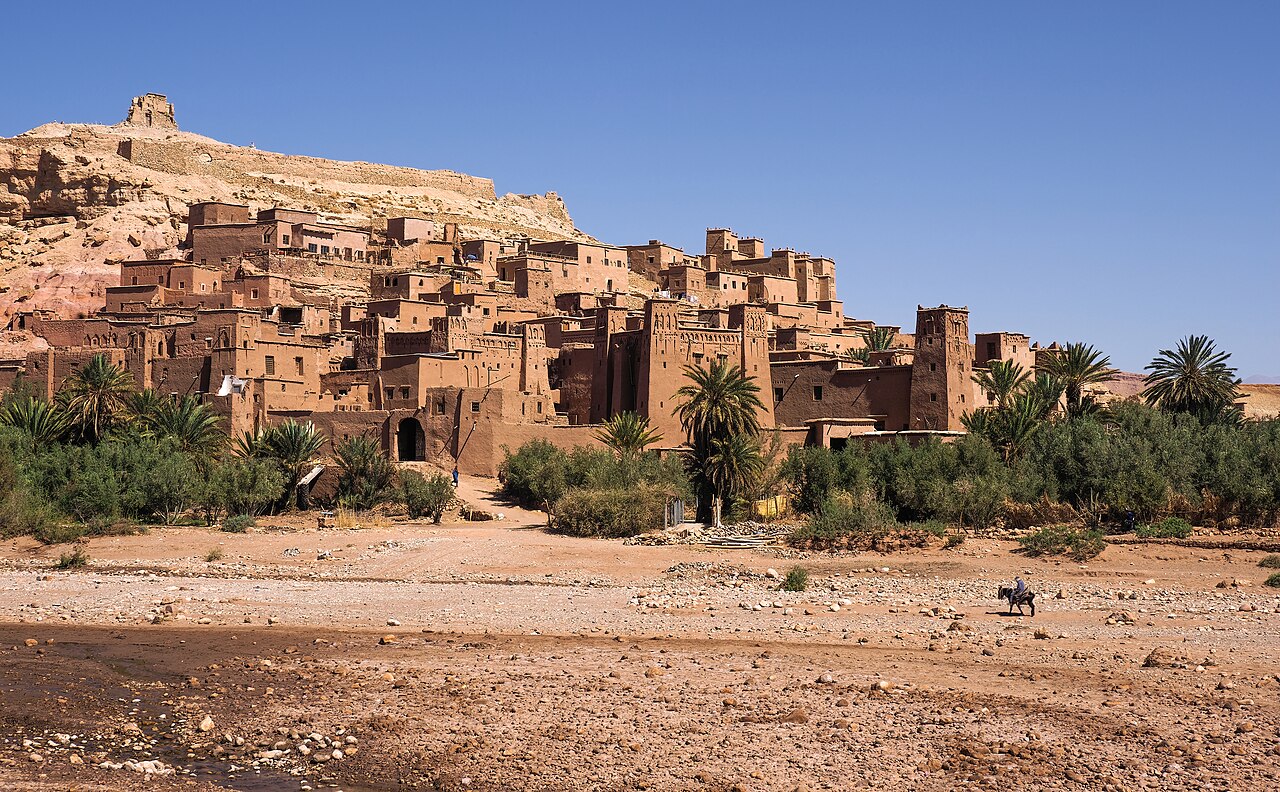
© Petar Milošević, CC BY-SA 4.0 Resized from original. (This derivative is under the same CC BY-SA license.)

World Heritage Research
Discover scientific research and academic studies that deepen our understanding of Ksar of Ait-Ben-Haddou from its history and significance to its conservation, management, and contemporary challenges.
-
Fast-survey techniques for digital mapping and understanding the Ksar of Ait Ben Haddou
A groundbreaking approach demonstrates that rapid, non-invasive digital mapping techniques can effectively capture the complex morphology of vernacular heritage sites with metric reliability. By combining unmanned aerial systems (UAS) videogrammetry and terrestrial laser scanning (TLS), researchers achieved high-resolution 3D representations of the Ksar of Ait Ben Haddou in southern Morocco, prioritizing speed, portability, and minimal equipment without compromising accuracy. Comparative analyses revealed that UAS-based photogrammetric data, processed through Structure from Motion–Multi View Stereo (SfM-MVS) algorithms, closely matched TLS measurements, validating its potential for preliminary analysis and interpretative modeling. This methodology offers a scalable solution for documenting architectural form, construction logic, and typological variation, enhancing visual comprehension of complex heritage structures.
PETTINEO, A. (2026). Fast-survey techniques for digital mapping and understanding the Ksar of Ait Ben Haddou. Emerging Research in Materials for Environment, and Civil Infrastructure: GeoME 5.5, 58, 123–129. https://doi.org/10.21741/9781644903933-17
View Publication Record | Read Publication -
Lessons Learnt from Adaptive Reuse of Earthen Heritage in Desert Oases in Hot Arid Climates
Adaptive reuse of earthen heritage in desert oases offers proven strategies for preserving historical values while meeting contemporary needs. This study identifies key lessons from successful projects in Egypt, Saudi Arabia (AlUla and Al-Turaif), Morocco (Ksar Ait Ben Haddou), and Yemen (Old Sanaa), highlighting common challenges and solutions applicable globally. Central to these approaches is community involvement and the creation of new economic opportunities for locals, which enhance both conservation efforts and local engagement. The analysis provides actionable insights for stakeholders, architects, and planners, emphasizing how earthen construction can be sustainably adapted in hot arid climates while maintaining cultural significance.
Khalil, M., Pons Valladares, O., & Bosch González, M. (2025). Lessons Learnt from Adaptive Reuse of Earthen Heritage in Desert Oases in Hot Arid Climates. HERITAGE2025 International Conference on Earthen & Vernacular Heritage Conservation, Adaptive Reuse & Urban Regeneration. https://doi.org/10.4995/heritage2025.2025.19388
View Publication Record | Read Publication