World Heritage Identification Number: 1505
World Heritage since: 2016
Category: Natural Heritage
WHE Type: Natural Landscapes & Geographic Features
Transboundary Heritage: No
Endangered Heritage: No
Country: 🇮🇷 Iran (Islamic Republic of)
Continent: Asia
UNESCO World Region: Asia and the Pacific
Map
The Lut Desert: A Geological Marvel in Iran
The Lut Desert, officially known as Dasht-e Lut, is a captivating expanse of arid land situated in the southeastern regions of Iran, spanning across the provinces of Kerman and Sistan-Baluchestan. This vast desert, covering approximately 51,800 square kilometers, is the 33rd largest desert globally and holds a significant place within the realm of geology due to its unique and awe-inspiring landforms. In recognition of its exceptional geological processes, the Lut Desert was inscribed onto the UNESCO World Heritage List on July 17, 2016.
More to come…UNESCO Description of the World Heritage Site
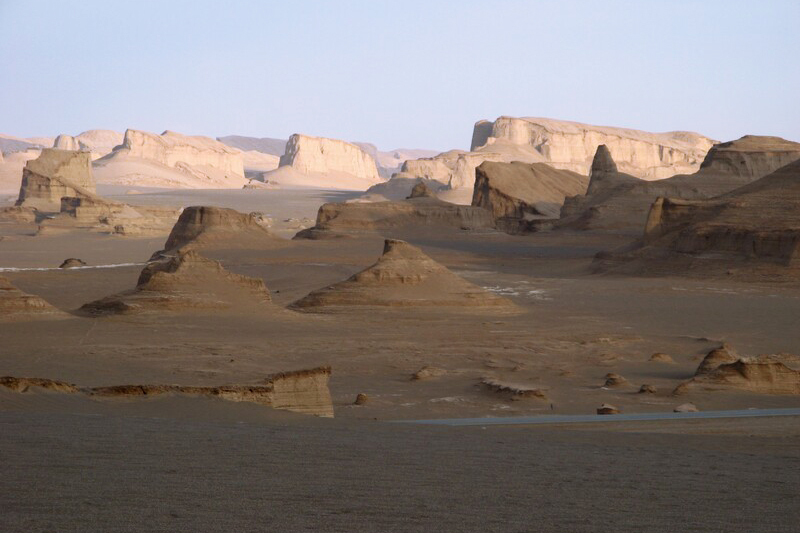
The Lut Desert, or Dasht-e-Lut, is located in the south-east of the country. Between June and October, this arid subtropical area is swept by strong winds, which transport sediment and cause aeolian erosion on a colossal scale. Consequently, the site presents some of the most spectacular examples of aeolian yardang landforms (massive corrugated ridges). It also contains extensive stony deserts and dune fields. The property represents an exceptional example of ongoing geological processes.
UNESCO Justification of the World Heritage Site
Criterion (vii): The Lut Desert protects a globally-recognized iconic hot desert landscape, one of the hottest places on earth. It is renowned for its spectacular series of landforms, namely the yardangs (massive corrugated ridges) in the west of the property and the sand-sea in the east. The yardangs are so large and impressive that they can be seen easily from space. Lut is particularly significant for the great variety of desert landform types found in a relatively small area. Key attributes of the aesthetic values of the unspoilt property relate to the diversity and sheer scale of its landforms; a visually stunning mosaic of desert colours; and uninterrupted vistas across huge and varied dune systems that transition into large flat desert pavement areas.
Criterion (viii): The property represents an exceptional example of ongoing geological processes related to erosional and depositional features in a hot desert. The yardang/kalut landforms are widely considered the best-expressed in the world in terms of extent, unbroken continuity and height. The Lut sand-seas are amongst the best developed active dune fields in the world, displaying a wide variety of dune types (crescentic ridges, star dunes, complex linear dunes, funnel-shaped dunes) with dunes amongst the highest observed anywhere on our planet. Nebkha dune fields (dunes formed around plants) are widespread with those at Lut as high as any measured elsewhere. Evaporite (salt) landforms are displayed in wide variety, including white salt-crusted crystalline riverbeds, salt pans (playa) with polygonally fractured crusts, pressure-induced tepee-fractured salt crusts, gypsum domes, small salt pingos (or blisters), and salt karren. Other dry-land landforms include extensive hamada (stony desert pavements or reg) usually located on pediment surfaces with wind faceted stones (ventifacts), gullied badlands and alluvial fans (bajada).
Encyclopedia Record: Dasht-e Lut
Dasht-e Lut, also known as Namakzar-e Shahdad and widely referred to as the Lut Desert is a salt desert located in the provinces of Kerman and Sistan-Baluchestan, Iran. It is the world's 33rd-largest desert, and was included in UNESCO's World Heritage List on July 17, 2016.Additional Site Details
Area: 2,278,015 hectares
Number of Components: 1
(viii) — Outstanding example representing major earth stages
Coordinates: 30.2161111111 , 58.8388888889
IUCN World Heritage Outlook
The 2025 Conservation Outlook on Lut Desert reports the following assessment:
Source: International Union for Conservation of Nature (IUCN) · View assessment
World Heritage Research
Discover scientific research and academic studies that deepen our understanding of Lut Desert from its history and significance to its conservation, management, and contemporary challenges.
-
Lut Desert Mars Hike Tour as an Idea for Destination Dupe
Researchers propose the concept of 'destination dupe' to address gaps in current theories of destination substitutability, where tourists consciously engage with fantasies that lack terrestrial equivalents. A 5-year study involving a professional team traversing over 700 km across the Lut Desert, accompanied by native guides and researchers as part of the 'Lut Desert Mars Hike Tour Package,' explored this phenomenon. The study used recorded GPS tracks to analyze terrestrial analogs of Martian phenomena, highlighting how destination dupe extends beyond traditional substitutability by incorporating elements that do not exist in reality.
Ghorbani, A., & Zangiabadi, A. (2026). Lut Desert Mars Hike Tour as an Idea for Destination Dupe. Journal of Travel Research. https://doi.org/10.1177/00472875261424439
View Publication Record | Read Publication -
Plant diversity of the Lut Desert natural world heritage site: the hottest place on earth
Contrary to its harsh reputation, the Lut Desert—UNESCO's first Natural World Heritage Site in Iran and one of Earth's hottest places—hosts significant plant diversity. A 2021 study revealed that species richness and phylogenetic diversity increase monotonically with elevation, peaking at mid-high elevations (764–1386 m) due to milder temperatures and better soil conditions. The survey identified 76 plant species across five subregions, dominated by perennial shrubs and grasses adapted to extreme aridity, with the Irano-Turanian/Saharo-Sindian chorotype being most prevalent. Notably, one threatened species, Haloxylon persicum, was discovered, highlighting the desert's conservation importance. This challenges the perception of barrenness and underscores its role as a biological refuge vulnerable to climate change.
Hamidreza Keshtkar, Hassan Yeganeh, Mehran Maghsoudi, Winfried Voigt. (2026). Plant diversity of the Lut Desert natural world heritage site: the hottest place on earth. Zenodo. https://doi.org/10.5281/ZENODO.20237789
View Publication Record | Read Publication -
Halamphora izadii sp. nov., a new diatom species from the hottest place on earth, Lut Desert, Iran
Scientists have identified Halamphora izadii, a new diatom species capable of surviving extreme conditions, from the Lut Desert—the hottest place on Earth. This microscopic organism thrives in high temperatures and salinity, distinguishing itself with fine striae (26-30 per 10 µm) and unique areolae structures. The discovery, based on light microscopy (LM) and scanning electron microscopy (SEM), highlights the desert's resilient diatom flora and contributes to understanding its ecological adaptations. Researchers compared H. izadii with similar species, discussing its phylogenetic placement and ecological significance in this harsh environment.
Kheiri, S., Edlund, M. B., Spaulding, S. A., Nadir Solak, C., Sabouri, J., & Peszek, Ł. (2026). Halamphora izadii sp. nov., a new diatom species from the hottest place on earth, Lut Desert, Iran. Fottea. https://doi.org/10.5507/fot.2026.002
View Publication Record | Read Publication -
Isolation and Identification of High-Density Polyethylene (HDPE) Degrading Bacteria from the Lut Desert, Iran
Researchers have identified high-density polyethylene (HDPE)-degrading bacteria from the Lut Desert, Iran, demonstrating significant biodegradation potential. Among 50 bacterial isolates, six showed over 40% surface hydrophobicity and reduced HDPE weight by up to 47% after 60 days—far exceeding non-biological controls. The study confirmed the presence of degradation-related genes (cotA, alkB, phoD) and detected intermediate metabolites like alkanes (C10–C20), hexanoic acid, and benzaldehyde via GC-MS analysis. This suggests that extremophile bacteria in arid environments may play a crucial role in plastic biodegradation, offering potential for bioremediation strategies.
Setateh Hakakzadeh, Abbas AkhavanSepahi, Parvaneh Maghami, & MohamadMahdi Motaghi. (2026). Isolation and Identification of High-Density Polyethylene (HDPE) Degrading Bacteria from the Lut Desert, Iran. Journal of Microbial World, 19(1), 25. https://doi.org/10.82363/JMW.2026.1251930
View Publication Record | Read Publication -
Traces of hominin occupations in eastern Iran: Middle Pleistocene lithics from Khousf Plain in the Lut Desert margin
A significant discovery of Middle Pleistocene lithic tools, including cleavers and Levallois artifacts, from the Khousf Plain in Iran's Lut Desert suggests that this arid region played a crucial role in early hominin dispersal. The findings, centered around the Goab playa, indicate that eastern Iran may have served as a corridor for human migration to Eastern Asia. Researchers employed geospatial analysis and sedimentary studies to identify and date these tools, providing new insights into the adaptability of early humans in challenging environments.
Rafei, S. R., Shayestehfar, M., Bakhshandeh Pahmedani, Z., Nikzad, M., & Sadraei, A. (2025). Traces of hominin occupations in eastern Iran: Middle Pleistocene lithics from Khousf Plain in the Lut Desert margin. Antiquity, 100(409). https://doi.org/10.15184/aqy.2025.10207
View Publication Record | Read Publication -
Lutophila gen. nov., a new diatom genus from the hottest place on Earth, Lut Desert, Iran
Scientists have discovered Lutophila, a new diatom genus, in the hypersaline pools and saline river of Iran's Lut Desert, recognized as the hottest place on Earth. This novel genus, characterized by its linear-lanceolate shape with broadly rounded apices and distinctive areolae patterns, shares morphological traits with genera like Krasskella, Biremis, Chamaepinnularia, and Oestrupia. The study identifies one species, Lutophila iranica, which exhibits two morphotypes differing in width and central area prominence. This research contributes to the understanding of microbial flora in extreme environments, particularly in the understudied hypersaline ecosystems of the Lut Desert.
KHEIRI, S., EDLUND, M. B., SPAULDING, S., NADIR SOLAK, C., SABOURI, J., IZADI, B., & PESZEK, Ł. (2024). Lutophila gen. nov., a new diatom genus from the hottest place on Earth, Lut Desert, Iran. Phytotaxa, 641(2), 99–111. https://doi.org/10.11646/phytotaxa.641.2.2
View Publication Record | Read Publication -
Identification and isolation of efficient phenol-degrading and heavy metal-resistant bacteria from seasonal catchments of the Lut Desert
A highly efficient phenol-degrading bacterium, Bacillus cereus LD-1, resistant to cadmium, was isolated from the Lut Desert, Iran. This strain demonstrated remarkable resilience and degradation capabilities, breaking down phenol concentrations up to 1,500 mg/L. Under optimized conditions—pH 8, temperature of 30°C, zero salinity, and a carbon-to-nitrogen ratio of 100:30—the bacterium achieved an 80.57% degradation rate. Among the tested factors, pH had the most significant impact on phenol biodegradation, followed by salinity, temperature, and C:N ratio. This discovery highlights the potential of B. cereus LD-1 for bioremediation applications in treating phenolic effluents contaminated with heavy metals, offering a promising solution for environmental cleanup in arid regions.
Samimi, M., & Shahriari-Moghadam, M. (2024). Identification and isolation of efficient phenol-degrading and heavy metal-resistant bacteria from seasonal catchments of the Lut Desert. Water Science & Technology, 90(7), 2017–2028. https://doi.org/10.2166/wst.2024.329
View Publication Record | Read Publication