World Heritage Identification Number: 402
World Heritage since: 1987
Category: Natural Heritage
WHE Type: Protected Areas & National Parks
Transboundary Heritage: No
Endangered Heritage: No
Country: 🇵🇪 Peru
Continent: Americas
UNESCO World Region: Latin America and the Caribbean
Map
Manú National Park: A Biodiverse Haven in Peruvian Amazon Rainforest
Manú National Park, situated in the regions of Madre de Dios and Cusco in Peru, stands as a testament to the country's commitment towards preserving its rich natural heritage. Inscribed as a UNESCO World Heritage Site in 1987, this expansive protected area spans over 1.5 million hectares, making it one of the largest national parks in South America.
More to come…UNESCO Description of the World Heritage Site
This huge 1.5 million-ha park has successive tiers of vegetation rising from 150 to 4,200 m above sea-level. The tropical forest in the lower tiers is home to an unrivalled variety of animal and plant species. Some 850 species of birds have been identified and rare species such as the giant otter and the giant armadillo also find refuge there. Jaguars are often sighted in the park.
UNESCO Justification of the World Heritage Site
Criterion (ix): Manu National Park has a remarkable location at the meeting point of the Tropical Andes and the Amazonian lowland forests. The massive altitudinal gradient has favoured an extremely broad range of ecological conditions and the evolution of highly diverse species and ecological communities. The landscape diversity ranges from high Andean grasslands to various forests types, including pristine montane cloud forests and lush lowland rainforest. The combination of topography, ecological conditions and isolation have permitted the almost undisturbed and ongoing evolution of an extraordinary diversity of life at all levels and a high degree of endemism. In addition to the diversity of life, Manu National Park is also known for an unusually high abundance of fauna across many taxonomic groups.
Criterion (x): The extraordinary biodiversity combined with the large size and excellent conservation state makes Manu National Park a protected area of major and global biodiversity conservation importance. More than 200 species of mammals, 800 species of birds, 68 species of reptiles, 77 species of amphibians and impressive numbers of freshwater fish imply a diversity of vertebrates matched only in very few places of the World. Numbers in other taxonomic groups are at least as impressive, for example the more than 1,300 recorded species of butterflies out of probably several hundreds of thousands of arthropods. Thousands of higher plant species are distributed across the diverse ecosystems, habitats and niches. Hundreds of tree species have been identified, often jointly growing within very small areas. For decades, the property has been among the foremost references for scientific research in tropical ecology. As such the property has significantly helped our understanding of tropical forest ecosystems. Even seasoned researchers are overwhelmed not only by the diversity of life but also by the impressive abundance of vertebrates, including mammals. Despite the major record of research, even today taxonomic studies invariably reveal species unknown to science, including vertebrates, clear evidence that Manu continues to hold many of its biodiversity secrets.
Encyclopedia Record: Manu National Park
Manu National Park is a national park and biosphere reserve located in the regions of Madre de Dios and Cusco in Peru. It protects a diverse number of ecosystems including lowland rainforests, cloud forests and Andean grasslands.Additional Site Details
Area: 1,716,295 hectares
Number of Components: 1
(x) — Contains most important habitats for biodiversity
Coordinates: -12.25 , -71.75
IUCN World Heritage Outlook
The 2025 Conservation Outlook on Manú National Park reports the following assessment:
Source: International Union for Conservation of Nature (IUCN) · View assessment
Image
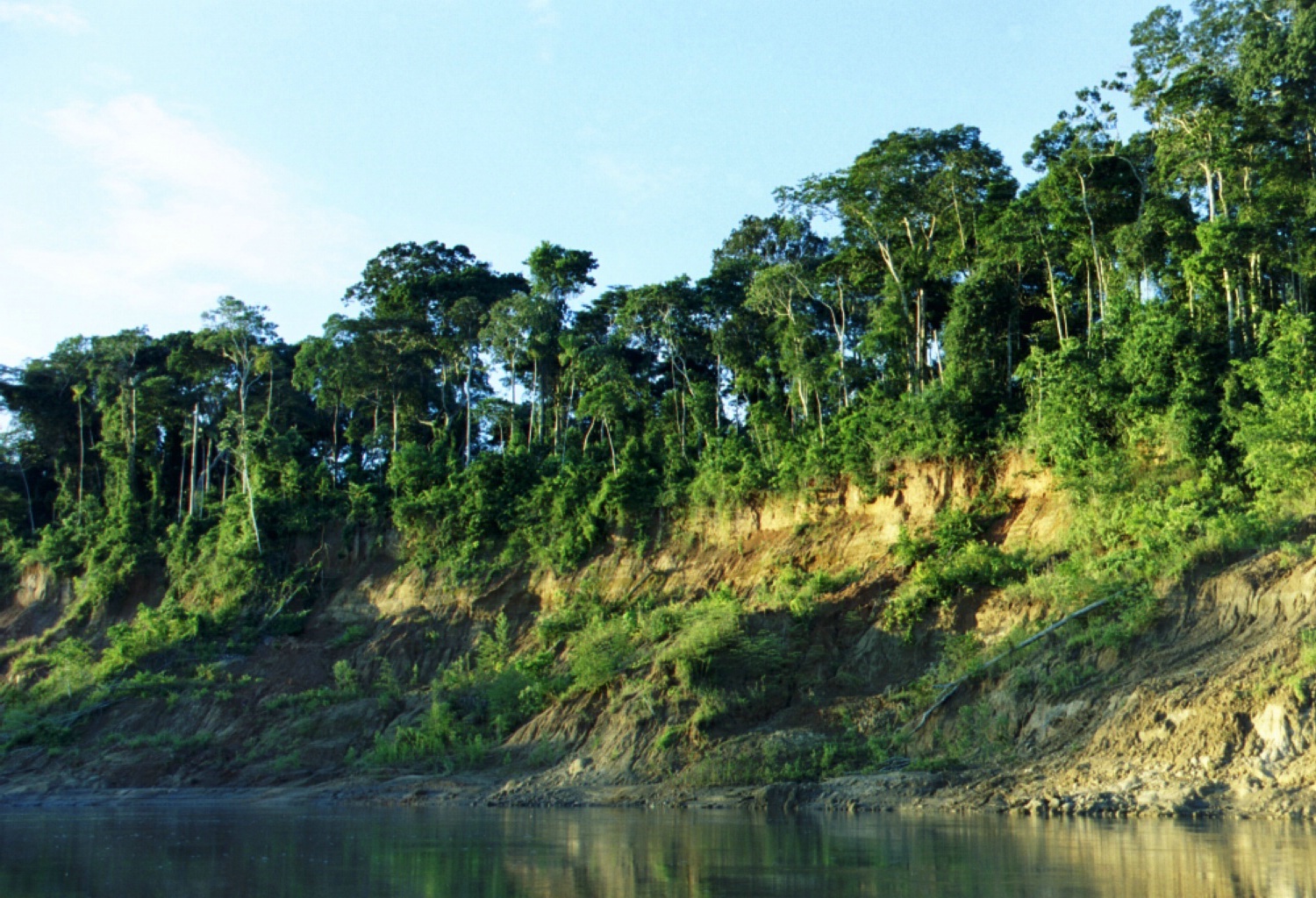
© As578, CC BY-SA 2.5 Resized from original. (This derivative is under the same CC BY-SA license.)
World Heritage Research
Discover scientific research and academic studies that deepen our understanding of Manú National Park from its history and significance to its conservation, management, and contemporary challenges.
-
Social preferences and choice experiments in biodiversity conservation in Manu National Park, Peru
A study quantifies the economic value of biodiversity conservation in Peru's Manu National Park (MNP), a UNESCO World Heritage Site renowned for its exceptional biodiversity. Using choice experiments with 560 households in Lima, researchers estimated marginal willingness to pay for conservation efforts, addressing threats like illegal logging and mining. The findings highlight the significant economic benefits of protecting MNP, emphasizing its role as a critical tool for biodiversity preservation and ecosystem service provision. This approach provides actionable insights for policymakers aiming to balance conservation with land-use challenges.
Minaya Gutiérrez, C. A., Vasquez Quispe, C. Z., & Chinguel Labán, D. O. (2026). Social preferences and choice experiments in biodiversity conservation in Manu National Park, Peru. Rper, (73), 65–80. https://doi.org/10.59072/rper.vi73.765
View Publication Record | Read Publication -
Redefining conservation in world society : indigenous peoples’ challenges to green colonialism in the UNESCO World Heritage regime
The UNESCO World Heritage regime is increasingly becoming a contested platform for addressing historical injustices, with its legitimacy hinging on Indigenous-led conservation approaches. This study reveals that while the formal recognition of Indigenous rights has expanded within the regime, implementation often remains partial and decoupled from actual conservation practices. The research employs a comparative analysis across four sites—Manú National Park (Peru), Tongariro National Park (Aotearoa/New Zealand), Lake Bogoria (Kenya), and Pimachiowin Aki (Canada)—using qualitative content analysis of official UNESCO records from 1987 to 2023. It demonstrates how Indigenous actors and human rights institutions can influence the regime's openness to inclusive conservation, challenging persistent exclusionary practices rooted in 'green colonialism.' The study also highlights the potential of UNESCO's documentary repository for tracing institutional change and reconstructing organizational realities.
Rode, R. (2026). Redefining conservation in world society : indigenous peoples’ challenges to green colonialism in the UNESCO World Heritage regime [BTU Cottbus - Senftenberg]. https://doi.org/10.26127/BTUOPEN-7339
View Publication Record | Read Publication -
‘…the Hardest Working People on This Planet…’: Conservation Practitioners' Narratives of Heroism and Indigenous Erasure in the Manu National Park, Perú
Conservation practitioners' narratives often perpetuate exclusionary wilderness discourses, emphasizing their own heroism while erasing or marginalizing Indigenous peoples. A critical analysis of archival material and interviews from the Manu National Park, Peru—a global conservation priority—reveals that these narratives frame Indigenous communities as environmental threats rather than acknowledging their vital roles. While some exceptions exist, fundamental reflexivity in conservation practices remains lacking, highlighting the need for practitioners to de-center themselves and recognize Indigenous contributions.
Salazar Moreira, E. (2026). ‘…the Hardest Working People on This Planet…’: Conservation Practitioners’ Narratives of Heroism and Indigenous Erasure in the Manu National Park, Perú. Geo: Geography and Environment, 13(1). Portico. https://doi.org/10.1002/geo2.70076
View Publication Record | Read Publication -
Making knowledge and making wilderness: The politics of introducing the social sciences into conservation in the Manu National Park, Perú
Conservation efforts in the UNESCO-listed Manu National Park, Peru, have historically relied on Western ontologies that separate humans from nature, sidelining social sciences. This study reveals how conservation practitioners and organizations often instrumentalize social science tools to reinforce wilderness narratives and portray Indigenous communities as environmental threats. Conversely, critical social science research challenging these colonial notions faces hostility and exclusion from decision-making processes. Despite the potential for reflexive conservation practices that could reshape conservation approaches, their influence remains limited within dominant paradigms.
Salazar Moreira, E. (2026). Making knowledge and making wilderness: The politics of introducing the social sciences into conservation in the Manu National Park, Perú. Journal of Political Ecology, 33(1). https://doi.org/10.2458/jpe.8411
View Publication Record | Read Publication -
Using Choice Experiments to value biodiversity in a Megadiverse Protected Area: The case of Manu National Park, Peru
A higher willingness to pay for threatened flora in Manu National Park—associated with cultural familiarity—was quantified, revealing non-use values of USD 19.7 million that could support conservation policies. The study used choice experiments to estimate economic value for biodiversity protection and deforestation reduction in this UNESCO World Heritage Site, addressing a gap in evidence for megadiverse countries like Peru where biodiversity loss threatens ecosystem resilience.
Dávila-García, José , Orihuela, Carlos Enrique, Vásquez-Lavín, Felipe , Luna, Hugo, & Minaya Gutiérrez, Carlos. (2026). Using Choice Experiments to value biodiversity in a Megadiverse Protected Area: The case of Manu National Park, Peru. Unknown. https://doi.org/10.22004/AG.ECON.404222
View Publication Record | Read Publication -
Valuing Biodiversity Conservation in Manu National Park: A Choice Experiment Case Study Conducted During the COVID-19 Pandemic
A groundbreaking study reveals that ecological functionality, such as species interaction networks, is the most influential factor in public preferences for biodiversity conservation in Peru's Manu National Park. Using a choice experiment conducted during the COVID-19 pandemic among 1,005 residents of Metropolitan Lima, researchers found that improvements in functional biodiversity attributes generated significantly higher willingness to pay (WTP) compared to traditional indicators like species counts or habitat loss. This suggests that functional ecological metrics may more effectively communicate complex biodiversity changes to urban populations, offering valuable insights for conservation policy. The study employed mixed logit and latent class models to account for respondent heterogeneity, though its findings are not nationally representative.
Dávila-García, J., & Orihuela, C. (2026). Valuing Biodiversity Conservation in Manu National Park: A Choice Experiment Case Study Conducted During the COVID-19 Pandemic. Case Studies in the Environment, 10(1). https://doi.org/10.1525/cse.2026.2878067
View Publication Record | Read Publication -
Podanotum wayquecha Faynel, Fahraeus & Siebel 2026, sp. nov.
Scientists have discovered and described a new species of butterfly, Podanotum wayquecha, within the UNESCO-listed Manú National Park. This species is distinguished by its unique wing pattern, which includes rounder hindwings and reduced blue scaling compared to similar species like P. clarissimus. Genetic analysis revealed a 3.28% mean divergence in COI from P. clarissimus, confirming its status as a distinct species. The discovery was made through morphological examination of adult specimens and genitalia, alongside genetic sequencing. Podanotum wayquecha inhabits cloud forests at elevations between 2950–3400 meters in southern Peru and northern Bolivia, exhibiting territorial behavior on treetops. Its name derives from the Quechua word for 'brother,' referencing its habitat near the Wayquecha biological station.
Robertc. Busby, Siebel, G., Schomann, A. M., Gonzalez-Mercado, J. H., Lopez-Calderón, L., Moreno-Torres, K., & Prieto, C. (2026). Podanotum wayquecha Faynel, Fahraeus & Siebel 2026, sp. nov. Zenodo. https://doi.org/10.5281/ZENODO.21564743
View Publication Record | Read Publication