World Heritage Identification Number: 263
World Heritage since: 1983
Category: Cultural Heritage
WHE Type: Buildings & Architectural Ensembles
Transboundary Heritage: No
Endangered Heritage: No
Country: 🇵🇹 Portugal
Continent: Europe
UNESCO World Region: Europe and North America
Map
The Monastery of the Hieronymites and Tower of Belém: A Cultural Landmark in Lisbon
The Monastery of the Hieronymites and Tower of Belém, located in Lisbon, Portugal, stand as significant reminders of the country's rich history and artistic prowess. Inscribed as a UNESCO World Heritage Site in 1983, these structures have been recognized for their architectural, historical, and cultural significance.
The Monastery of the Hieronymites, officially known as Mosteiro dos Jerónimos, was constructed between 1502 and 1572 during the reign of King Manuel I. Named after St. Jerome, the patron saint of scholars, the monastery is closely linked to Portugal’s religious and intellectual traditions. The monastery’s architecture exemplifies the Late Gothic Manueline style, characterized by intricate sculptural details, ornate portals, and nautical motifs reflecting Portugal’s maritime explorations during the Age of Discoveries.
The monastery served as the necropolis for the Portuguese royal dynasty of Aviz from the 16th century until the 19th century. Notable figures buried there include King Manuel I and Queen Maria of Aragon. In addition, the celebrated tombs of explorer Vasco da Gama and poet Luís de Camões were relocated to the monastery in 1880.
After the dissolution of religious orders in Portugal in 1833, the monastery was secularized and transferred to the charitable institution, Real Casa Pia de Lisboa. Today, it houses the National Archaeology Museum and the Maritime Museum, preserving both the history of the monastery and Portugal’s broader cultural heritage.
Nearby, the Tower of Belém stands as an iconic symbol of Portugal’s maritime power. Commissioned by King Manuel I around 1514 and completed circa 1520, the tower was originally built as a fortified gateway and a defense system for the mouth of the Tagus River, while also commemorating Vasco da Gama’s successful voyage to India. The tower remains a testament to Portugal's maritime dominance during this era.
Its design merges Manueline and Late Gothic elements, featuring elaborate carvings, rope motifs, and sculpted symbols of Portugal’s seafaring achievements. Over the centuries, the tower has served as a fortress, lighthouse, and customs house, with occasional use as a place of detention. Today, it operates as a museum, offering visitors insight into Portugal’s Age of Discoveries and its strategic role in global exploration.
Together, the Monastery of the Hieronymites and the Tower of Belém exemplify two defining aspects of Portugal’s history: religion and maritime exploration. Their inclusion as a UNESCO World Heritage Site underscores their importance not only to Portugal but to the world. These structures serve as a testament to Portugal's cultural heritage and its significant contributions to the modern world.
UNESCO Description of the World Heritage Site
Standing at the entrance to Lisbon harbour, the Monastery of the Hieronymites – construction of which began in 1502 – exemplifies Portuguese art at its best. The nearby Tower of Belém, built to commemorate Vasco da Gama's expedition, is a reminder of the great maritime discoveries that laid the foundations of the modern world.
UNESCO Justification of the World Heritage Site
Criterion (iii): The Monastery of the Hieronymites and Tower of Belém are a unique and exceptional testimony to a 15th and 16th-century civilization and culture. They reflect the power, knowledge and courage of the Portuguese people at a time when they consolidated their presence and domain of intercontinental trade routes.
Criterion (vi): The complex of Belém is directly associated with the Golden Age of the Discovery and the pioneer role the Portuguese had in the 15th and 16th centuries in creating contacts, dialogue and interchange among different cultures.
Encyclopedia Record: Jerónimos Monastery
The Jerónimos Monastery or Hieronymites Monastery is a former monastery of the Order of Saint Jerome near the Tagus river in the parish of Belém, in the Lisbon Municipality, Portugal. It became the necropolis of the Portuguese royal dynasty of Aviz in the 16th century but was secularized on 28 December 1833 by state decree and its ownership transferred to the charitable institution, Real Casa Pia de Lisboa.Additional Site Details
Area: 2.66 hectares
Number of Components: 2
(vi) — Directly associated with events or living traditions
Coordinates: 38.69194 , -9.21583
Image
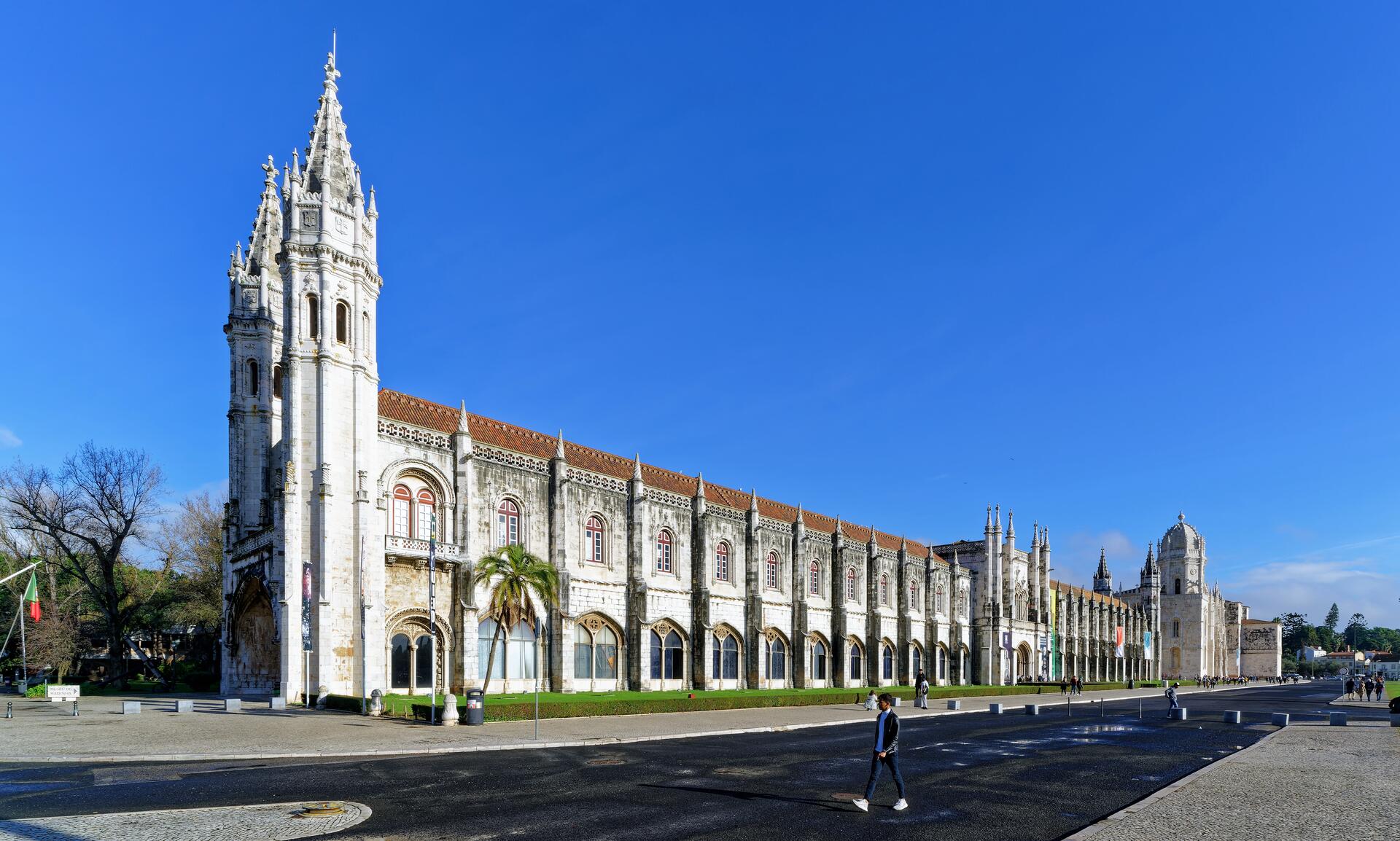
© Holger Uwe Schmitt, CC BY-SA 4.0 Resized from original. (This derivative is under the same CC BY-SA license.)