World Heritage Identification Number: 323
World Heritage since: 1985
Category: Cultural Heritage
WHE Type: Buildings & Architectural Ensembles
Transboundary Heritage: No
Endangered Heritage: No
Country: 🇧🇯 Benin
Continent: Africa
UNESCO World Region: Africa
Map
The Royal Palaces of Abomey: A Reminder of a Powerful West African Kingdom
The Royal Palaces of Abomey, located in the heart of Abomey town, Benin, serve as a testament to the once formidable Kingdom of Dahomey that thrived along the Slave Coast from 1625 to 1900. Inscribed as a UNESCO World Heritage Site in 1985, these palaces offer a unique glimpse into the history and culture of this powerful West African kingdom.
More to come…UNESCO Description of the World Heritage Site
From 1625 to 1900, 12 kings succeeded one another at the head of the powerful Kingdom of Abomey. With the exception of King Akaba, who had his own separate enclosure, they all had their palaces built within the same cob-wall area, in keeping with previous palaces as regards the use of space and materials. The royal palaces of Abomey are a unique reminder of this vanished kingdom.
UNESCO Justification of the World Heritage Site
Criterion (iii): The Royal Palaces of Abomey are a group of monuments of great historical and cultural value because of the conditions that led to their erection and the events they have witnessed. They are the living expression of a culture and an organized power, testimony to the glorious past of the kings who ruled the Kingdom of Dahomey from 1620 to 1900.
Criterion (iv): Organised as a series of courtyards of increasing importance, the access to each being provided by portals built astride the walls of the main enclosure, the Royal Palaces of Abomey are a unique architectural ensemble. These complex fortified structures illustrate the ingenuity developed by the royal power, from the mid-17th century, to comply with the precept laid down by the founder of the kingdom Wegbaja “that the kingdom shall always be made greater”.
Encyclopedia Record: Royal Palaces of Abomey
The Royal Palaces of Abomey are 12 palaces spread over an area of 40 hectares at the heart of the Abomey town in Benin, formerly the capital of the West African Kingdom of Dahomey. The Kingdom was founded in 1625 by the Fon people who developed it into a powerful military and commercial empire, which dominated trade with European slave traders on the Slave Coast until the late 19th century, to whom they sold their prisoners of war. At its peak the palaces could accommodate up to 8000 people. The King's palace included a two-story building known as the "cowrie house" or akuehue. Under the twelve kings who succeeded from 1625 to 1900, the kingdom established itself as one of the most powerful of the western coast of Africa.Additional Site Details
Area: 47.6 hectares
Number of Components: 2
(iv) — Outstanding example of a type of building or landscape
Coordinates: 7.183333333 , 1.983333333
Image
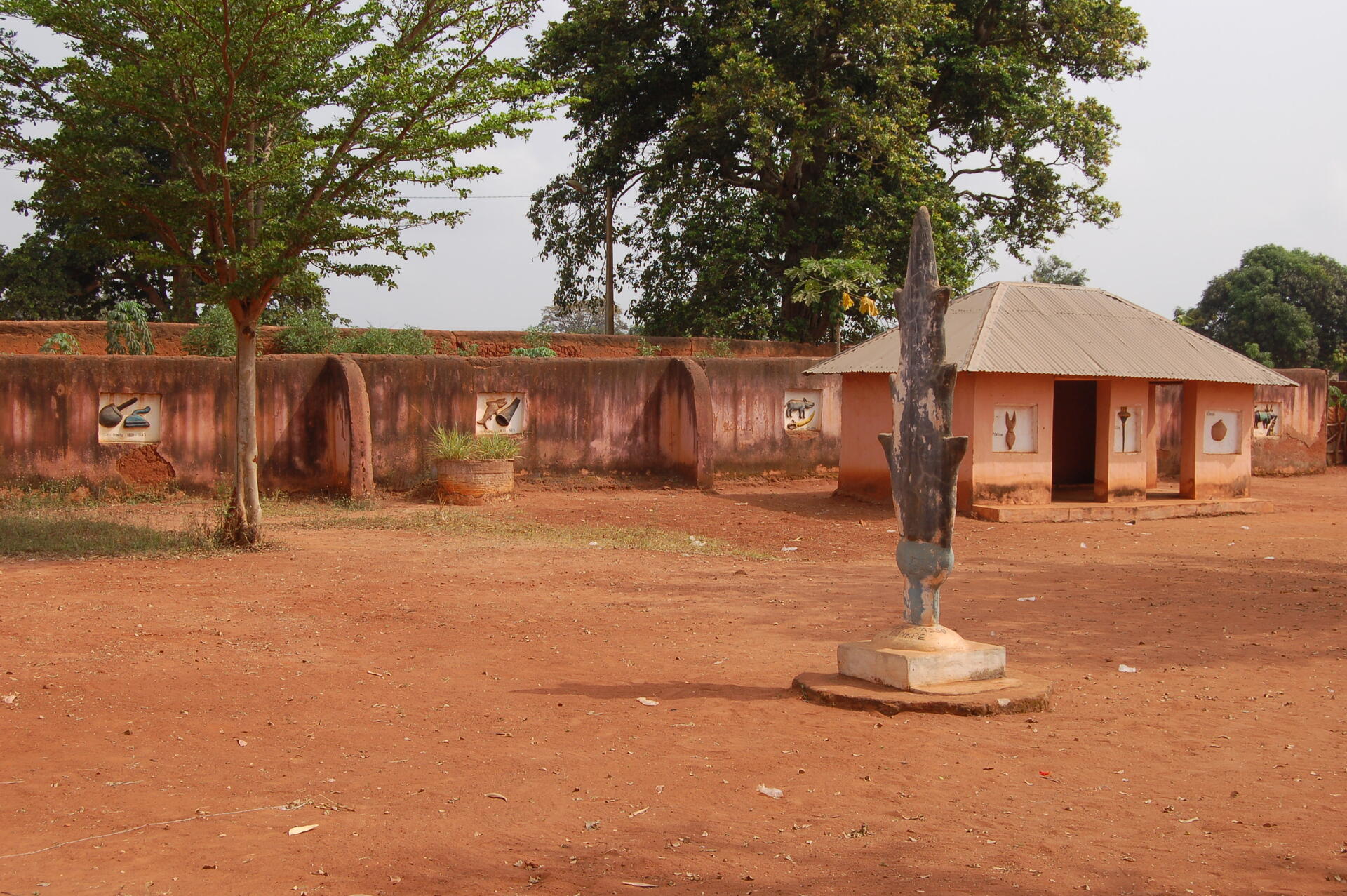
© Joachim Huber, CC BY-SA 2.0 Resized from original. (This derivative is under the same CC BY-SA license.)
World Heritage Research
Discover scientific research and academic studies that deepen our understanding of Royal Palaces of Abomey from its history and significance to its conservation, management, and contemporary challenges.
-
The diversity of plant resources exploited in the palaces of Agbomè (kingdom of Danxomè/Dahomey), Bénin: the contribution of starch grain analysis from the palatial complex of Zasa (eighteenth to twentieth centuries AD)
Starch grain analysis from the Zasa palatial complex in Agbomè, Bénin, reveals that cereals, legumes, and tubers formed a significant part of the diet in the Danxomè kingdom (18th–20th centuries AD), alongside non-local resources like maize and wheat. This study provides the first detailed archaeobotanical evidence of plant resource exploitation in royal palaces, complementing existing knowledge on animal consumption. By analyzing stone tools and ceramics, researchers identified a diverse range of plants used for food and potential medical practices. Cross-referencing with oral and written sources further enriched the interpretation, offering insights into dietary habits, craft production, and cultural practices during this pivotal period in West African history.
Tokannou, S., Cagnato, C., & Petit, C. (2025). The diversity of plant resources exploited in the palaces of Agbomè (kingdom of Danxomè/Dahomey), Bénin: the contribution of starch grain analysis from the palatial complex of Zasa (eighteenth to twentieth centuries AD). Azania: Archaeological Research in Africa, 61(1), 140–167. https://doi.org/10.1080/0067270x.2025.2586374
View Publication Record | Read Publication -
Nothing Can Force the Buffalo to Take off His Tunic
The Royal Palaces of Abomey serve as a living symbol of post-colonial identity, integrating spiritual practices with architectural and urban space. Research highlights how royal Vodun worship ceremonies—including daily libations at palace tombs, large annual tributes to pre-colonial kings, and the rare Gandaxi ritual—reinforce cultural continuity. Key to this are temples linked to the tohosu, spiritually empowered descendants of deformed royalty, and the dadassi, female royal guardians who oversee sacred altars. These elements collectively facilitate spiritual renewal while preserving Dahomey’s pre-colonial heritage amid modern contexts.
Larsen, L. E. (2023). Nothing Can Force the Buffalo to Take off His Tunic. Dahomey’s Royal Architecture, 139–171. https://doi.org/10.4324/9781003297383-6
View Publication Record | Read Publication -
Like a Jar with Many Holes
The Royal Palaces of Abomey serve as a tangible architectural record of Dahomey's tumultuous 18th and 19th centuries, reflecting political, social, and economic transformations. The study reveals how the palace's physical features—including bas-relief sculptures and structural expansions—mirror the reigns of kings Tegbesu, Kpengla, Agonglo, Adandozan, Guezo, and Glele. Notably, the palace's evolution documents periods of conflict, innovation in artistry (e.g., Agonglo's contributions to bas-reliefs), and later stability under Guezo and Glele, which saw economic growth and international engagement. By analyzing oral and written histories alongside architectural elements, the research demonstrates how the palace encapsulates Dahomey's complex legacy, from erasures of despised rulers like Adandozan to expansions symbolizing renewed prosperity.
Larsen, L. E. (2023). Like a Jar with Many Holes. Dahomey’s Royal Architecture, 45–69. https://doi.org/10.4324/9781003297383-3
View Publication Record | Read Publication -
The Fish That Escaped the Net
A study of the Royal Palaces of Abomey reveals that the architectural design and spatial organization of the palace complex were deeply influenced by cultural, political, and supernatural factors during the reigns of King Huegbadja (c. 1645–1685), King Akaba (1685–1708), Regent Hangbe (1708–1711), and King Agadja (1711–1740). The research argues that the palace's structures encoded cultural standards, which were both shaped by and used to manipulate the kingdom's political dynamics. These standards drew from supernatural origins of the Dahomean dynasty, existing Guedevian architectural forms, gendered space, and the immediate history of the ruling dynasty. This analysis provides insight into how architecture served as a tool for political consolidation and expansion during this pivotal period in Dahomey's pre-colonial history.
Larsen, L. E. (2023). The Fish That Escaped the Net. Dahomey’s Royal Architecture, 13–44. https://doi.org/10.4324/9781003297383-2
View Publication Record | Read Publication -
Conclusion. Dahomey’s Royal Architecture
The Royal Palace of Dahomey in Abomey serves as a enduring symbol of cultural identity and historical continuity, reinforcing the significance of pre-colonial history in post-colonial society. This study highlights how bas-relief sculptures depicting royal themes are integrated into public spaces like market facades, hotel courtyards, and homes, affirming the palace's role as a constant structure that transcends colonial rule. The research examines the palace's evolution through periods of construction, subjugation, and reclamation, emphasizing its representation of history, religion, and culture. By analyzing these elements, the study underscores the palace's capacity to strengthen community bonds and preserve cultural heritage.
Larsen, L. E. (2023). Conclusion. Dahomey’s Royal Architecture, 172–177. https://doi.org/10.4324/9781003297383-7
View Publication Record | Read Publication -
Dahomey’s Royal Architecture
The Royal Palace of Abomey, spanning over 108 acres and encircled by a two-mile wall, serves as a historic record demonstrating how architecture can be manipulated to serve political, religious, or cultural agendas across nearly four centuries. Originally destroyed in 1892 to prevent capture by French colonial forces, portions of the palace were later restored for colonial administration before being transformed into a museum in 1945 and inscribed as a UNESCO World Heritage Site in 1985. The study documents the palace's physical transformations, revealing its enduring religious significance despite shifting purposes—from royal residence to colonial outpost to cultural institution. This research highlights the intersection of architecture, history, and identity in West Africa, offering insights into post-colonial studies, religious practices, and the preservation of heritage.
Ellsworth Larsen, L. (2023). Dahomey’s Royal Architecture. https://doi.org/10.4324/9781003297383
View Publication Record | Read Publication -
The Shark and the Egg
The Royal Palaces of Abomey, inscribed on the UNESCO World Heritage list in 1985, have undergone significant transformations since Benin's post-colonial independence in 1960. This study reveals how these palaces transitioned from colonial administrative sites to symbols of Dahomean cultural identity and pride. It highlights the spiritual reclamation of architecture, including the relocation of royal tombs within the palace, which preserved religious traditions while asserting a distinct non-European narrative. The research also examines the complexities of restoration efforts, often led by foreign entities, which exposed differing preservation priorities rooted in cultural perspectives. Through this analysis, the study explores the metaphorical layers of the palaces as 'architectural documents,' delving into themes of creolization and the evolution of their narratives in the post-colonial era.
Larsen, L. E. (2023). The Shark and the Egg. Dahomey’s Royal Architecture, 104–138. https://doi.org/10.4324/9781003297383-5
View Publication Record | Read Publication