World Heritage Identification Number: 246
World Heritage since: 1984
Category: Cultural Heritage
WHE Type: Religious Sites & Sacred Architecture
Transboundary Heritage: No
Endangered Heritage: No
Country: 🇮🇳 India
Continent: Asia
UNESCO World Region: Asia and the Pacific
Map
Sun Temple, Konarak: A Monumental Representation of the Sun God Surya
The Sun Temple at Konarak, located on the eastern coast of India in the state of Odisha, is a remarkable testament to the architectural prowess and artistic brilliance of ancient Indian craftsmanship. Inscribed as a UNESCO World Heritage Site in 1984, this 13th-century temple is dedicated to the Sun God, Surya, and stands as a significant example of the Odisha or Kalinga architectural style.
More to come…UNESCO Description of the World Heritage Site
On the shores of the Bay of Bengal, bathed in the rays of the rising sun, the temple at Konarak is a monumental representation of the sun god Surya's chariot; its 24 wheels are decorated with symbolic designs and it is led by a team of six horses. Built in the 13th century, it is one of India's most famous Brahman sanctuaries.
UNESCO Justification of the World Heritage Site
Criterion (i): A unique artistic achievement, the temple has raised up those lovely legends which are affiliated everywhere with absolute works of art: its construction caused the mobilization of 1,200 workers for 12 years. The architect, Bisu Moharana, having left his birthplace to devote himself to his work, became the father of a son while he was away. This son, in his turn, became part of the workshop and after having constructed the cupola of the temple, which his father was unable to complete, immolated himself by jumping into space.
Criterion (iii): Konârak is an outstanding testimony to the 13th-century kingdom of Orissa.
Criterion (vi): Directly and materially linked to the Brahman beliefs, Konârak is the invaluable link in the history of the diffusion of the cult of Surya, which originating in Kashmir during the 8th century, finally reached the shores of Eastern India.
Encyclopedia Record: Konark Sun Temple
Konark Sun Temple is a 13th-century CE Hindu Sun temple at Konark about 35 kilometres (22 mi) northeast from Puri city on the coastline in Puri district, Odisha, India. The temple is attributed to king Narasingha Deva I of the Eastern Ganga dynasty about 1250 CE. It is the pinnacle of Hindu Orissan architecture. Dedicated to the Hindu Sun-god Surya, it reflects the pinnacle of kalingan architecture and artistic excellence, what remains of the temple complex has the appearance of a 100-foot (30 m) high chariot with immense wheels and horses, all carved from stone. Once over 200 feet (61 m) high, much of the temple is now in ruins, in particular the large shikara tower over the sanctuary; at one time this rose much higher than the mandapa that remains. The structures and elements that have survived are famed for their intricate artwork, iconography, and themes, including erotic kama and mithuna scenes. Also called the Surya Devalaya, it is a classic illustration of the Odisha style of Architecture or Kalinga architecture.Additional Site Details
Area: 10.62 hectares
Number of Components: 1
(iii) — Unique or exceptional testimony to a cultural tradition
(vi) — Directly associated with events or living traditions
Coordinates: 19.8875 , 86.09472
Image
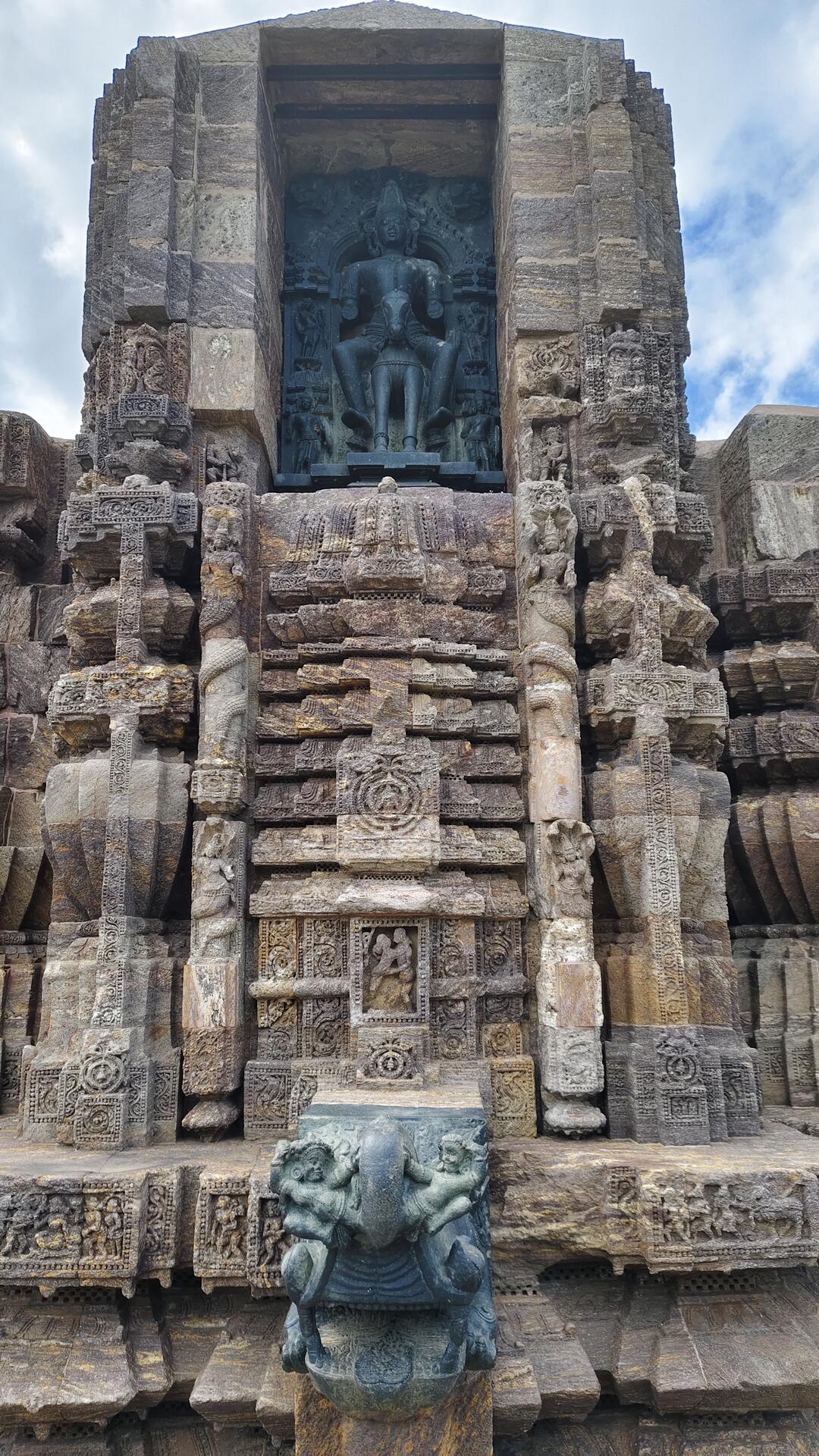
© Aliva Sahoo, CC BY-SA 4.0 Resized from original. (This derivative is under the same CC BY-SA license.)