World Heritage Identification Number: 1053
World Heritage since: 2003
Category: Cultural Heritage
WHE Type: Religious Sites & Sacred Architecture
Transboundary Heritage: No
Endangered Heritage: No
Country: 🇵🇱 Poland
Continent: Europe
UNESCO World Region: Europe and North America
Map
The Wooden Churches of Southern Małopolska: A Unique Testament to Medieval Church-Building Traditions
The Wooden Churches of Southern Małopolska, inscribed as a UNESCO World Heritage Site in 2003, stand as remarkable testaments to the diverse aspects of medieval church-building traditions within Roman Catholic culture. These architectural marvels, built using the horizontal log technique, offer a captivating contrast to the stone structures that dominated urban centers during the same period.
More to come…UNESCO Description of the World Heritage Site
The wooden churches of southern Little Poland represent outstanding examples of the different aspects of medieval church-building traditions in Roman Catholic culture. Built using the horizontal log technique, common in eastern and northern Europe since the Middle Ages, these churches were sponsored by noble families and became status symbols. They offered an alternative to the stone structures erected in urban centres.
UNESCO Justification of the World Heritage Site
Criterion (iii): The wooden churches of Southern Małopolska bear important testimony to medieval church building traditions associated with the liturgical and cult functions of the Roman Catholic Church in this relatively isolated region of Central Europe.
Criterion (iv): The churches are the most representative examples of surviving Gothic churches built using the horizontal log technique; they are particularly impressive in their artistic and technical execution, and were sponsored by noble families and rulers as symbols of social and political prestige.
Encyclopedia Record: Wooden churches of Southern Lesser Poland
The wooden churches of southern Lesser Poland of the UNESCO inscription are located in Binarowa, Blizne, Dębno, Haczów, Lipnica Murowana, and Sękowa.Additional Site Details
Area: 8.26 hectares
Number of Components: 6
(iv) — Outstanding example of a type of building or landscape
Coordinates: 49.75 , 21.23333333
Image
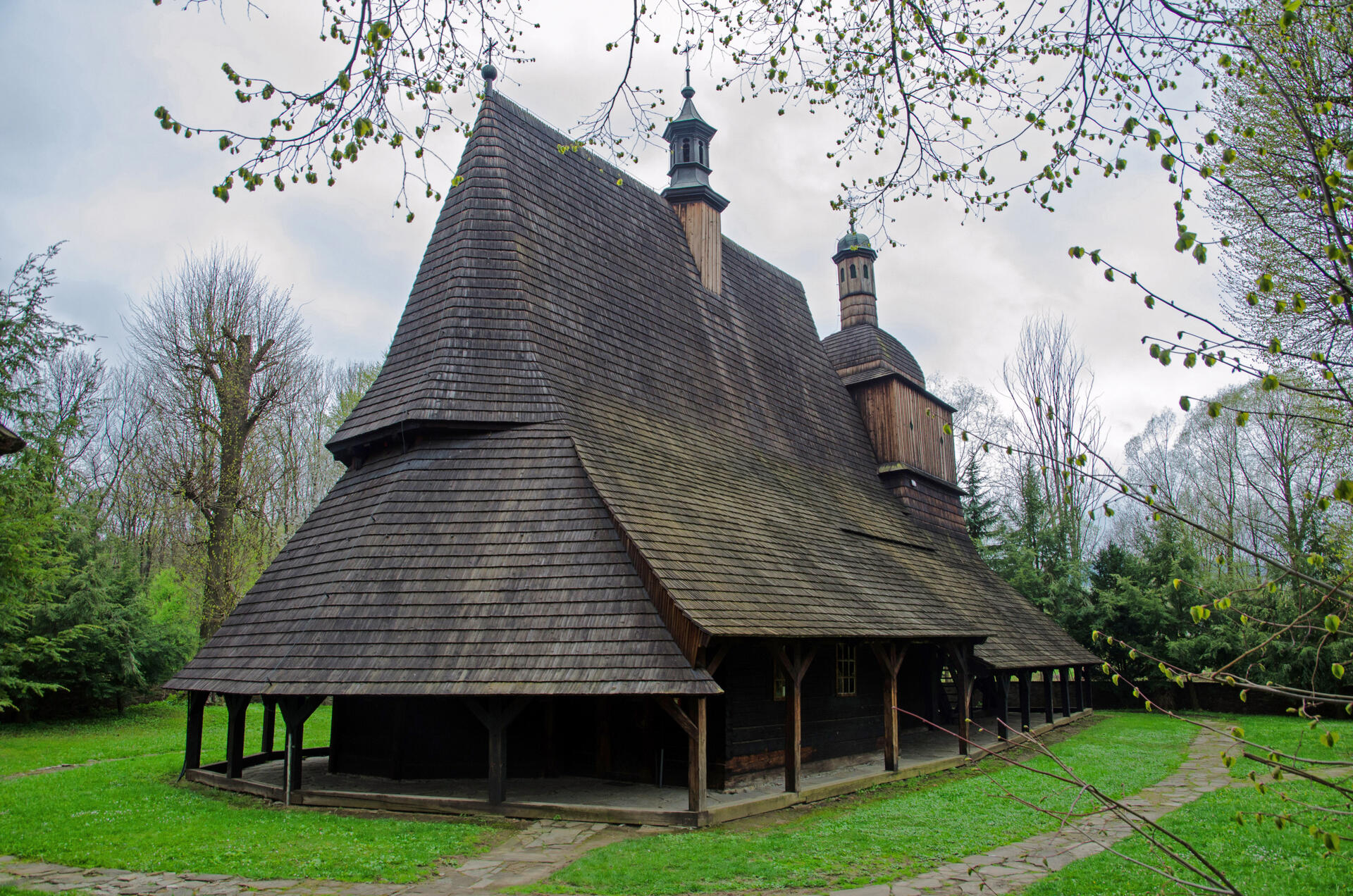
© Sebastian Mierzwa, CC BY-SA 3.0 pl Resized from original. (This derivative is under the same CC BY-SA license.)
World Heritage Research
Discover scientific research and academic studies that deepen our understanding of Wooden Churches of Southern Małopolska from its history and significance to its conservation, management, and contemporary challenges.
-
Modelling a sacred object using MLS data and non-metric images
A novel approach combining mobile laser scanning (MLS) and non-metric images successfully generated high-precision 3D models of the historic wooden church of St. Mark in Rodaki, demonstrating the potential of low-cost, handheld technology for cultural heritage documentation. The study leveraged a Livox-Mid360 sensor mounted on a Ronin bracket and a Samsung Galaxy M51 smartphone camera to capture data efficiently. Processed using Agisoft Metashape and Cyclone 3DR, the models were validated through differential analysis in CloudCompare, showcasing the effectiveness of SLAM-derived MLS techniques for rapid, accurate spatial modeling of sacred objects. This method offers a cost-effective alternative to traditional surveying while maintaining high fidelity in documentation.
Kwoczyńska, B., & Olszańska, S. (2025). Modelling a sacred object using MLS data and non-metric images. Geomatics, Landmanagement and Landscape, (4). https://doi.org/10.15576/gll/194241
View Publication Record | Read Publication -
Fatemplomok a Kárpátok vidékén : Az univerzalizmus és multilateralizmus dilemmája egy világörökségi jelölés tükrében
Despite the strong cultural and architectural cohesion of the wooden churches in Southern Małopolska, their potential as a unified UNESCO World Heritage Site was undermined by national-level resource allocation and multilateral frameworks prioritizing individual state interests. While professional recommendations from ICOMOS and EU funding opportunities supported a joint nomination, separate submissions resulted in fragmentation across four distinct sites. This outcome underscores the tension between universalist approaches—justified by shared stylistic and technical features—and the practical constraints of national-level heritage management.
Szűcs, T. Á. (2025). Fatemplomok a Kárpátok vidékén : Az univerzalizmus és multilateralizmus dilemmája egy világörökségi jelölés tükrében. Az Egyházak Kultúraközvetítő Szerepe Északkelet-Magyarországon a 16-20. Században, 147–165. https://doi.org/10.46403/regiotortenet4.147
View Publication Record | Read Publication -
Chapel of St. Anne in Podegrodzie, Nowy Sącz district – archaeological and conservation perspective
Archaeological investigations during the renovation of the 17th-century Chapel of St. Anne in Podegrodzie, Nowy Sącz district, uncovered two human skeletons and fragments of other burials, alongside a rare Jagiellonian coin. The study employed a Faro Focus laser scanner to create a detailed three-dimensional model of the chapel, revealing its architectural details down to the foundation footing. This digital documentation proved invaluable after the front wall's collapse, highlighting the significance of even small-scale archaeological research and conservation efforts for understanding and preserving this historically significant site.
Sztybe, A., & Wasilewski, M. (2025). Chapel of St. Anne in Podegrodzie, Nowy Sącz district – archaeological and conservation perspective. Acta Archaeologica Carpathica, 60, 219. https://doi.org/10.4467/00015229aac.25.011.23012
View Publication Record | Read Publication -
Impact of climatic-meteorological conditions on the Polish wooden cultural heritage: the example of wooden churches in Krakow
Polish wooden churches, a significant cultural heritage, face increasing threats from climate change. A study focusing on six churches within the UNESCO World Heritage Site 'Wooden Churches of Southern Małopolska' reveals that while the region is less prone to extreme flooding due to its geographic and hydrological characteristics, it faces high risks of fires in densely forested core and buffer zones. Additionally, current climatic conditions pose challenges with year-round high relative humidity and temperature fluctuations that only meet protection criteria during summer months. The research proposes specific recommendations for conservation and restoration, emphasizing damp proofing, insulation, and drainage to mitigate these impacts. This work provides a data-driven foundation for future studies on the preservation of wooden heritage in similar climates.
hu, h. (2024). Impact of climatic-meteorological conditions on the Polish wooden cultural heritage: the example of wooden churches in Krakow. https://doi.org/10.21203/rs.3.rs-3850364/v1
View Publication Record | Read Publication -
Awareness of local communities about the value of their city’s cultural heritage and the need to protect it on the example of selected historic towns in the Małopolska region (Poland)
A significant gap exists between the inherent cultural value of historic towns and the awareness of their local communities regarding its protection. Research in Muszyna and Piwniczna-Zdrój, two small towns in Poland’s Małopolska region, revealed that while these areas possess rich architectural heritage—including UNESCO-listed wooden churches—their inhabitants often lack a deep understanding or appreciation for the urbanistic, architectural, and cultural significance of their surroundings. The study, combining qualitative and quantitative methods, identified critical educational needs to foster community engagement in preserving indigenous heritage. Findings underscore the necessity for targeted interventions to cultivate a sense of stewardship among locals, ensuring long-term safeguarding of these irreplaceable sites.
Kuśnierz-Krupa, D., Sandu, I., Tišliar, P., Bednarz, Ł., Dmytrenko, A., Ivashko, O.,. (2024). Awareness of local communities about the value of their city’s cultural heritage and the need to protect it on the example of selected historic towns in the Małopolska region (Poland). Technical Transactions, 1(2024), 1–11. https://doi.org/10.37705/techtrans/e2024007
View Publication Record | Read Publication -
Inclusion of Vanishing Cultural Heritage in a Sustainable Rural Development Strategy–Prospects, Opportunities, Recommendations
A study reveals that rural communities in Małopolskie Voivodeship, Poland, prioritize 'classical' perceptions of cultural heritage while overlooking emerging forms like digital cyberfolklore. Research involving 400 respondents identified vanishing heritage elements such as shrines on trees, old barns (69%), wells (55%), and root cellars (40%) as key components for sustainable rural development. Traditional professions like beekeeping, lacemaking, and pottery were also recognized, with farmers’ wives’ associations noted for their role in promoting food traditions. The study highlights a gap in digital cultural heritage representation, suggesting its potential inclusion in future strategic documents to enhance regional identity and socioeconomic growth.
Knapik, W., & Król, K. (2023). Inclusion of Vanishing Cultural Heritage in a Sustainable Rural Development Strategy–Prospects, Opportunities, Recommendations. Sustainability, 15(4), 3656. https://doi.org/10.3390/su15043656
View Publication Record | Read Publication -
Arguments based on biocultural diversity to cease abandonment of traditional agricultural systems: Lessons from Poland
Traditional agricultural systems in the Kraków-Częstochowa Upland, Poland, are critical to preserving both biological and cultural diversity. The study reveals that the abandonment of these systems due to socio-economic changes and environmental policies threatens the region's unique biocultural heritage. Using a SWOT analysis, researchers identified strong interdependencies between cultural practices and biodiversity, emphasizing the need for sustainable agricultural strategies to protect this UNESCO-recognized landscape. The findings highlight the importance of integrating traditional knowledge with modern conservation efforts to safeguard both ecological and cultural values.
Prus, B., Uruszczak, M., & Hernik, J. (2021). Arguments based on biocultural diversity to cease abandonment of traditional agricultural systems: Lessons from Poland. Biodiversity and Conservation, 31(10), 1–26. https://doi.org/10.1007/s10531-021-02297-2
View Publication Record | Read Publication