World Heritage Identification Number: 601
World Heritage since: 1991
Category: Cultural Heritage
WHE Type: Buildings & Architectural Ensembles
Transboundary Heritage: No
Endangered Heritage: No
Country: 🇫🇷 France
Continent: Europe
UNESCO World Region: Europe and North America
Map
Masterpiece of Gothic Architecture: Notre-Dame de Reims, Former Abbey of Saint-Rémi, and Palace of Tau
Notre-Dame de Reims, located in the heart of the French city of Reims, stands as a testament to the grandeur of Gothic architecture. This cathedral, along with the former Abbey of Saint-Rémi and the Palace of Tau, forms a unique and significant UNESCO World Heritage Site.
More to come…UNESCO Description of the World Heritage Site
The outstanding handling of new architectural techniques in the 13th century, and the harmonious marriage of sculptural decoration with architecture, has made Notre-Dame in Reims one of the masterpieces of Gothic art. The former abbey still has its beautiful 9th-century nave, in which lie the remains of Archbishop St Rémi (440–533), who instituted the Holy Anointing of the kings of France. The former archiepiscopal palace known as the Tau Palace, which played an important role in religious ceremonies, was almost entirely rebuilt in the 17th century.
UNESCO Justification of the World Heritage Site
Criterion (i): The Cathedral of Notre-Dame of Reims is a masterpiece of Gothic art due to the outstanding handling of new architectural techniques in the 13th century and the harmonious marriage of architecture and sculptured ornamentation.
Criterion (ii): The perfection of the architecture and sculptural work of these buildings had a strong influence on later buildings in Europe.
Criterion (vi): The cathedral, the archiepiscopal palace and the former Abbey of Saint-Rémi are directly linked to the history of the French monarchy and hence the history of France. These places involved in the coronation ceremony recall the balance between public authority and sacred function that has made French royalty a political model throughout Europe.
Encyclopedia Record: Reims Cathedral
Notre-Dame de Reims, known in English as Reims Cathedral, is a Catholic cathedral in the French city of the same name, the seat of the Archdiocese of Reims. The cathedral was dedicated to the Virgin Mary and was the traditional location for the coronation of the kings of France. The cathedral is considered to be one of the most important works of Gothic architecture. A major tourist destination, it receives about a million visitors annually. It became a UNESCO World Heritage Site in 1991.Additional Site Details
Area: 4.16 hectares
Number of Components: 1
(ii) — Significant interchange of human values
(vi) — Directly associated with events or living traditions
Coordinates: 49.25333333 , 4.032777778
Image
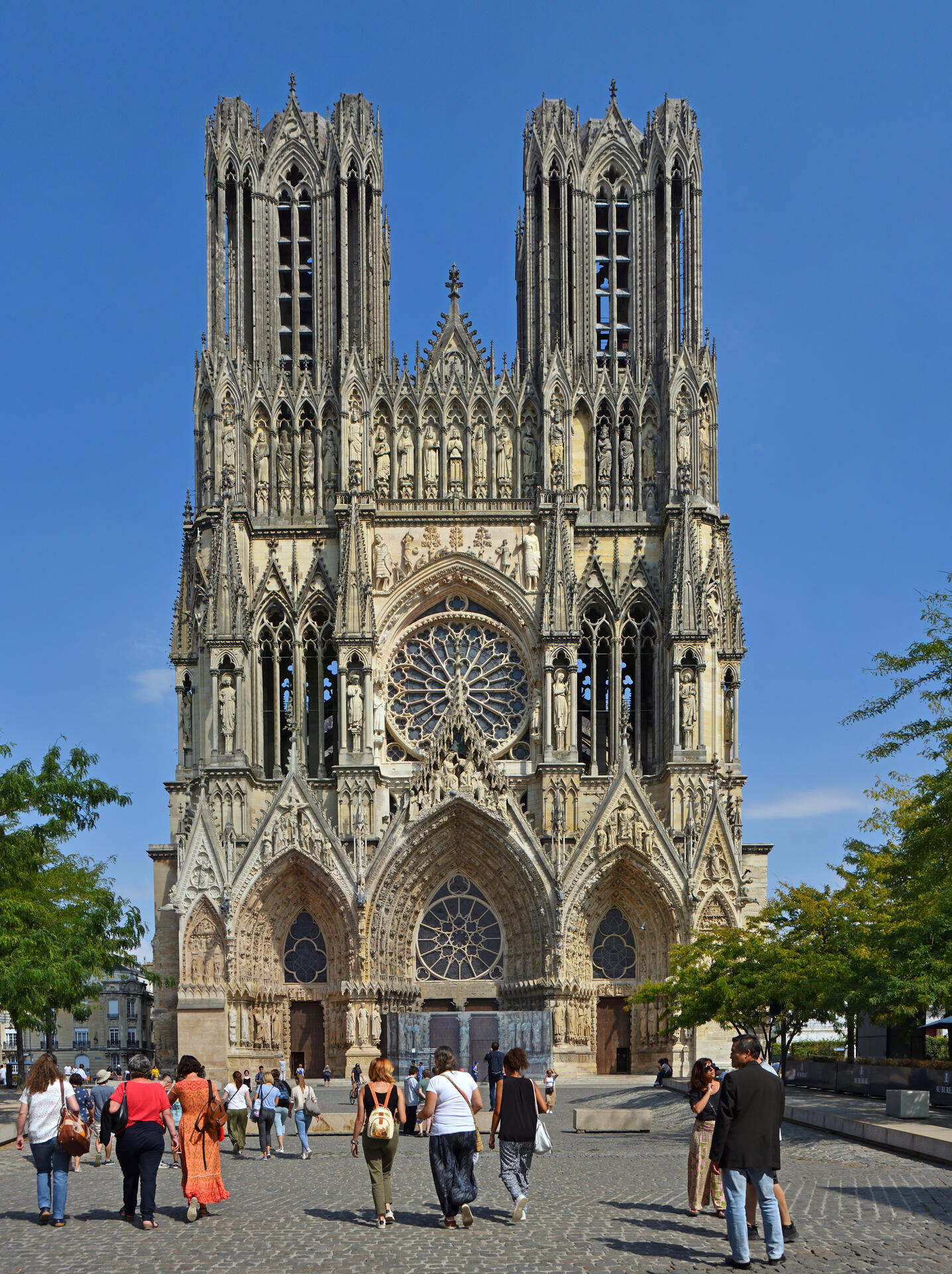
© Ludvig14, CC BY-SA 4.0 Resized from original. (This derivative is under the same CC BY-SA license.)
World Heritage Research
Discover scientific research and academic studies that deepen our understanding of Cathedral of Notre-Dame, Former Abbey of Saint-Rémi and Palace of Tau, Reims from its history and significance to its conservation, management, and contemporary challenges.
-
The Analysis of Gothic Architecture
A groundbreaking exploration of Gothic architecture, this volume advances our understanding through high-technology research methods pioneered by Robert Mark and Andrew Tallon. Utilizing photogrammetric and laser-scanned building surveys, the study offers unprecedented geometrical and structural analyses of iconic sites, including Notre-Dame in Paris and the cathedrals of Reims and Wells. The work not only honors Mark and Tallon's contributions but also provides new perspectives on major churches such as the abbeys of Saint-Denis and Alcobaça, Santa Maria Novella in Florence, and Clermont Cathedral. Contributors from diverse disciplines combine personal reminiscences with meticulous historiographical discussions, enriching the field with innovative insights.
Bork, R. (2023). The Analysis of Gothic Architecture. https://doi.org/10.1163/9789004529335
View Publication Record | Read Publication -
The Afflicted Body of Job and the Aesthetic of Wholeness in Gothic Sculpture
Gothic sculptures depicting the afflicted body of Job (c. 1210–1235) challenge medieval aesthetic ideals by portraying physical suffering as compatible with inner virtue, offering a counter-narrative to the prevailing discourse of bodily wholeness. These works, found in Notre-Dame cathedrals of Paris and Reims, depict Job as an emaciated figure tormented by the Devil, yet their iconography varies subtly across sites, suggesting localized theological or symbolic meanings. The study argues that these sculptures represent a deliberate artistic shift—balancing realism with idealization—to convey the beauty of sanctity through affliction, providing new insights for disability studies and medieval art history.
Feltman, J. M. (2022). The Afflicted Body of Job and the Aesthetic of Wholeness in Gothic Sculpture. The Routledge Companion to Art and Disability, 149–167. https://doi.org/10.4324/9781003009986-12
View Publication Record | Read Publication -
Arts of the Medieval Cathedrals: Studies on Architecture, Stained Glass and Sculpture in Honor of Anne Prache ed. by Kathleen Nolan, Dany Sandron
A collection of thirteen essays, published in Arts of the Medieval Cathedrals: Studies on Architecture, Stained Glass and Sculpture in Honor of Anne Prache, presents groundbreaking insights into Gothic art and architecture. The volume, edited by Kathleen Nolan and Dany Sandron, integrates historical and archaeological evidence with new technologies to analyze the design, decoration, and functions of medieval cathedrals, including Reims Cathedral. Key contributions include Walter Berry's re-examination of Reims Cathedral's building chronology using 1990s excavation data, Michael T. Davis's analysis of Guillebert de Mets's fifteenth-century description of Paris, and Ellen M. Shortell's study on the choir of Saint-Quentin. The essays also explore stained glass programs, such as Sylvie Balcon-Berry's reconstruction of Reims Cathedral's destroyed windows, and sculpture, including William W. Clark's examination of the radiating chapels' exterior program. By applying geometric analysis and interdisciplinary approaches, the volume advances the understanding of Gothic architectural integration and workshop practices.
Sullivan, A. I. (2018). Arts of the Medieval Cathedrals: Studies on Architecture, Stained Glass and Sculpture in Honor of Anne Prache ed. by Kathleen Nolan, Dany Sandron. Parergon, 35(1), 188–189. https://doi.org/10.1353/pgn.2018.0037
View Publication Record | Read Publication -
Encounter: Louis Grodecki
Louis Grodecki, a pioneering art historian and stained-glass expert, significantly advanced the study of medieval glass through his meticulous documentation and authentication methods. His work on the Corpus Vitrearum Medii Aevi (CVMA) project, which aimed to catalog and preserve medieval stained glass, introduced rigorous criteria for distinguishing original from restored pieces, such as analyzing glass thickness, weathering patterns, and paint adhesion. Grodecki's scholarly approach, characterized by relentless questioning and interdisciplinary research, challenged conventional dating and stylistic assumptions, notably in his studies of Gothic architecture and stained glass. His collaboration with colleagues like Jean Lafond and Anne Prache further enriched the understanding of medieval art, particularly at sites like the Cathedral of Notre-Dame in Paris and the Abbey of Saint-Rémi in Reims. Grodecki's legacy includes a profound impact on international art history, though his confrontational teaching style and resistance to contemporary intellectual trends left a complex legacy.
Caviness, M. H. (2018). Encounter: Louis Grodecki. Gesta, 57(2), 119–122. https://doi.org/10.1086/698838
View Publication Record | Read Publication -
Alex J. Novikoff.The Medieval Culture of Disputation: Pedagogy, Practice, and Performance.
Alex J. Novikoff's study challenges the negative post-medieval perception of medieval scholastic disputation, revealing it as a dynamic and multifaceted practice integral to intellectual development from 1050 to 1263 in Northern France. Contrary to Renaissance and Enlightenment critiques, Novikoff demonstrates that disputation was part of a broader 'science of doubt,' encompassing argument, debate, dialogue, and polemic across educational, literary, performative, written, oral, and musical contexts. The research focuses on key figures like Anselm of Canterbury and his students at Bec, who revitalized dialectical reasoning and its application in theological debates, while also influencing the rise of the literary dialogue genre and sophisticated hermeneutics. It further explores how Aristotelian logic shaped medieval disputational practices, including vernacular debate poetry and art, culminating in the institutionalization of scholastic disputation within universities and Dominican preaching practices.
Utz, R. (2015). Alex J. Novikoff.The Medieval Culture of Disputation: Pedagogy, Practice, and Performance. The American Historical Review, 120(4), 1541–1542. https://doi.org/10.1093/ahr/120.4.1541
View Publication Record | Read Publication -
Dynamic Unfolding and the Conventions of Procedure: Geometric Proportioning Strategies in Gothic Architectural Design
Gothic architectural design employs dynamic geometric proportioning strategies that differ fundamentally from classical methods. These strategies involve conventions of procedure governing the sequential unfolding of forms, creating a unique architectural order distinct from the static proportions seen in classical design. This study clarifies these often misunderstood practices by leveraging computer-aided design (CAD) software to analyze measured buildings and original design drawings, including the towers of Ulm and Freiburg, and cross-sections of cathedrals like Reims and Prague. By reconstructing step-by-step geometric sequences, the research provides a rigorous foundation for understanding Gothic proportion, challenging previous unreliable interpretations, such as those by Konrad Hecht.
Bork, R. (2014). Dynamic Unfolding and the Conventions of Procedure: Geometric Proportioning Strategies in Gothic Architectural Design. Architectural Histories, 2(1), 14. https://doi.org/10.5334/ah.bq
View Publication Record | Read Publication -
Cathédrale et pèlerinage aux époques médiévale et moderne: Reliques, processions et devotions à l’église-mère du diocese (review)
A review of the volume 'Cathédrale et pèlerinage aux époques médiévale et moderne' challenges the conventional distinction between cathedral worship and pilgrimage, demonstrating that cathedrals actively cultivated pilgrimage through relics, processions, and devotional practices. The collection of 17 essays, spanning medieval to postmedieval periods, reveals how cathedral authorities in sites like Reims, Le Puy-en-Velay, and Paris strategically acquired relics and organized liturgical events to attract pilgrims, blurring the line between institutional worship and individual devotion. The study highlights the enduring role of cathedrals as pilgrimage destinations, even during the Reformation and post-Tridentine periods, with notable examples including the Black Virgin at Le Puy-en-Velay and mendicant processions in Tournai. Methodologically, the review synthesizes historical evidence from multiple European sites to argue for a more integrated understanding of cathedral socio-religious dynamics.
Ashley, K. (2012). Cathédrale et pèlerinage aux époques médiévale et moderne: Reliques, processions et devotions à l’église-mère du diocese (review). The Catholic Historical Review, 98(3), 549–550. https://doi.org/10.1353/cat.2012.0215
View Publication Record | Read Publication