
World Heritage Identification Number: 1693
World Heritage since: 2023
Category: Natural Heritage
WHE Type: Natural Landscapes & Geographic Features
Transboundary Heritage: Yes
Endangered Heritage: No
Country: Kazakhstan, Turkmenistan, Uzbekistan
Continent: Asia
UNESCO World Region: Asia and the Pacific
Map
Cold Winter Deserts of Turan: A Transboundary World Heritage Site in Central Asia
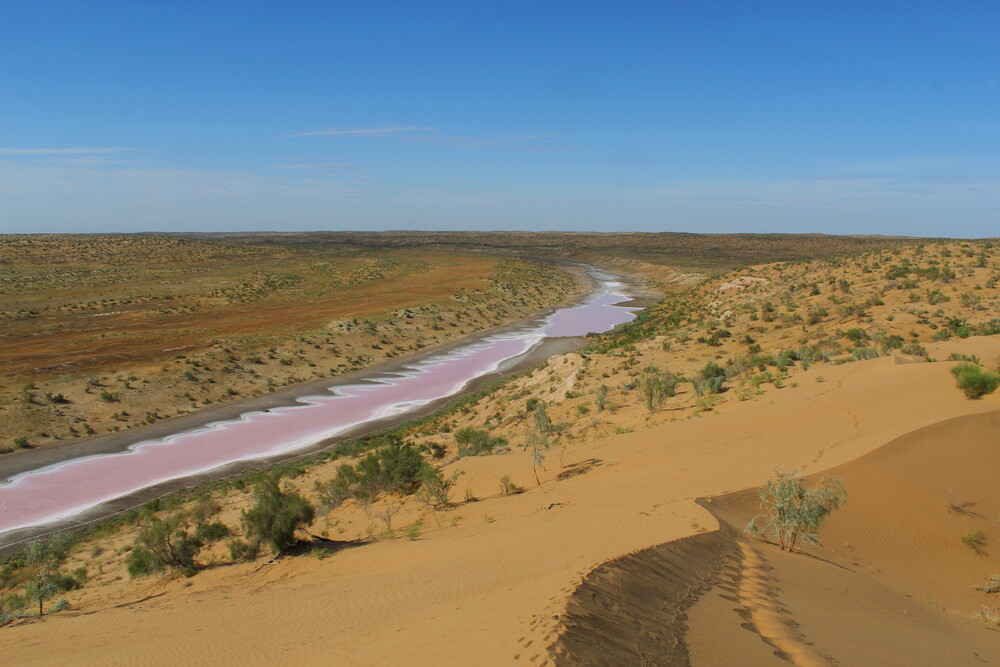
The Cold Winter Deserts of Turan, inscribed as a UNESCO World Heritage Site in 2023, encompasses a vast expanse of arid landscapes stretching over 1,500 kilometers across Central Asia's temperate zone. This transboundary property, comprising fourteen distinct component parts, lies between the Caspian Sea and the towering Turanian high mountains.
More to come…UNESCO Description of the World Heritage Site
This transnational property comprises fourteen component parts found across arid areas of Central Asia’s temperate zone between the Caspian Sea and the Turanian high mountains. The area is subject to extreme climatic conditions with very cold winters and hot summers, and boasts an exceptionally diverse flora and fauna that has adapted to the harsh conditions. The property also represents a considerable diversity of desert ecosystems, spanning a distance of more than 1,500 kilometres from East to West. Each of the component parts complements the others in terms of biodiversity, desert types, and ongoing ecological processes.UNESCO Justification of the World Heritage Site
Criterion (ix): The serial property represents the cold winter deserts as an outstanding example of the development of terrestrial ecosystems in extreme climate conditions and of the evolution of survival and adaptation strategies of plants and animals as ongoing ecological and biological processes. The 14 component parts include diverse geomorphological desert types, which are reflected by different ecosystems. It is representative of most of the ecological-physiographic vegetation types in the Turan deserts: sagebrush and perennial saltwort vegetation; psammophytic vegetation, i.e. desert grasses; saxaul shrubs and woodland. Taxonomic diversification and morphological convergence of plants are significant ongoing biological processes. Saxaul woodland demonstrates the ability of desert ecosystems for ongoing carbon sequestration and storage. Morphological, physiological and behavioural adaptations ensure survival of animal life as a fundamental ongoing process within the cold winter deserts of Turan. The component parts are important to the migration of migratory birds and ungulate species and serve as node points for migratory species and their dispersal across wider areas in the region.
Criterion (x): The serial property hosts very specific and diverse flora and fauna, adapted to the extreme climatic conditions of the Cold Winter Deserts of Turan. The species diversity is high, including diversity hotspots of Chenopodiaceae and plant genera of different families such as Artemisia, Calligonum, Salsola, Zygophyllum or Limonium, including a high share of endemic species. The property hosts numerous breeding birds, and important resting places of migrating bird species, as well as desert-adapted herpetofauna and insects. The Cold Winter Deserts of Turan are the habitat of globally threatened mammals, such as Goitered Gazelle, Saiga and Urial. Further important species that occur in component parts of the property include Kulan, Snow Leopard, Marbled Polecat and Striped Hyena as well as Asian Houbara, Great Bustard, Saker Falcon, White-headed Duck, Egyptian Vulture and Steppe Tortoise.
Encyclopedia Record: Turan
Turan is a historical region in Central Asia. The term is of Iranian origin and may refer to a particular prehistoric human settlement, a historic geographical region, or a culture. The original Turanians were an Iranian tribe of the Avestan age.Additional Site Details
Area: 3,366,441 hectares
Number of Components: 14
(x) — Contains most important habitats for biodiversity
Coordinates: 44.0258333333 , 79.0341666667
IUCN World Heritage Outlook
The 2025 Conservation Outlook on Cold Winter Deserts of Turan reports the following assessment:
Source: International Union for Conservation of Nature (IUCN) · View assessment
Image
© A. Pavlenko. Used with permission.