
Complex of Hué Monuments


World Heritage Identification Number: 678

World Heritage since: 1993

Category: Cultural Heritage

WHE Type: Buildings & Architectural Ensembles

Transboundary Heritage: No

Endangered Heritage: No

Country: 🇻🇳 Viet Nam

Continent: Asia

UNESCO World Region: Asia and the Pacific

Map

Complex of Hué Monuments: A Cultural and Religious Centre of Unified Viet Nam

The Complex of Hué Monuments, inscribed as a UNESCO World Heritage Site in 1993, offers a captivating glimpse into the rich history and culture of Vietnam. Situated along the picturesque Perfume River, this architectural ensemble serves as a testament to the grandeur and significance of Hué as the political, cultural, and religious capital of the Nguyen Dynasty from 1802 to 1945.

More to come…

UNESCO Description of the World Heritage Site

Established as the capital of unified Viet Nam in 1802, Hué was not only the political but also the cultural and religious centre under the Nguyen dynasty until 1945. The Perfume River winds its way through the Capital City, the Imperial City, the Forbidden Purple City and the Inner City, giving this unique feudal capital a setting of great natural beauty.

UNESCO Justification of the World Heritage Site

Criterion (iv): The Complex of Hue Monuments is an outstanding example of an eastern feudal capital.

Encyclopedia Record: Imperial City of Huế

The Imperial City or Imperial Palace also known as Đại Nội (大內), is a royal enclosure within the walled city of Huế, the former imperial capital of Vietnam during the Nguyễn dynasty. It contains the palaces that housed the imperial family, as well as shrines, gardens, and offices for mandarins. Constructed in 1804 under Emperor Gia Long as a new capital and later re-modelled and enlarged to its current scale in 1833, it mostly served as a ceremonial function and imperial residence during the French colonial period. After the end of the monarchy in 1945, it suffered heavy damage and neglect during the Indochina Wars through the 1980s. The Imperial City was designated as a UNESCO World Heritage Site in 1993 as part of the Complex of Huế Monuments and is undergoing restoration.

Read more on Wikipedia

Additional Site Details

Area: 315.47 hectares

Number of Components: 14

UNESCO Criteria: (iv) — Outstanding example of a type of building or landscape

Coordinates: 16.46944 , 107.57778

Image
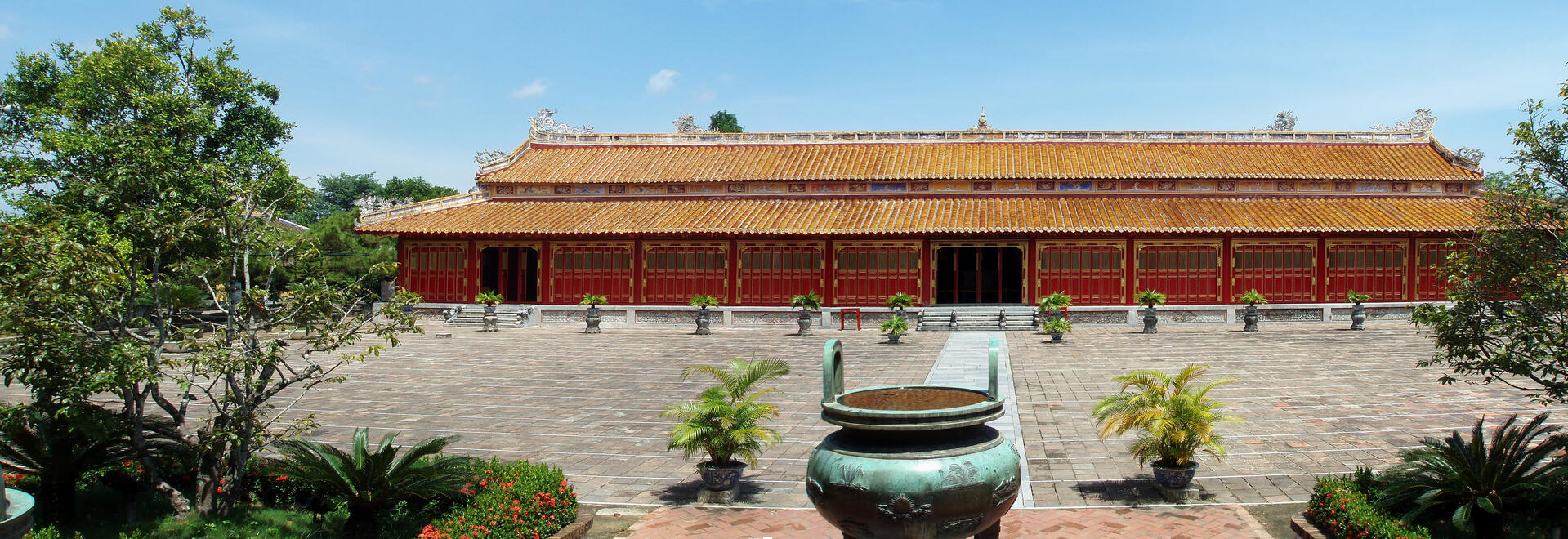
Image of Complex of Hué Monuments

© https://www.flickr.com/photos/sixty4coupe/, CC BY-SA 2.0 Resized from original. (This derivative is under the same CC BY-SA license.)

World Heritage Research

Discover scientific research and academic studies that deepen our understanding of Complex of Hué Monuments from its history and significance to its conservation, management, and contemporary challenges.

  • Methodology for Establishing the Appropriate Protected Area based on the Analysis of Old Drawings In case of Gia Long Mausoleum, Hue

    A groundbreaking analysis of old drawings and maps reveals that the current protected area of Gia Long Mausoleum (GLM), part of Vietnam's UNESCO-listed Complex of Hué Monuments, is significantly smaller than Emperor Gia Long's original vision. This study deciphers historical records to demonstrate GLM's integration with 'Shan-Shui design,' tropical water management, and local community symbiosis—elements overlooked during its 1993 World Heritage inscription. By reconstructing the ideal worldview of Gia Long and identifying forbidden areas from the era, researchers provide a methodology for defining an appropriate protected area that deepens the site's Outstanding Universal Value (OUV). This approach offers a model for preserving cultural heritage while respecting historical intentions.

    YamadA, H., Satoh, S., Tanaka, S., Hirai, Y., Kawahara, S., & Sugano, K. (2023). Methodology for Establishing the Appropriate Protected Area based on the Analysis of Old Drawings In case of Gia Long Mausoleum, Hue. Restauro Archeologico, 30(1). https://doi.org/10.36253/rar-14350

    View Publication Record | Read Publication

About World Heritage Explorer

World Heritage Explorer is an independent educational project designed to uncover and share the richness of our world’s cultural and natural heritage. Dive into detailed site profiles, immersive imagery, interactive maps, and tools that help you explore UNESCO World Heritage Sites across the globe. Drawing extensively on open data sources, the project delivers authoritative, well-structured information for learners, educators, travelers, and younger explorers alike.

Learn more about the project

Nearby World Heritage Sites

My Son Sanctuary
96 km — Viet Nam
Hoi An Ancient Town
104 km — Viet Nam
Phong Nha-Ke Bang National Park and Hin Nam No National Park
207 km — Lao People's Democratic Republic, Viet Nam
Vat Phou and Associated Ancient Settlements within the Champasak Cultural Landscape
260 km — Lao People's Democratic Republic
Temple of Preah Vihear
387 km — Cambodia
Flag of Viet Nam

Viet Nam and the World Heritage Convention

State Party since: October 19, 1987

Status: Acceptance

Mandates to the World Heritage Committee: 2013-2017, 2023-2027

Total of Mandate Years: 8

Total of Mandates: 2

WHC Electoral Group: IV (Asia/Pacific)

Learn more about Viet Nam

Weather at the World Heritage Site

Last updated: September 8, 2026

Portions of the page Complex of Hué Monuments are based on data from UNESCO — World Heritage List Dataset and on text from the Wikipedia article Imperial City of Huế, licensed under CC BY-SA 4.0. Changes made. Additional original content by World Heritage Explorer (WHE), licensed under CC BY-SA 4.0. WHE is not affiliated with UNESCO or the World Heritage Committee. Legal Notice. Privacy Policy.

Open Data for an Open World