World Heritage Identification Number: 1293
World Heritage since: 2008
Category: Cultural Heritage
WHE Type: Archaeological Sites
Transboundary Heritage: No
Endangered Heritage: No
Country: 🇸🇦 Saudi Arabia
Continent: Asia
UNESCO World Region: Arab States
Map
Hegra Archaeological Site (al-Hijr / Madā ͐ in Ṣāliḥ): A Testimony to Nabataean Civilization
The Hegra Archaeological Site, officially known as al-Hijr / Madā ͐ in Ṣāliḥ, stands as one of the most important archaeological landmarks in Saudi Arabia. Inscribed on the UNESCO World Heritage List in 2008, it was the first World Heritage property to be inscribed in the Kingdom. Formerly known as Hegra, the site is the largest conserved site of the Nabataean civilization south of Petra in Jordan. Its remarkably preserved monuments provide exceptional evidence of the architectural, artistic, and technological achievements of the Nabataeans.
Located in the Al-'Ula region of northwestern Saudi Arabia, Hegra contains 111 monumental tombs, with 94 featuring decorated façades. Dating primarily from the 1st century BC to the 1st century AD, these tombs were carved directly into sandstone outcrops and display elaborate architectural and decorative elements. Their façades reflect a distinctive Nabataean style while also revealing influences from other cultures, including Assyrian, Egyptian, Phoenician, and Hellenistic traditions.
Among the site's most famous individual monuments is Qasr al-Farid (the "Lonely Castle"), a towering, isolated tomb carved from a single sandstone outcrop. Rising to roughly 22 meters, it is the tallest finished tomb at Hegra and remains famously unfinished at its lower portion. The contrast between its completed upper sections and rough lower areas provides valuable evidence of the methods used by Nabataean stoneworkers to carve monumental façades from the rock.
Beyond the monumental necropolises, Jabal Ithlib, a dramatic rocky massif, served as an important religious and ceremonial center. The area includes the Diwan, a rock-cut triclinium lined with stone benches that was associated with communal feasting and ritual activity, as well as sacred spaces and numerous ancient inscriptions carved into the surrounding rock. Together, these remains provide evidence of the religious and social practices of the Nabataean community.
One of the most remarkable aspects of Hegra is its hydraulic expertise. The site contains numerous wells, many of them cut directly into the rock, demonstrating the Nabataeans' ability to access and manage water in an arid environment. These wells supported agricultural activities and helped sustain the settlement and the movement of caravans through the region. Their presence provides important evidence of the practical technologies that enabled the Nabataeans to thrive in the challenging environment of northern Arabia.
Hegra also preserves evidence of human activity that predates the Nabataean settlement. The site contains approximately 50 inscriptions from the pre-Nabataean period, including inscriptions in Lihyanite script, as well as a number of cave drawings. These remains provide valuable evidence of the peoples who inhabited and travelled through the region before and alongside the development of the Nabataean city.
Hegra's importance extends beyond its tombs and archaeological remains. The city occupied a strategic position on the ancient caravan routes linking the Arabian Peninsula with the Mediterranean world and Asia. Its archaeological remains bear witness not only to Nabataean culture but also to the movement of people, goods, languages, artistic traditions, and ideas across the region. Inscriptions in several ancient languages further illustrate the site's role as a meeting point between different cultures.
The site's remarkable state of preservation is one of its defining characteristics. Following the decline of the Nabataean kingdom, Hegra's importance diminished, while the region's exceptionally dry climate helped protect many of its monuments from extensive later alteration and reuse. This combination of archaeological integrity and environmental preservation has allowed researchers to study Nabataean architecture, inscriptions, hydraulic technology, and patterns of settlement in unusual detail.
Ongoing archaeological research continues to refine our understanding of Hegra and the wider Nabataean civilization. Excavations and the study of inscriptions, monuments, and archaeological remains are helping researchers reconstruct the history of a society that played an important role in the trade networks of late antiquity. Hegra therefore offers not simply a collection of spectacular rock-cut tombs, but a remarkably complete archaeological window into the culture, technology, and international connections of the Nabataeans.
Today, Hegra stands as a powerful symbol of Saudi Arabia's ancient heritage and of the cultural connections that once linked the Arabian Peninsula with the wider ancient world. Its monumental tombs, rock-cut architecture, inscriptions, and sophisticated water systems provide an extraordinary glimpse into the achievements of the Nabataean civilization. As a UNESCO World Heritage Site, Hegra preserves a unique chapter of human history and continues to offer visitors and researchers an opportunity to explore the enduring legacy of one of the ancient world's most remarkable civilizations.
UNESCO Description of the World Heritage Site
The Hegra Archaeological Site (al-Hijr / Madā ͐ in Ṣāliḥ) is the first World Heritage property to be inscribed in Saudi Arabia. Formerly known as Hegra it is the largest conserved site of the civilization of the Nabataeans south of Petra in Jordan. It features well-preserved monumental tombs with decorated facades dating from the 1st century BC to the 1st century AD. The site also features some 50 inscriptions of the pre-Nabataean period and some cave drawings. Al-Hijr bears a unique testimony to Nabataean civilization. With its 111 monumental tombs, 94 of which are decorated, and water wells, the site is an outstanding example of the Nabataeans’ architectural accomplishment and hydraulic expertise.
UNESCO Justification of the World Heritage Site
Criterion (ii): The site of Al-Hijr is located at a meeting point between various civilisations of late Antiquity, on a trade route between the Arabian Peninsula, the Mediterranean world and Asia. It bears outstanding witness to important cultural exchanges in architecture, decoration, language use and the caravan trade. Although the Nabataean city was abandoned during the pre-Islamic period, the route continued to play its international role for caravans and then for the pilgrimage to Mecca, up to its modernisation by the construction of the railway at the start of the 20th century.
Criterion (iii): The site of Al-Hijr bears unique testimony to the Nabataean civilisation, between the 2nd and 3rd centuries BC and the pre-Islamic period, and particularly in the 1st century AD. It is an outstanding illustration of the architectural style specific to the Nabataeans, consisting of monuments directly cut into the rock, and with facades bearing a large number of decorative motifs. The site includes a set of wells, most of which were sunk into the rock, demonstrating the Nabataeans' mastery of hydraulic techniques for agricultural purposes.
Encyclopedia Record: Hegra
Hegra, also known as Mada’in Salih, is an archaeological site located in the area of Al-'Ula within Medina Province in the Hejaz region, Saudi Arabia.Additional Site Details
Area: 1,621.2 hectares
Number of Components: 1
(iii) — Unique or exceptional testimony to a cultural tradition
Coordinates: 26.7836111111 , 37.955
Image
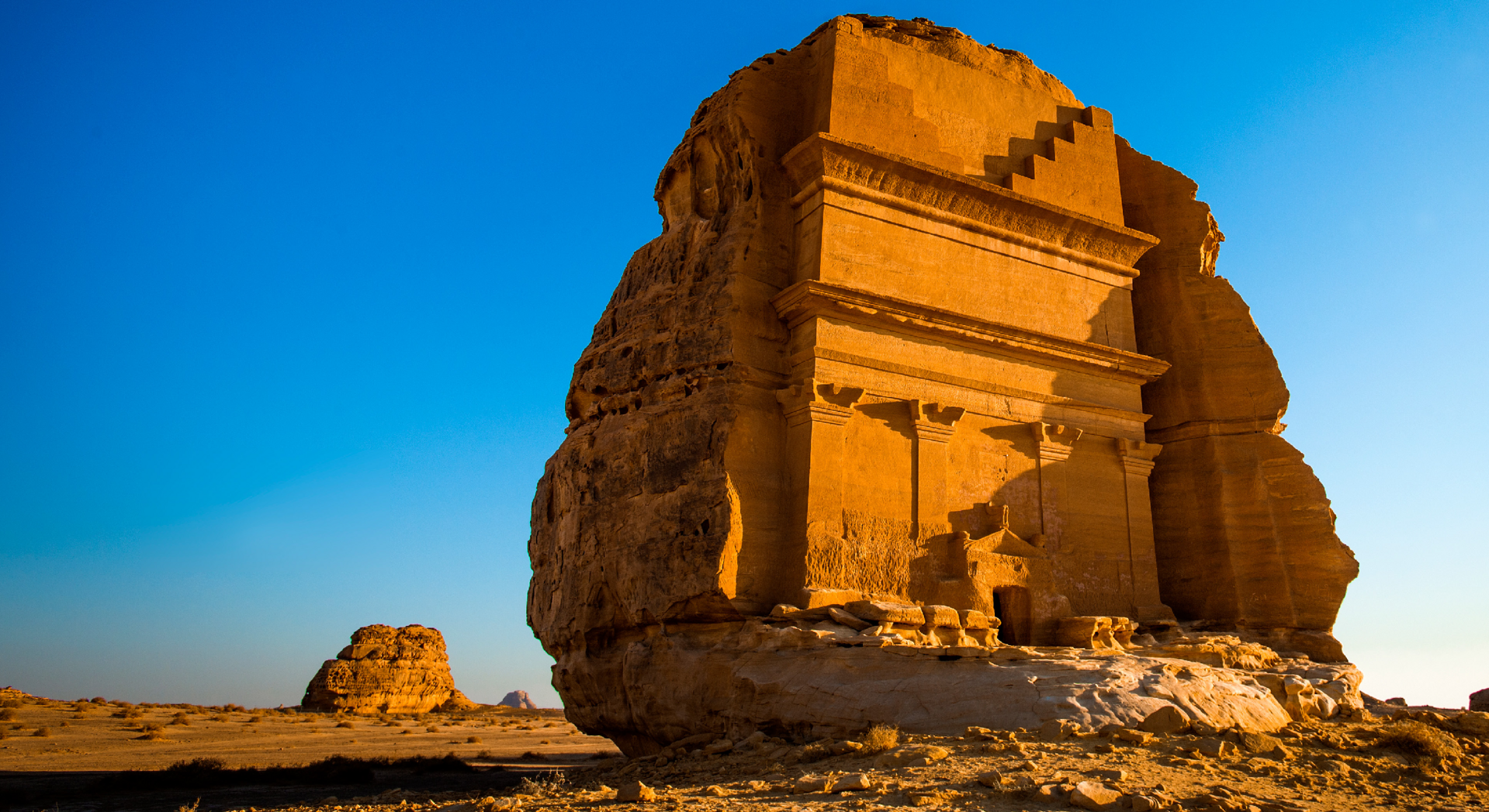
Ali Lajami, CC0
World Heritage Research
Discover scientific research and academic studies that deepen our understanding of Hegra Archaeological Site (al-Hijr / Madā ͐ in Ṣāliḥ) from its history and significance to its conservation, management, and contemporary challenges.
-
Tracing the pathways to Yathrib (Al-Madinah): A GIS-based analysis of settlement patterns and ancient trade networks
A GIS-based analysis reveals that ancient human settlement and trade networks in the Al-Madinah region of Arabia were primarily governed by hydrological accessibility and terrain favorability. The study, using Multi-Criteria Spatial Analysis (MCSA) and Least-Cost Path (LCP) modeling, identified proximity to watercourses, slope, and soil as key controlling factors for historical settlements, with 32.01% of the study area deemed highly suitable. Additionally, reconstructed caravan routes converging on Yathrib (Al-Madinah) demonstrated that these environmental variables jointly influenced patterns of ancient mobility, offering a replicable methodology for exploring trade networks in arid landscapes.
Metwaly, M., & Alshami, A. (2026). Tracing the pathways to Yathrib (Al-Madinah): A GIS-based analysis of settlement patterns and ancient trade networks. PLOS One, 21(5), e0348677. https://doi.org/10.1371/journal.pone.0348677
View Publication Record | Read Publication -
A hima traditional ecological knowledge perspective of the sustainability goals in AlUla’s journey through time masterplan
Integrating traditional ecological knowledge, known as hima, into Saudi Arabia's 'Journey Through Time' Masterplan for AlUla could significantly enhance sustainability and cultural heritage preservation. This study reveals that hima practices—rooted in ancient traditions—offer sustainable solutions for water and land management, disaster mitigation, and intergenerational knowledge transmission. By analyzing interviews with elders, traditional practices, and government documents, researchers demonstrate how hima's social and ecological dimensions can bridge heritage conservation with modern urban development. The findings underscore the potential of blending indigenous wisdom with contemporary planning to foster resilient, culturally rich communities in UNESCO World Heritage Sites like Hegra.
Alshami, A., Bryant, M., & Toland, A. (2025). A hima traditional ecological knowledge perspective of the sustainability goals in AlUla’s journey through time masterplan. Urban Studies, 62(3), 560–580. https://doi.org/10.1177/00420980241301656
View Publication Record | Read Publication -
Tourism Development through the Sense of UNESCO World Heritage: The Case of Hegra, Saudi Arabia
Tourists visiting Hegra, a UNESCO World Heritage Site in Saudi Arabia, predominantly express positive sentiments toward the site's historical significance and unique cultural value. However, reviews also highlight critical challenges such as isolation, cost, privatization, and competition with other destinations. The study analyzed 267 TripAdvisor reviews from 2020 to 2023 using sentiment polarity analysis (VADER) and machine learning (NMF), offering actionable insights for heritage management. This research stands out for its focus on a recently tourist-accessible site in Saudi Arabia, providing pragmatic solutions to enhance the visitor experience and sustainable tourism development.
Sampieri, S., Saoualih, A., Safaa, L., de Carnero Calzada, F. M., Ramazzotti, M., & Martínez-Peláez, A. (2024). Tourism Development through the Sense of UNESCO World Heritage: The Case of Hegra, Saudi Arabia. Heritage, 7(4), 2195–2216. https://doi.org/10.3390/heritage7040104
View Publication Record | Read Publication -
A probable case of a non-union condylar fracture in an individual from Hegra (Madâ’in Sâlih), AlUla, Kingdom of Saudi Arabia
A probable case of non-union condylar fracture, characterized by exuberant bone formation and significant morphological remodelling, has been identified in a young adult male from Hegra (Madâ’in Sâlih), dating to the 1st Century CE. This rare finding suggests compensatory biomechanical adaptations due to impaired mandibular function, potentially indicating high-status care during convalescence. The study employed morphoscopic, microscopic, and x-ray examinations to assess trauma, pathology, and oral health, revealing excellent dental condition except for a periapical lesion with an associated odontogenic sinus tract. This case highlights the diagnostic potential of incomplete skeletal remains from UNESCO World Heritage Sites.
Franklin, D., Swift, L., Flavel, A., Marks, M. K., O’Higgins, P., Shui, W., & Alshihri, A. (2025). A probable case of a non-union condylar fracture in an individual from Hegra (Madâ’in Sâlih), AlUla, Kingdom of Saudi Arabia. Journal of Archaeological Science: Reports, 61, 104916. https://doi.org/10.1016/j.jasrep.2024.104916
View Publication Record | Read Publication -
Jaussen-Savignac 17: The Earliest Dated Arabic Document (A.D. 267)1
A previously overlooked inscription at the UNESCO World Heritage Site Hegra (al-Hijr/Madāʿin Ṣāliḥ) has been reclassified as the earliest dated Arabic document, dating to A.D. 267. This challenges prior assumptions that it was Aramaic. The study, conducted during fieldwork in Madāʿin Ṣāliḥ with support from Saudi authorities, employs philological analysis to argue for its Arabic origin. While a fuller examination of the text's history and context is planned for future work, this finding marks a significant advancement in understanding early Arabic epigraphy at this ancient site.
Healey, J. F., & Smith, G. R. (2023). Jaussen-Savignac 17: The Earliest Dated Arabic Document (A.D. 267)1. Law and Religion between Petra and Edessa, VII–VI1. https://doi.org/10.4324/9781003420675-7
View Publication Record | Read Publication -
Nabataeo-Arabic: Jaussen-Savignac nab. 17 and 18
A joint expedition to Hegra (al-Hijr / Madāʾin Ṣāliḥ) in 1985 uncovered a previously undocumented Nabataeo-Arabic inscription, the Raqūsh inscription, which dates later than other known inscriptions at the site. This discovery, facilitated by high-quality on-site photography, provided critical insights into the epigraphic culture of the region during the Nabataean period. The research involved collaboration with the Saudi Department of Antiquities and Museums, leveraging expertise in Aramaic inscriptions to contextualize the findings. The Raqūsh inscription was subsequently published in 1989 (appearing in 1992), contributing to the understanding of linguistic and cultural transitions between Petra and Edessa.
Healey, J. (2023). Nabataeo-Arabic: Jaussen-Savignac nab. 17 and 18. Law and Religion between Petra and Edessa, VIII–VI81. https://doi.org/10.4324/9781003420675-8
View Publication Record | Read Publication -
A Nabataean Sundial from Madā'in ṣāliḥ
A significant Nabataean sundial has been identified at the UNESCO World Heritage Site of Hegra (al-Hijr / Madā'in Ṣāliḥ), offering new insights into ancient timekeeping practices. The discovery underscores the advanced astronomical knowledge of the Nabataeans, who integrated precise solar measurements into their architectural and religious structures. Additionally, a similar sundial was noted on a Nabataean altar from Ḍumayr near Damascus, suggesting regional consistency in such designs. While the study focuses primarily on the Hegra sundial, its broader implications highlight the cultural and technological sophistication of this ancient civilization.
Healey, J. (2023). A Nabataean Sundial from Madā’in ṣāliḥ. Law and Religion between Petra and Edessa, VI–331. https://doi.org/10.4324/9781003420675-6
View Publication Record | Read Publication