World Heritage Identification Number: 1405
World Heritage since: 2012
Category: Cultural Heritage
WHE Type: Archaeological Sites
Transboundary Heritage: No
Endangered Heritage: No
Country: 🇹🇷 Türkiye
Continent: Asia
UNESCO World Region: Europe and North America
Map
Unraveling the Mysteries of Çatalhöyük: A Journey Through Time
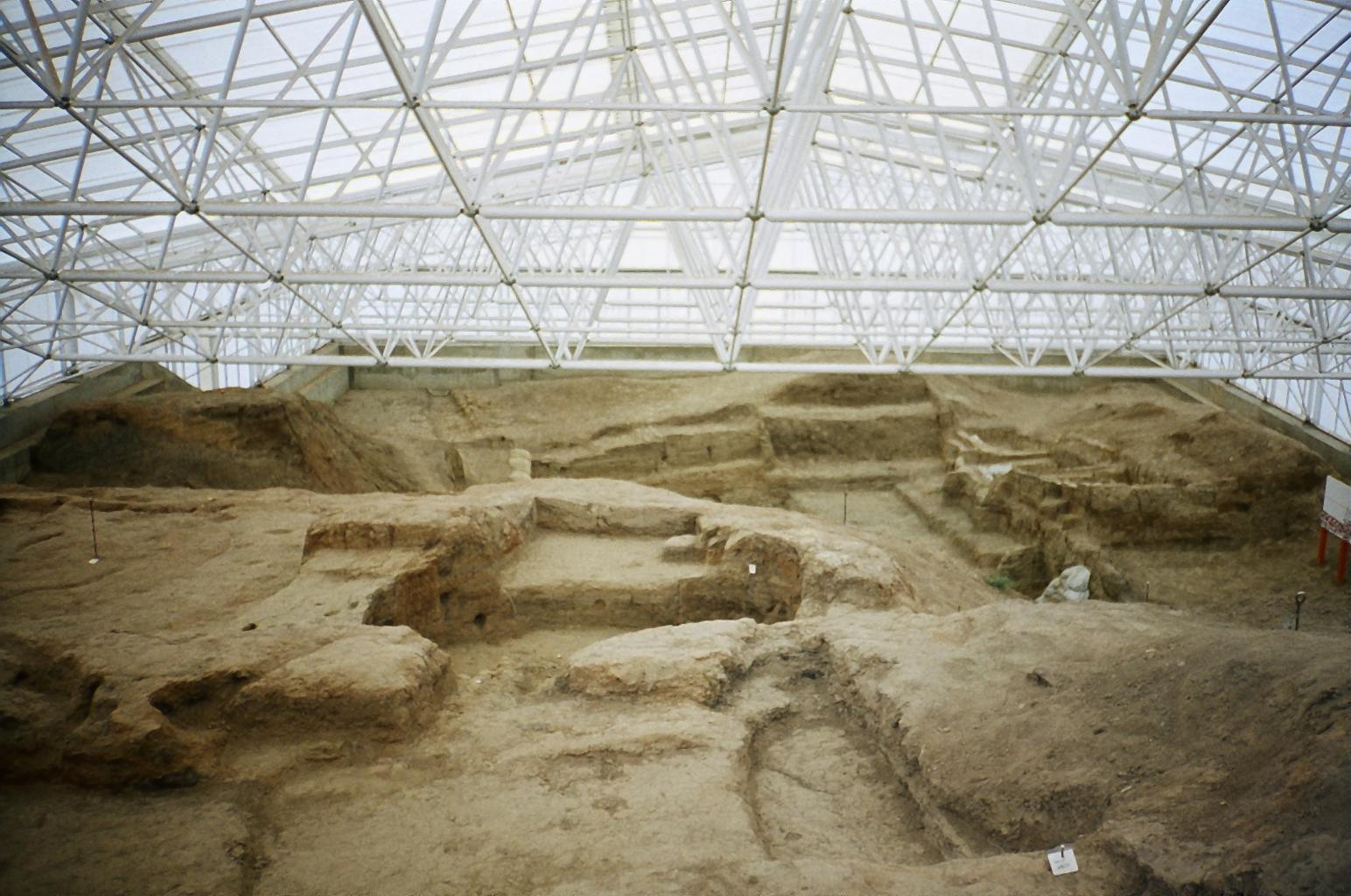
The Neolithic Site of Çatalhöyük, nestled on the Southern Anatolian Plateau in central Turkey, offers a remarkable glimpse into the early stages of settled human civilization. Covering approximately 37 hectares, this extensive archaeological site has been exceptionally well preserved, providing invaluable evidence for the transition from mobile hunter-gatherer societies to permanent farming communities.
The archaeological importance of Çatalhöyük was first recognized in 1958, and excavations began in 1961 under the direction of British archaeologist James Mellaart and his team. These early investigations revealed a remarkably preserved Neolithic settlement with richly decorated houses, numerous artifacts, and evidence of complex cultural practices. After a long interruption, excavations resumed in 1993 through the Çatalhöyük Research Project led by Ian Hodder, introducing new approaches that combined archaeology, conservation, and scientific analysis to explore the site's many dimensions.
The primary focus of Çatalhöyük is the taller eastern mound, where eighteen levels of Neolithic occupation have been unearthed, dating from approximately 7400 BC to 6200 BC. The site's significance lies in its distinctive streetless settlement, in which houses were built closely together with shared walls. Access to the dwellings was gained through openings in the roofs, creating an interconnected network of homes unlike those of most contemporary settlements. This unusual layout reflects a highly organized community and offers unique insights into early settlement planning and domestic life.
One of the most intriguing aspects of Çatalhöyük is the abundance of symbolic and artistic features preserved within its dwellings. Wall paintings, plaster reliefs, sculptures, decorated installations, and numerous artifacts reveal the rich cultural traditions and complex belief systems of its inhabitants. Many houses also contained burials beneath their floors, providing important evidence of family life, ritual practices, and ancestor veneration. Together, these discoveries offer exceptional insights into the social, religious, and cultural development of one of the world's earliest farming communities.
The inhabitants of Çatalhöyük developed a diverse economy based on agriculture, animal husbandry, hunting, and craft production. They cultivated crops such as wheat, barley, and legumes, raised sheep and goats, and continued to exploit wild resources from the surrounding landscape. Within their houses, people prepared food, produced tools, created textiles, and worked materials such as obsidian, which was obtained from nearby volcanic sources and widely used for making sharp tools and other objects. These activities reveal a sophisticated community with extensive knowledge of its environment and valuable regional connections.
The western mound at Çatalhöyük preserves evidence of occupation during the Chalcolithic (Copper Age), dating from approximately 6200 BC to 5200 BC. This era followed the Neolithic and preceded the Bronze Age, and it was characterized by the increasing use of copper alongside a continued reliance on stone tools. The western mound demonstrates the continuity of settlement at Çatalhöyük for more than two millennia and illustrates the gradual evolution of its cultural traditions.
The strategic location of Çatalhöyük on the Konya Plain further enhances its historical importance. Situated approximately 50 kilometers southeast of the modern city of Konya, the site occupies a fertile landscape that supported early agriculture and permanent settlement. It sits within clear sight of Mount Hasan, a twin-peaked volcano that dominates the horizon and forms a striking element of the region's natural landscape.
Çatalhöyük has transformed modern understanding of early settled societies by challenging traditional ideas about the origins of cities and social organization. Unlike later urban centers, the settlement contains no clear evidence of palaces, monumental temples, or elite residences, suggesting a community organized around households rather than centralized authority. Although scholars continue to debate the exact nature of social relationships at the site, Çatalhöyük provides exceptional evidence of how early farming communities developed complex forms of cooperation, ritual expression, and shared cultural identity.
In 2012, Çatalhöyük was inscribed on the UNESCO World Heritage List in recognition of its outstanding universal value and its exceptional testimony to the development of early settled communities. The site remains a major focus of archaeological research, continually enriching our understanding of early agriculture, social organization, architecture, and symbolic expression. As new discoveries continue to emerge, Çatalhöyük provides an unparalleled window into the lives of some of the world's earliest farming societies and the foundations of human civilization.
UNESCO Description of the World Heritage Site
Two hills form the 37 ha site on the Southern Anatolian Plateau. The taller eastern mound contains eighteen levels of Neolithic occupation between 7400 bc and 6200 bc, including wall paintings, reliefs, sculptures and other symbolic and artistic features. Together they testify to the evolution of social organization and cultural practices as humans adapted to a sedentary life. The western mound shows the evolution of cultural practices in the Chalcolithic period, from 6200 bc to 5200 bc. Çatalhöyük provides important evidence of the transition from settled villages to urban agglomeration, which was maintained in the same location for over 2,000 years. It features a unique streetless settlement of houses clustered back to back with roof access into the buildings.
UNESCO Justification of the World Heritage Site
Criterion (iii): Çatalhöyük provides a unique testimony to a moment of the Neolithic, in which the first agrarian settlements were established in central Anatolia and developed over centuries from villages to urban centres, largely based on egalitarian principles. The early principles of these settlements have been well preserved through the abandonment of the site for several millennia. These principles can be read in the urban plan, architectural structures, wall paintings and burial evidence. The stratigraphy of up to 18 settlement layers provides an exceptional testimony to the gradual development, re-shaping and expansion of the settlement.
Criterion (iv): The house clusters of Çatalhöyük, characterized by their streetless neighbourhoods, dwellings with roof access, and house types representing a highly circumscribed distribution of activity areas and features according to a clear spatial order aligned on cardinal directions, form an outstanding settlement type of the Neolithic period. The comparable sizes of the dwellings throughout the city illustrate an early type of urban layout based on community and egalitarian ideals.
Encyclopedia Record: Çatalhöyük
Çatalhöyük is a tell of a very large Neolithic and Chalcolithic proto-city settlement in southern Anatolia, which existed from approximately 7500 BC to 5600 BC and flourished around 7000 BC. In July 2012, it was inscribed as a UNESCO World Heritage Site. Çatalhöyük overlooks the Konya Plain, southeast of the present-day city of Konya in Turkey, approximately 140 km (87 mi) from the twin-coned volcano of Mount Hasan.Additional Site Details
Area: 37 hectares
Number of Components: 1
(iv) — Outstanding example of a type of building or landscape
Coordinates: 37.6666666667 , 32.8280555556
Image
© Unknown, CC BY-SA 3.0 Resized from original. (This derivative is under the same CC BY-SA license.)
World Heritage Research
Discover scientific research and academic studies that deepen our understanding of Neolithic Site of Çatalhöyük from its history and significance to its conservation, management, and contemporary challenges.
-
Gastronomy culture from the neolithic site of Çatalhöyük to 21st century
A study reveals enduring culinary traditions from the Neolithic site of Çatalhöyük, with significant continuity in the consumption and preparation of wild plants like terebinths, acorns, and plums into the 21st century. Using qualitative research methods—including document reviews and interviews with locals—the study traced food resource consumption patterns, highlighting how ancient gastronomic practices persist today. This approach provides a unique lens on human behavior and environmental dynamics, bridging millennia through culinary culture.
Aksoy, M., & Çetin, K. (2024). Gastronomy culture from the neolithic site of Çatalhöyük to 21st century. Journal of Multidisciplinary Academic Tourism, 9(3), 201–212. https://doi.org/10.31822/jomat.2024-9-3-201
View Publication Record | Read Publication -
Contribution to Active Conservation: Characterization of Neolithic Period Mud Bricks Remains of the Archaeological Site of Çatalhöyük-Turkey
A groundbreaking study reveals that Neolithic inhabitants of Çatalhöyük used local materials and innovative techniques to create durable mud bricks, with variations in composition across different layers and buildings. The research, conducted during the 2014 excavation season, employed advanced archaeometric techniques such as XRD, SEM-EDX, and petrographic analysis to characterize six mud brick samples from the Eastern mound (C14 cal. 7100-5950 BC). Key findings include the identification of clay types (muscovite, kaolinite), organic additives (straw), and binders like gypsum and slacked lime, introduced progressively over time to enhance durability. The study also demonstrates that raw materials were sourced locally, with intentional modifications in binder composition across layers (VIA-IX) and buildings to improve brick robustness. These insights provide a critical reference for conserving Çatalhöyük's earthen structures while offering new understanding of Neolithic construction practices.
Noei, S. (2022). CONTRIBUTION TO ACTIVE CONSERVATION: CHARACTERIZATION OF NEOLITHIC PERIOD MUD BRICKS REMAINS OF THE ARCHAEOLOGICAL SITE OF ÇATALHÖYÜK-TURKEY. Zenodo. https://doi.org/10.5281/ZENODO.7072711
View Publication Record | Read Publication -
Did We Just Travel to the Past? Building and Evaluating With Cultural Presence Different Modes of VR-Mediated Experiences in Virtual Archaeology
A groundbreaking study reveals that virtual reality (VR) can effectively recreate the experience of traveling to the past, particularly when incorporating content meaningfulness, responsive characters, enhanced interaction, and multisensory realism. Researchers built six distinct VR reconstructions of Çatalhöyük, a Neolithic site in Turkey, and evaluated them using a novel framework based on Cultural Presence. The findings demonstrate that these elements significantly contribute to achieving successful VR-mediated experiences, offering new insights into how virtual archaeology can bridge the gap between past and present.
Pujol-Tost, L. (2019). Did We Just Travel to the Past? Building and Evaluating With Cultural Presence Different Modes of VR-Mediated Experiences in Virtual Archaeology. Journal on Computing and Cultural Heritage, 12(1), 1–20. https://doi.org/10.1145/3230678
View Publication Record | Read Publication -
Socio-Material Archaeological Networks at Çatalhöyük a Community Detection Approach
A novel application of socio-material network analysis reveals that Çatalhöyük, a large Late Neolithic Near Eastern settlement, lacked hierarchical social stratification despite its size. This challenges traditional views of such megasites as proto-urban or failed urban experiments. The study, leveraging diverse data sets, demonstrates how individual houses were embedded within complex social networks, providing insights into early community formation and integration in Holocene agricultural societies.
Mazzucato, C. (2019). Socio-Material Archaeological Networks at Çatalhöyük a Community Detection Approach. Frontiers in Digital Humanities, 6. https://doi.org/10.3389/fdigh.2019.00008
View Publication Record | Read Publication -
Democratising world heritage: The policies and practices of community involvement in Turkey
Turkey's efforts to integrate community involvement in UNESCO World Heritage management reflect a complex interplay between global standards and local politics. The study reveals that while these policies aim to democratize heritage governance, they often reinforce existing power hierarchies rather than challenge them. Using Çatalhöyük as a case study, the research applies Sally Merry’s concept of 'vernacularization' to analyze how Turkish officials adapt UNESCO's best practices, leading to contested ethical norms and governance structures. An ethnographic approach was employed to examine the social consequences of these policies, highlighting both unintended outcomes and the tension between transnational heritage ideals and state authority.
Human, H. (2015). Democratising world heritage: The policies and practices of community involvement in Turkey. Journal of Social Archaeology, 15(2), 160–183. https://doi.org/10.1177/1469605314566557
View Publication Record | Read Publication -
Substances: ‘Following the material’ through two prehistoric cases
A novel approach to studying prehistoric figurines and human effigies reveals their role as material bodies that interact with fleshly ones, linking them to broader aspects of material culture, environment, and political economy. The study advocates for a multi-dimensional research strategy called 'following the material,' which combines material, social, and phenomenological analysis. This method was demonstrated through two case studies: figurines from Çatalhöyük in Turkey and human effigies from the Moche region in Peru. By examining the substances used to create these artifacts and their contexts of production, circulation, and deposition, the research highlights the tight connections between objects in human form, material culture, landscape, and political economy.
Weismantel, M., & Meskell, L. (2014). Substances: ‘Following the material’ through two prehistoric cases. Journal of Material Culture, 19(3), 233–251. https://doi.org/10.1177/1359183514546803
View Publication Record | Read Publication -
Çatalhöyük: the leopard changes its spots. A summary of recent work
Recent analysis of Çatalhöyük East, a Neolithic site occupied between 7100 and 6200 BC, reveals significant shifts in social structure and health during its long occupation. The middle 'classic' levels (around 6500 BC) show evidence of increased population density, workload, and physical stress, likely linked to symbolic and ritual elaboration within an aggressively egalitarian society. However, the upper levels indicate a shift toward greater mobility, economic independence of households, and population dispersal, which may have facilitated the spread of farming populations into northwestern Anatolia and Europe. This study integrates data from extensive excavations (2000–2008) with earlier findings to provide a nuanced understanding of Neolithic societal dynamics.
Hodder, I. (2014). Çatalhöyük: the leopard changes its spots. A summary of recent work. Anatolian Studies, 64, 1–22. https://doi.org/10.1017/s0066154614000027
View Publication Record | Read Publication -
Mice, scats and burials: Unusual concentrations of microfauna found in human burials at the Neolithic site of Çatalhöyük, Central Anatolia
Archaeological research at the Neolithic site of Çatalhöyük reveals that human burials contained unusually high concentrations of microfauna, including small mammal bones and scats from carnivores. Taphonomic analysis confirmed these elements passed through the digestive tracts of small predators, suggesting deliberate placement by ancient inhabitants as part of ritualistic practices. One burial (F. 513) exhibited an exceptional concentration of microfauna over the torso, further supporting this interpretation. The study proposes that small carnivores were intentionally encouraged to inhabit Çatalhöyük to control house mouse populations, indicating a sophisticated relationship between humans and wildlife in Neolithic societies.
Jenkins, E. (2012). Mice, scats and burials: Unusual concentrations of microfauna found in human burials at the Neolithic site of Çatalhöyük, Central Anatolia. Journal of Social Archaeology, 12(3), 380–403. https://doi.org/10.1177/1469605312455765
View Publication Record | Read Publication -
“Official” and “practical” kin: Inferring social and community structure from dental phenotype at Neolithic Çatalhöyük, Turkey
At the Neolithic site of Çatalhöyük, Turkey (7400–5600 cal BC), social structure was not primarily based on biological kinship despite interments occurring within individual houses. A study analyzing dental phenotypes of 266 individuals found minimal correlation between biological affinity and house membership, challenging the notion that Çatalhöyük was a kin-based society. Instead, the house itself served as the central social unit, suggesting a more fluid definition of 'kin' that transcended biological lines. This research used multivariate and univariate statistical analyses on metric and nonmetric dental traits to test hypotheses about family units and neighborhood organization, providing insights into the transition to settled life and social dynamics in early farming communities.
Pilloud, M. A., & Larsen, C. S. (2011). “Official” and “practical” kin: Inferring social and community structure from dental phenotype at Neolithic Çatalhöyük, Turkey. American Journal of Physical Anthropology, 145(4), 519–530. Portico. https://doi.org/10.1002/ajpa.21520
View Publication Record | Read Publication