World Heritage Identification Number: 1310
World Heritage since: 2009
Category: Cultural Heritage
WHE Type: Historic Cities & Urban Areas
Transboundary Heritage: No
Endangered Heritage: No
Country: 🇨🇻 Cabo Verde
Continent: Africa
UNESCO World Region: Africa
Map
Cidade Velha, Historic Centre of Ribeira Grande: A Glimpse into Cape Verde's Colonial Past
The historic centre of Ribeira Grande, now known as Cidade Velha, offers a captivating window into Cape Verde's rich colonial history. Situated on the southern coast of Santiago Island, this ancient settlement holds significant importance as the first European colonial outpost in the tropics.
More to come…UNESCO Description of the World Heritage Site
The town of Ribeira Grande, renamed Cidade Velha in the late 18th century, was the first European colonial outpost in the tropics. Located in the south of the island of Santiago, the town features some of the original street layout impressive remains including two churches, a royal fortress and Pillory Square with its ornate 16th century marble pillar.
UNESCO Justification of the World Heritage Site
Criterion (ii): The monuments, the remains still present in Ribeira Grande and its maritime and agro-urban landscapes, are testimony to its considerable role in international trade associated with the development of European colonial domination towards Africa and America and the birth of Atlantic triangular trade. They are testimony to the organisation of the first intercontinental maritime trade, and Ribeira Grande’s role as centre for the acclimatisation and dissemination of numerous plant species between the temperate and tropical zones, and between the various continents.
Criterion (iii): The urban, maritime and landscape of Ribeira Grande provides eminent testimony to the origins and the development of over three centuries of Atlantic trade of enslaved persons in modern times and its relationships of domination. It was a major place for its commercial organisation and the early experience of using enslaved persons to develop a colonial territory. The mixing of human races and the meeting of African and European cultures gave birth to the first Creole culture.
Criterion (vi): Ribeira Grande is directly associated with the material manifestation of the history of the enslavement and trafficking of African peoples, and with its considerable cultural and economic consequences. Ribeira Grande was the cradle of the first fully fledged mixed-race Creole society. Creole culture then spread across the Atlantic, adapting to the different colonial contexts of the Caribbean and Americas. Its forms affected many fields including the arts, social customs, beliefs, the pharmacopoeia, and cooking techniques. Ribeira Grande is an important initial link in an intangible heritage shared by Africa, the Americas and Europe.
Encyclopedia Record: Cidade Velha
Cidade Velha is a city in the southern part of the island of Santiago, Cape Verde. Founded in 1462 by Portuguese traders, it is the oldest settlement in Cape Verde and its former capital. Once called Ribeira Grande by the Portuguese colonists, they changed its name to Cidade Velha in the late 18th century after relocating the capital to Praia. It is the seat of the Ribeira Grande de Santiago municipality.Additional Site Details
Area: 209.1 hectares
Number of Components: 1
(iii) — Unique or exceptional testimony to a cultural tradition
(vi) — Directly associated with events or living traditions
Coordinates: 14.9151388889 , -23.6051944444
Image
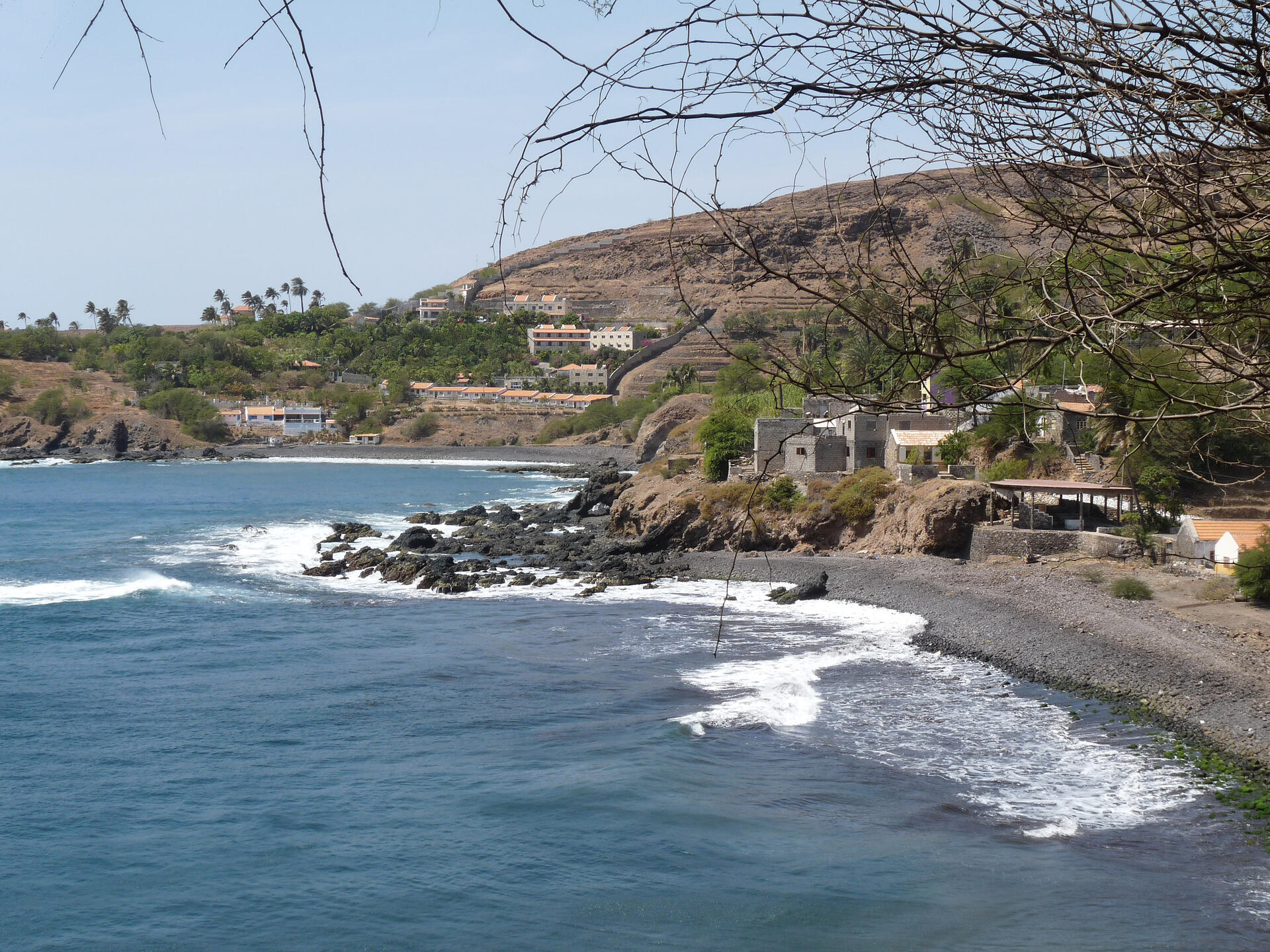
© Ji-Elle, CC BY-SA 3.0 Resized from original. (This derivative is under the same CC BY-SA license.)
World Heritage Research
Discover scientific research and academic studies that deepen our understanding of Cidade Velha, Historic Centre of Ribeira Grande from its history and significance to its conservation, management, and contemporary challenges.
-
Geodesy, Surveying, 3D Modelling, and AI Virtual Reconstruction in the Archaeological Sites and Monuments of the Former Settlement of Ribeira Grande in Cidade Velha (Santiago Island, Cape Verde)
Researchers successfully employed geodesy, surveying, and 3D modeling to document the ruins of Ribeira Grande's Cathedral within Cidade Velha. Despite limited time, equipment, and prior knowledge, they established a robust geodetic network and created detailed 3D models. Notably, the study utilized generative AI engines to virtually reconstruct the cathedral's original appearance, producing evocative images that offer new insights into its historical significance. This approach demonstrates the potential of combining traditional surveying techniques with AI for archaeological documentation in challenging fieldwork conditions.
García, B., Rodríguez-Miranda, Á., Valle-Melón, J. M., & Iñañez, J. G. (2025). Geodesy, Surveying, 3D Modelling, and AI Virtual Reconstruction in the Archaeological Sites and Monuments of the Former Settlement of Ribeira Grande in Cidade Velha (Santiago Island, Cape Verde). The International Archives of the Photogrammetry, Remote Sensing and Spatial Information Sciences, XLVIII-M-9-2025, 519–524. https://doi.org/10.5194/isprs-archives-xlviii-m-9-2025-519-2025
View Publication Record | Read Publication -
Paisagem Linguística da “zona velha” da cidade do Funchal: considerações históricas e sociolinguísticas
A linguistic landscape analysis of the historic 'Zona Velha' district in Funchal, Madeira, reveals significant British influence on local signage, particularly in commercial and tourism sectors. The study identified 216 linguistic signs, distinguishing between public/governmental (top-down) and private/industrial (bottom-up) sources. Top-down signs reflect historical British occupation's socio-political and economic impact, while bottom-up signs highlight the city's tourist-driven linguistic diversity. This approach, using Ben-Rafael et al.'s (2006) methodology, underscores how colonial history and tourism shape urban linguistic landscapes in UNESCO-listed sites.
Pereira, B. (2023). Paisagem Linguística da “zona velha” da cidade do Funchal: considerações históricas e sociolinguísticas. Diacrítica, 36(1), 193–224. https://doi.org/10.21814/diacritica.693
View Publication Record | Read Publication -
Situação fundiária e conservação de imóveis em centros históricos: o caso do bairro da Cidade Velha - Belém (PA).
Over half of the properties (55.85%) and nearly 45% of buildings in Belém's historic Cidade Velha district lack documented land ownership records, raising concerns for urban conservation. This study reveals that while 'traspasse' (a form of land transfer) is the most common property regime (41.5%), properties under this system show better preservation than those acquired through 'resgate' (redemption). Alarmingly, 59.5% of buildings are either abandoned, in ruins, or in poor to regular condition, suggesting a critical need for intervention. The research combines bibliographic analysis, geoprocessing, and documentary review to map land tenure regimes and conservation status, highlighting the tension between municipal and federal authorities over 'terrenos de marinha' (maritime lands) as a key barrier to heritage preservation in this UNESCO-listed site.
Tourinho, H. L. Z., Macedo, A. B. F. d., Alves, P. D. O., & Lobo, M. A. A. (2021). Situação fundiária e conservação de imóveis em centros históricos: o caso do bairro da Cidade Velha - Belém (PA). Revista de Direito Da Cidade, 13(4). https://doi.org/10.12957/rdc.2021.61297
View Publication Record | Read Publication -
Praça do Arsenal e Parque Naturalístico Mangal das Garças: uma análise sobre espaços de lazer no bairro da Cidade Velha em Belém, Pará
This study reveals the coexistence of distinct architectural temporalities within the historic neighborhood of Cidade Velha, Belém, Pará. It highlights how modern urban planning, exemplified by Praça do Arsenal, contrasts with organic, nature-oriented spaces like Parque Naturalístico Mangal das Garças. The research explores user perceptions of these spaces, demonstrating their unique roles in the neighborhood's identity and daily life. By analyzing spatial configurations and usage patterns, the study contributes to understanding the evolving character of Cidade Velha, bridging its colonial roots with contemporary urban development.
Costa Filho, S. P. da S., Queiroz, T. L. O. de, & Carvalho, R. N. F. M. de. (2021). Praça do Arsenal e Parque Naturalístico Mangal das Garças: uma análise sobre espaços de lazer no bairro da Cidade Velha em Belém, Pará (C. Chaves & C. S. Miranda, Eds.). Universidade Federal do Pará, FAU, PPGAU. https://doi.org/10.5281/ZENODO.19078163
View Publication Record | Read Publication -
Carta Arqueológica da Cidade Velha: Uma primeira abordagem
A pioneering archaeological map of Cidade Velha reveals authentic vestiges that trace the site's cultural diversity and historical trajectory, particularly its 16th and 17th-century urban expansion. The study identifies and inventories all remnants within the protected area, encompassing the Ribeira Grande valley and historic center, offering critical insights for conservation efforts. This first approach to archaeological mapping provides a foundational element for understanding and preserving the site's rich heritage, highlighting its significance as a primordial populated area.
Monteiro, J., Tavares, N., Veiga, S. d., Ramos, C., Brito, E., Carvalho, C., Moreira, F., & Tavares, A. (2020). Carta Arqueológica da Cidade Velha: Uma primeira abordagem. Arqueologia Em Portugal 2020 - Estado Da Questão - Textos, 297–306. https://doi.org/10.21747/978-989-8970-25-1/arqa22
View Publication Record | Read Publication -
Trabalhos arqueológicos na Cidade Velha (Ribeira Grande de Santiago, Cabo Verde): reflexões sobre um projecto de investigação e divulgação patrimonial
Archaeological excavations in Cidade Velha, Cape Verde's former 16th–17th century Atlantic trading hub and slave trade center, revealed new insights into the city's urban layout and abandonment by the 18th century. Focusing on Rua da Banana—a key thoroughfare—and the historic Nossa Senhora do Rosário church, researchers uncovered data on housing patterns and religious architecture. The study, linked to Cape Verde’s Museum of Archaeology, combined excavation with educational outreach, offering a rare glimpse into the city's layered history as both a maritime power and a site tied to transatlantic slavery.
Teixeira, A., Monteiro, J., Mateus, M., Tavares, N., Fonseca, C., Lopes, G. C., Torres, J. B., Pereira, D., Bargão, A., Mayer, A., Zélie, B., Lima, C., Chouzenoux, C., Henrqiues, I., Coelho, I. P., Lima, J., Carvalho, P., & Silva, T. (2020). Trabalhos arqueológicos na Cidade Velha (Ribeira Grande de Santiago, Cabo Verde): reflexões sobre um projecto de investigação e divulgação patrimonial. Arqueologia Em Portugal 2020 - Estado Da Questão - Textos, 2085–2101. https://doi.org/10.21747/978-989-8970-25-1/arqa156
View Publication Record | Read Publication -
Cachimbos de Barro Caulínitico da Sé da Cidade Velha (República de Cabo Verde)
Archaeological excavations at the ruins of the Cathedral of Cidade Velha, Cape Verde, uncovered clay tobacco pipe sherds dating from the late 17th and 18th centuries. These findings suggest frequent tobacco consumption in colonial-era Cape Verde and reveal commercial links between the Portuguese Empire and other European regions. The study, conducted between 1989 and 1993 under the direction of one of its authors, examined material culture contexts tied to temple reformations, providing insights into the archipelago's colonial period.
Silva, R. B. d., Pimenta, J., & Amaro, C. (2020). Cachimbos de Barro Caulínitico da Sé da Cidade Velha (República de Cabo Verde). Arqueologia Em Portugal 2020 - Estado Da Questão - Textos, 1787–1799. https://doi.org/10.21747/978-989-8970-25-1/arqa133
View Publication Record | Read Publication