World Heritage Identification Number: 863
World Heritage since: 1999
Category: Cultural Heritage
WHE Type: Historic Cities & Urban Areas
Transboundary Heritage: No
Endangered Heritage: No
Country: 🇪🇨 Ecuador
Continent: Americas
UNESCO World Region: Latin America and the Caribbean
Map
The Historic Centre of Santa Ana de los Ríos de Cuenca: A Well-Preserved Colonial Gem in Ecuador
The Historic Centre of Santa Ana de los Ríos de Cuenca, located in the picturesque Azuay Province of Ecuador, offers a captivating glimpse into the rich history and cultural heritage of this South American nation. Inscribed as a UNESCO World Heritage Site in 1999, the city center retains its original colonial layout, showcasing an intriguing blend of indigenous and European architectural styles that have evolved over four centuries.
More to come…UNESCO Description of the World Heritage Site
Santa Ana de los Ríos de Cuenca is set in a valley surrounded by the Andean mountains in the south of Ecuador. This inland colonial town (entroterra ), now the country's third city, was founded in 1557 on the rigorous planning guidelines issued 30 years earlier by the Spanish king Charles V. Cuenca still observes the formal orthogonal town plan that it has respected for 400 years. One of the region's agricultural and administrative centres, it has been a melting pot for local and immigrant populations. Cuenca's architecture, much of which dates from the 18th century, was 'modernized' in the economic prosperity of the 19th century as the city became a major exporter of quinine, straw hats and other products.
UNESCO Justification of the World Heritage Site
Criterion (ii): Cuenca illustrates the perfect implantation of the principles of urban planning of the Renaissance in the Americas.
Criterion (iv): The successful fusion of the different societies and cultures of Latin America is symbolized in a striking manner by the layout and townscape of Cuenca.
Criterion (v): Cuenca is an outstanding example of a planned inland Spanish colonial town.
Encyclopedia Record: Cuenca, Ecuador
Cuenca, officially Santa Ana de los Ríos de Cuenca, is an Ecuadorian city, head of the canton of the same name and capital of the province of Azuay, as well as its largest and most populated city. It is crossed by the Tomebamba, Tarqui, Yanuncay and Machángara rivers, in the south-central inter-Andean region of Ecuador, in the Paute river basin, at an altitude of 2,538 meters above sea level and with a temperate Andean climate averaging 16.3 °C.Additional Site Details
Area: 224.14 hectares
Number of Components: 1
(iv) — Outstanding example of a type of building or landscape
(v) — Outstanding example of traditional human settlement
Coordinates: -2.897447 , -79.004382
Image
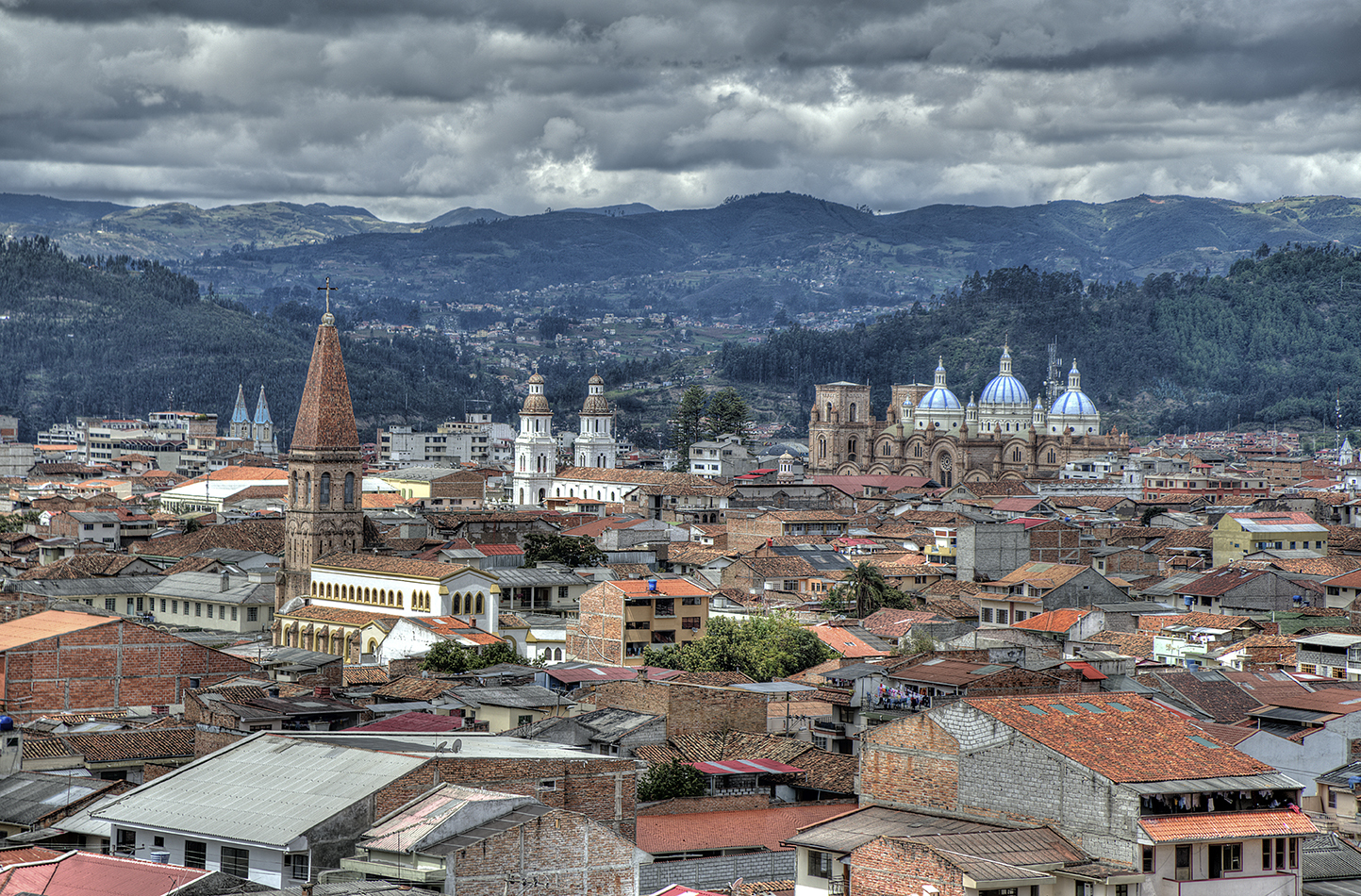
© amalavida.tv from Ecuador, CC BY-SA 2.0 Resized from original. (This derivative is under the same CC BY-SA license.)
World Heritage Research
Discover scientific research and academic studies that deepen our understanding of Historic Centre of Santa Ana de los Ríos de Cuenca from its history and significance to its conservation, management, and contemporary challenges.
-
Dificultades de la Gestión Participativa del Patrimonio Mundial. El Caso de Santa Ana de Cuenca
Despite UNESCO's promotion of participatory management for the Historic Centre of Santa Ana de los Ríos de Cuenca, Ecuadorthis study reveals that such practices remain largely ineffective. Analysis of three cases between 2021 and 2025 shows that the absence of a comprehensive management plan, incentives, or technical tools has led to violations of cultural rights, housing rights, and usufruct for property owners. While Ecuadorian law mandates full participation, it is reduced to consultative processes with no tangible impact. The 2010 ordinance governing historic zones focuses on restrictive architectural criteria, lacks updated inventories, and shifts legal and financial burdens onto property owners. International comparisons suggest that effective incentives and collaboration mechanisms could address these challenges, but urgent reform is needed to establish direct communication between UNESCO and local communities to foster inclusive and just heritage policies.
VERDAD, U. (2025). DIFICULTADES DE LA GESTIÓN PARTICIPATIVA DEL PATRIMONIO MUNDIAL. EL CASO DE SANTA ANA DE CUENCA. Universidad-Verdad, (87). https://doi.org/10.33324/uv.vi87.1072
View Publication Record | Read Publication -
The quantification of physico-mechanical properties and durability of onyx-travertines from Santa Ana de los Ríos de Cuenca, Ecuador
Onyx-travertines from Sinincay, Ecuador, exhibit significant variation in durability and mechanical strength depending on their sedimentary structure. Research reveals that laminated facies are more vulnerable to accelerated aging tests than cryptolaminated ones, with salt crystallization (S-C) being the most severe test, followed by freeze-thaw (F-T), acid attack (A-A), and thermal shock (T-S). The orientation of lamination also influences mechanical strength, with normal-to-lamination specimens showing the lowest values. Scanning Electron Microscopic (SEM) analyses further elucidate weathering patterns and deterioration mechanisms, providing insights into the material's behavior under different environmental stresses. This study highlights the importance of standardized durability tests in heritage stone research, offering a case study for Ecuador and globally significant World Heritage Sites like the Historic Centre of Santa Ana de los Ríos de Cuenca.
Romero Bastidas, M., Aguirre Ullauri, M. d. C., Ramírez Bustamante, J., Vargas Vallejo, M., & Castillo Carchipulla, E. (2022). The quantification of physico-mechanical properties and durability of onyx-travertines from Santa Ana de los Ríos de Cuenca, Ecuador. Heritage Science, 10(1). https://doi.org/10.1186/s40494-022-00826-y
View Publication Record | Read Publication -
Heritage values protection, from the monument to the urban dimension. Case study: the historic centre of Santa Ana de los Ríos de Cuenca, Ecuador
A comprehensive strategy for protecting heritage values in urban landscapes has been developed, focusing beyond traditional monument preservation to include geomorphology, environment, hydrology, urban planning, historical cartography, land uses, symbolic imagery, and intangible aspects. This approach, applied to Cuenca's historic center in Ecuador, integrates multiple data layers using ArcMap to create a visual tool that facilitates stakeholder engagement and social participation in conservation efforts. The strategy aims to broaden the scope of heritage protection by mapping these elements, providing a holistic framework for urban-level conservation that aligns with principles from international agreements like the 1972 Convention.
Siguencia Avila, M. E., & Rey Pérez, J. (2016). Heritage values protection, from the monument to the urban dimension. Case study: the historic centre of Santa Ana de los Ríos de Cuenca, Ecuador. The Historic Environment: Policy & Practice, 7(2-3), 164–176. https://doi.org/10.1080/17567505.2016.1172785
View Publication Record | Read Publication