World Heritage Identification Number: 1112
World Heritage since: 2007
Category: Cultural Heritage
WHE Type: Buildings & Architectural Ensembles
Transboundary Heritage: No
Endangered Heritage: No
Country: 🇨🇳 China
Continent: Asia
UNESCO World Region: Asia and the Pacific
Map
A Glimpse into the Unique Architecture of Kaiping Diaolou and Villages
The Kaiping Diaolou and Villages, a remarkable ensemble of fortified structures nestled in the rural landscapes of Guangdong Province, China, stand as a testament to the rich cultural exchange between East and West. Inscribed as a UNESCO World Heritage Site in 2007, this architectural marvel showcases a unique blend of traditional Chinese and Western architectural styles, reflecting the global influence of emigrants from Kaiping during the late 19th and early 20th centuries.
More to come…UNESCO Description of the World Heritage Site
Kaiping Diaolou and Villages feature the Diaolou, multi-storeyed defensive village houses in Kaiping, which display a complex and flamboyant fusion of Chinese and Western structural and decorative forms. They reflect the significant role of émigré Kaiping people in the development of several countries in South Asia, Australasia and North America, during the late 19th and early 20th centuries. There are four groups of Diaolou and twenty of the most symbolic ones are inscribed on the List. These buildings take three forms: communal towers built by several families and used as temporary refuge, residential towers built by individual rich families and used as fortified residences, and watch towers. Built of stone, pise , brick or concrete, these buildings represent a complex and confident fusion between Chinese and Western architectural styles. Retaining a harmonious relationship with the surrounding landscape, the Diaolou testify to the final flowering of local building traditions that started in the Ming period in response to local banditry.
UNESCO Justification of the World Heritage Site
Criterion (ii): The Diaolou represent in dramatic physical terms an important interchange of human values - architectural styles brought back from North America by returning Chinese and fused with local rural traditions - within a particular cultural area of the world.
Criterion (iii): The building of defensive towers was a local tradition in the Kaiping area since Ming times in response to local banditry. The nominated Diaolou represent the final flourishing of this tradition, in which the conspicuous wealth of the retuning Chinese contributed to the spread of banditry and their towers were an extreme response.
Criterion (iv): The main towers, with their settings and through their flamboyant display of wealth, are a type of building that reflects the significant role played by émigré Kaiping people in the development of several countries in South Asia, Australasia, and North America, during the late 19th and early 20th centuries, and the continuing links between the Kaiping community and Chinese communities in these parts of the world.
Encyclopedia Record: Diaolou
Diaolou are fortified multi-storey watchtowers in rural villages, generally made of reinforced concrete. These towers are located mainly in Kaiping, Guangdong province, China. In 2007, UNESCO designated the Kaiping Diaolou and Villages (开平碉楼与村落) a World Heritage Site, which covers four separate Kaiping village areas: Sanmenli (三门里), Zilicun (自力村), Jinjiangli (锦江里), and Majianglong village cluster (马降龙村落群). These areas demonstrate a unique fusion of 19th- and 20th-century Chinese and Western architectural styles.Additional Site Details
Area: 371.948 hectares
Number of Components: 4
(iii) — Unique or exceptional testimony to a cultural tradition
(iv) — Outstanding example of a type of building or landscape
Coordinates: 22.2855194444 , 112.5658611111
Image
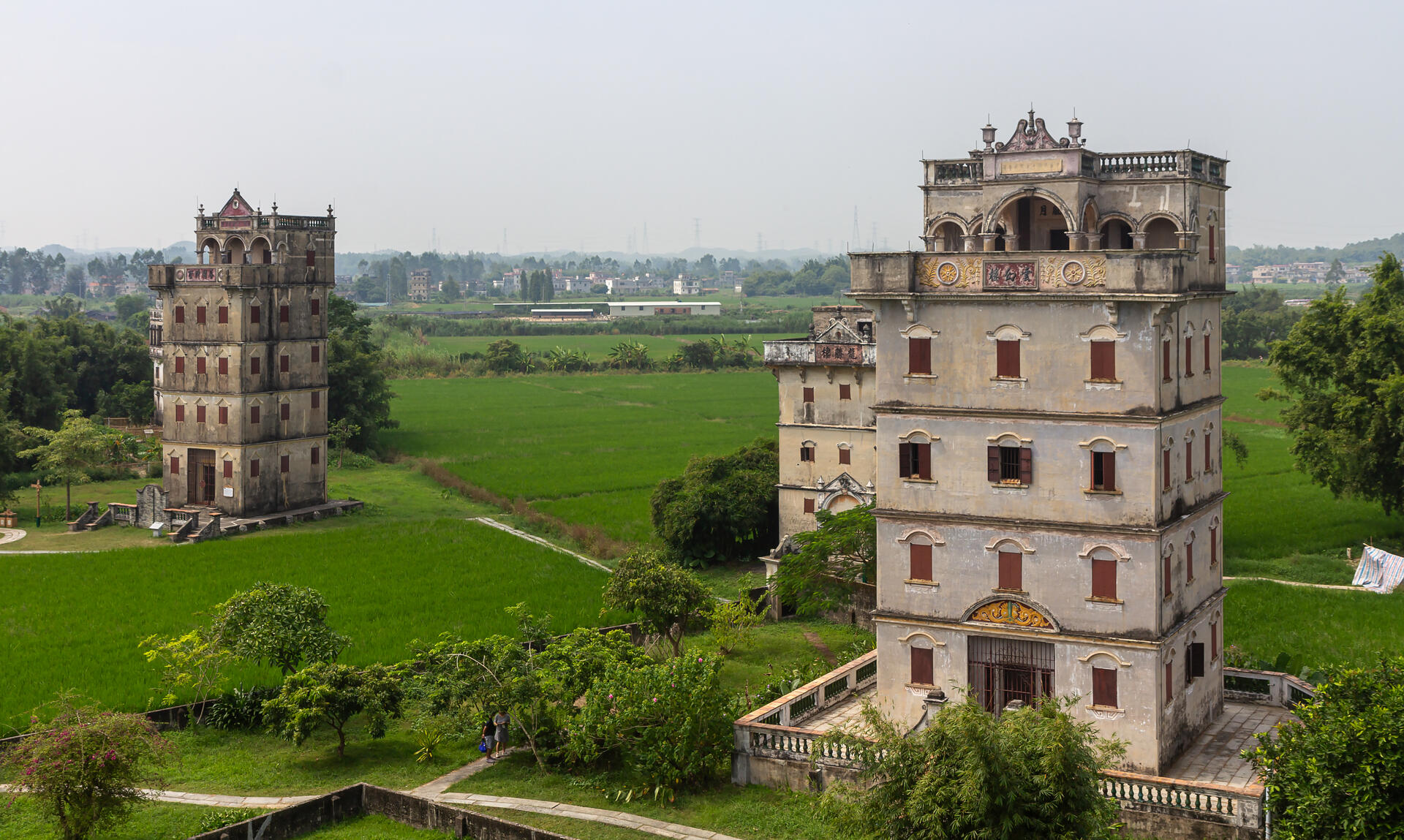
© Stefan Fussan, CC BY-SA 3.0 Resized from original. (This derivative is under the same CC BY-SA license.)
World Heritage Research
Discover scientific research and academic studies that deepen our understanding of Kaiping Diaolou and Villages from its history and significance to its conservation, management, and contemporary challenges.
-
Gen-Diaolou: An Integrated AI-Assisted Interactive System for Diachronic Understanding and Preservation of the Kaiping Diaolou
An AI-assisted interactive system, Gen-Diaolou, demonstrates significant potential to enhance visitors' diachronic understanding and preservation awareness of the UNESCO-listed Kaiping Diaolou and Villages. This hybrid Chinese-Western architectural heritage site, shaped by migration culture, faces challenges in engagement due to authenticity debates and limited participatory approaches. Through formative studies with 14 stakeholders, pilot tests with 18 participants, and museum field studies involving 26 individuals, the system was designed and refined. Findings suggest that Gen-Diaolou effectively bridges gaps between passive heritage systems and unconstrained creative tools, offering a promising model for human-AI collaboration in digital cultural heritage engagement.
Han, L., Gao, Y., Lu, X., Wang, B., Zhang, L., Wang, Z., & Yip, D. (2026). Gen-Diaolou: An Integrated AI-Assisted Interactive System for Diachronic Understanding and Preservation of the Kaiping Diaolou. Proceedings of the 2026 CHI Conference on Human Factors in Computing Systems, 1–25. https://doi.org/10.1145/3772318.3790720
View Publication Record | Read Publication -
From resources to resourcefulness practices: How community agency shapes divergent rural community development in heritage tourism
Divergent development outcomes among rural communities within the same heritage tourism destination arise not from differences in resource endowments but from variations in community agency and resourcefulness practices. A comparative ethnographic study of three villages in Kaiping Diaolou and Villages, a UNESCO World Heritage site in China, identified three distinct configurations of resourcefulness: market-driven centralization, resilience-driven decentralization, and externally constrained agency. These configurations, shaped by internal power architectures, translate shared structural conditions into divergent developmental trajectories. The study advances Entrepreneurial Resourcefulness (ER) theory by highlighting the role of practice-level mechanisms in shaping community development, offering insights into how resource-constrained communities navigate heritage tourism challenges.
Zhang, L., Hao, X., & Qiu, C. (2026). From resources to resourcefulness practices: How community agency shapes divergent rural community development in heritage tourism. Tourist Studies. https://doi.org/10.1177/14687976261481336
View Publication Record | Read Publication -
Diaolou Revitalization——Inheritance and Innovation of Kaiping Diaolou from the Perspective of Rural Revitalization
Kaiping Diaolou, over a century old, faces the risk of becoming uninhabited due to historical and societal changes. A recent study proposes that revitalizing these iconic structures through inheritance and innovation is crucial for rural revitalization. The research analyzes the architectural characteristics of Diaolou and identifies gaps in their village locations, offering a design practice approach to preserve and rejuvenate these cultural landmarks. This strategy not only ensures the survival of Diaolou culture but also contributes to the broader goal of sustainable rural development.
Liang, Q., & Ying, B. (2024). Diaolou Revitalization——Inheritance and Innovation of Kaiping Diaolou from the Perspective of Rural Revitalization. Proceedings of the 2024 3rd International Conference on Social Sciences and Humanities and Arts (SSHA 2024), 1110–1118. https://doi.org/10.2991/978-2-38476-259-0_116
View Publication Record | Read Publication -
Research on the residential buildings forms of kaiping diaolou and villages in guangdong province
Kaiping Diaolou and Villages in Guangdong Province exemplify a harmonious fusion of Western and Chinese architectural styles, characterized by intricate spatial layouts and decorative patterns. This study reveals that the forms and patterns of residential buildings in these villages are interrelated and complementary, forming a cohesive whole. The research employed documentary analysis and rooting theory to examine 10 traditional residential buildings, focusing on facades, internal furniture, and decorative motifs. Key architectural elements such as auspicious symbols were extracted, leading to the identification of 'patterns integration' as a defining feature. This approach highlights the cultural significance and aesthetic coherence of Kaiping Diaolou's architecture.
Yuxin, W., & Pohsun, W. (2023). Research on the residential buildings forms of kaiping diaolou and villages in guangdong province. South Florida Journal of Development, 4(1), 551–566. https://doi.org/10.46932/sfjdv4n1-040
View Publication Record | Read Publication -
Intangible cultural heritage complexes in China: Representation and restoration of pigmented reliefs in Kaiping Diaolou
Scientific analysis reveals the composition and durability of pigments used in the decorative art of Kaiping Diaolou. The study identifies green pigment as a mixture of colored copper arsenate minerals, red as hematite (Fe2O3), white as calcite, and blue as either lapis lazuli or synthetic ultramarine. Raman spectroscopy and scanning electron microscopy confirmed the pigments' structural similarities, while UV aging experiments demonstrated that antioxidants effectively inhibited degradation, reducing interface cracking. Tensile tests showed optimal bond stress at 0.193 MPa under specific humidity and temperature conditions. These findings provide a robust scientific basis for pigment restoration in Kaiping Diaolou and offer valuable insights for conserving similar historical architectural decorations.
Li, Q., Sang, T., Li, Y., Li, M., & Sun, Q. (2023). Intangible cultural heritage complexes in China: Representation and restoration of pigmented reliefs in Kaiping Diaolou. BioResources, 18(3), 5665–5682. https://doi.org/10.15376/biores.18.3.5665-5682
View Publication Record | Read Publication -
Perceived value of, and experience with, a World Heritage Site in China—the case of Kaiping Diaolou and villages in China
A study on the UNESCO World Heritage Site Kaiping Diaolou and Villages (China) reveals that tourists' satisfaction and intention to revisit are significantly influenced by multiple perceived values, including social, emotional, brand, functional, and monetary. These factors collectively shape visitors' experiences and behavioral intentions, validating a multidimensional model of perceived value in ancient village contexts. The research, based on a survey of 617 visitors, contributes to the understanding of how diverse values interact to enhance tourism outcomes at culturally rich heritage sites.
Zhang, L., Yang, S., Wang, D., & Ma, E. (2020). Perceived value of, and experience with, a World Heritage Site in China—the case of Kaiping Diaolou and villages in China. Journal of Heritage Tourism, 17(1), 91–106. https://doi.org/10.1080/1743873x.2020.1820014
View Publication Record | Read Publication -
Communicating the outstanding universal value of World Heritage in China? The tour guides’ perspective
Tour guides at Kaiping Diaolou and Villages often emphasize the human and cultural significance of the site over its material attributes, creating a sense of "Chineseness" that resonates with domestic tourists. This approach contrasts with the Eurocentric focus on materiality outlined in the site's Outstanding Universal Value (OUV). The study, based on participant observations and interviews, reveals that heritage value construction is a dynamic process involving multiple stakeholders—national and local governments, experts, and guides—who shape the narrative to balance national identity with regional distinctiveness. This co-constructive process highlights how local interpretations can enhance the attractiveness of World Heritage Sites while reflecting broader cultural narratives.
Gao, J., Zhang, C., & Liu, L. (2019). Communicating the outstanding universal value of World Heritage in China? The tour guides’ perspective. Asia Pacific Journal of Tourism Research, 25(9), 1042–1055. https://doi.org/10.1080/10941665.2018.1564340
View Publication Record | Read Publication