World Heritage Identification Number: 564
World Heritage since: 1992
Category: Cultural Heritage
WHE Type: Historic Cities & Urban Areas
Transboundary Heritage: No
Endangered Heritage: No
Country: 🇵🇱 Poland
Continent: Europe
UNESCO World Region: Europe and North America
Map
A Glimpse into the Renaissance Planning of the Old City of Zamość
The Old City of Zamość, located in southeastern Poland, stands as a remarkable testament to the Renaissance ideals of urban planning. Founded in the mid-16th century by Jan Zamoyski, a prominent Polish nobleman who served as Chancellor of the Crown, the city was designed according to the principles of the 'ideal city'. This architectural masterpiece, built under the guidance of the Italian architect Bernardo Morando, has been recognized as a UNESCO World Heritage Site since 1992.
More to come…UNESCO Description of the World Heritage Site
Zamosc was founded in the 16th century by the chancellor Jan Zamoysky on the trade route linking western and northern Europe with the Black Sea. Modelled on Italian theories of the 'ideal city' and built by the architect Bernando Morando, a native of Padua, Zamosc is a perfect example of a late-16th-century Renaissance town. It has retained its original layout and fortifications and a large number of buildings that combine Italian and central European architectural traditions.
UNESCO Justification of the World Heritage Site
Criterion (iv): Zamość is an oustanding example of a Renaissance planned town of the late 16th century, which retains its original layout and fortifications and a large number of buildings of particular interest, blending Italian and Central European architectural traditions.
Encyclopedia Record: Old City (Zamość)
The osiedle Old City is the oldest historic district of the city of Zamość. It is one of World Heritage Sites in Poland. According to UNESCO, this monument value lies in it being "an outstanding example of a Renaissance planned town of the late 16th century, which retains its original layout and fortifications and many buildings of particular interest, blending Italian and Central European architectural traditions". The Medieval Town has an area of 75 ha and a buffer zone of 200 ha.Additional Site Details
Area: 75.0391 hectares
Number of Components: 1
Coordinates: 50.7169444444 , 23.2527777778
Image
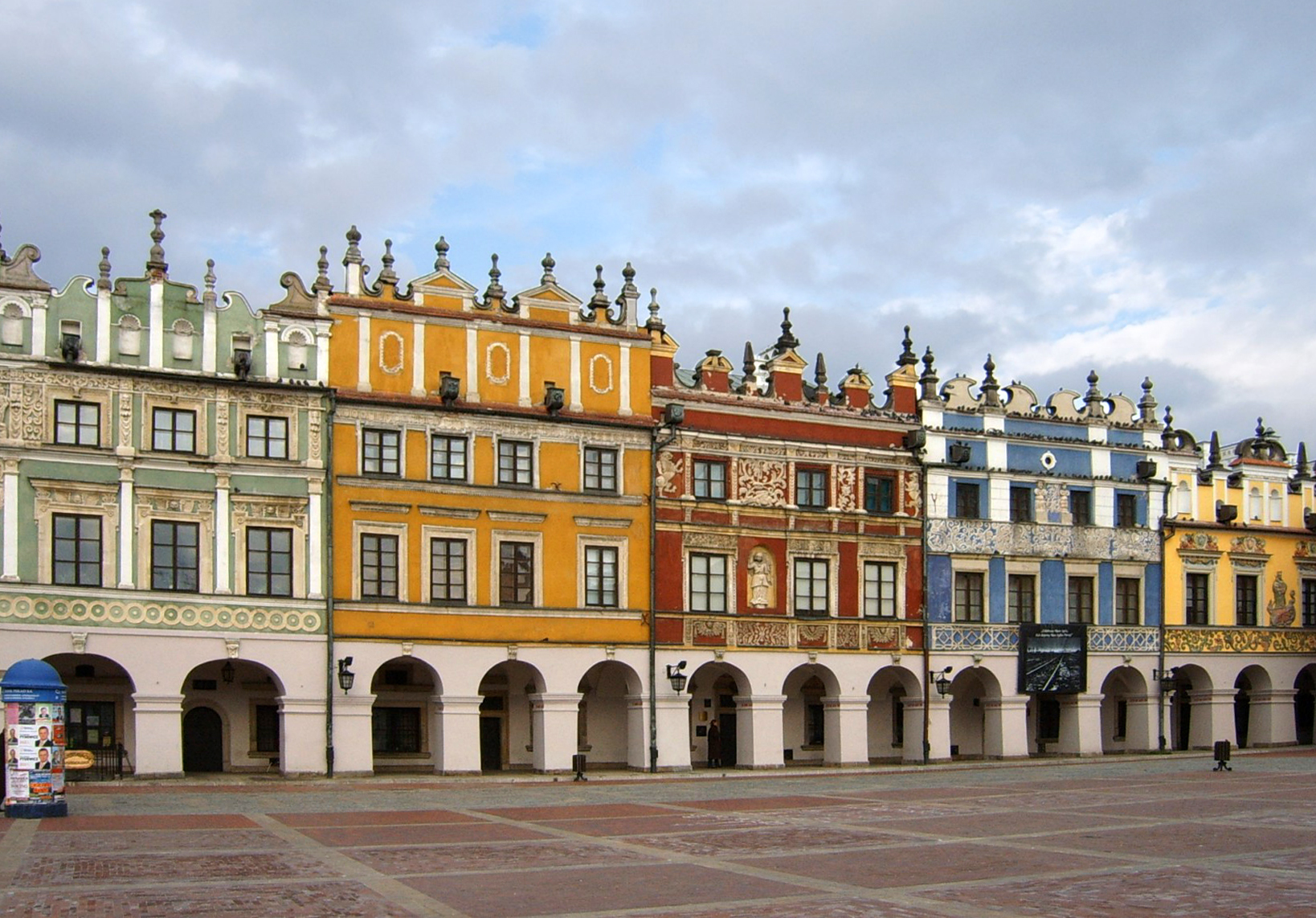
© MaKa, CC BY-SA 2.5 Resized from original. (This derivative is under the same CC BY-SA license.)
World Heritage Research
Discover scientific research and academic studies that deepen our understanding of Old City of Zamość from its history and significance to its conservation, management, and contemporary challenges.
-
Digital Tool Supporting the Documentation and Analysis of Cultural Heritage – The Case of the Analytical 3D Model of the Zamość Fortress
A city-scale digital twin of Zamość UNESCO Old Town, integrating advanced technologies such as LiDAR/TLS, UAV photogrammetry, and terrestrial photogrammetry with BIM/IFC standards, has been developed. This innovative tool enables comprehensive documentation, conservation planning, and energy analysis at an unprecedented scale. By combining high-resolution 3D data acquisition methods with Building Information Modeling (BIM) workflows, the model provides a robust framework for preserving cultural heritage while supporting sustainable urban development strategies.
Wac, M., & Szostak, B. (2026). Digital Tool Supporting the Documentation and Analysis of Cultural Heritage – The Case of the Analytical 3D Model of the Zamość Fortress. Computer Assisted Methods in Engineering and Science, 33(1): 27–49. https://doi.org/10.24423/CAMES.2025.1943
View Publication Record | Read Publication -
The Renovation of the Former Zamość Academy Building in Zamość in the Context of Renovation and Research Challenges
During the renovation of the former Zamość Academy building, completed in 2024, significant historical discoveries were made that shed light on the building's complex architectural history. These included 18th-century illusionistic wall paintings in the chapel and Jan Kanty Hall, floors from various periods, foundations of older structures, and remarkably preserved 18th-century recessed latrines with wooden seating elements. The findings also revealed attempts to address high wall moisture and early heating systems from the 19th century. These discoveries expanded beyond the original renovation scope, providing valuable insights into the building's evolution, the city's history, and regional architectural practices.
janus, k., & Krupa, K. (2025). The Renovation of the Former Zamość Academy Building in Zamość in the Context of Renovation and Research Challenges. Civil and Environmental Engineering Reports, 35(1), 116–141. https://doi.org/10.59440/ceer/199691
View Publication Record | Read Publication -
Zamość (1918–1939)
Zamość's city walls, central to its identity as both a fortress and symbol of Polish resilience, underwent significant mythologization during the interwar period (1918–1939). This study reveals how the city, one of Europe's best-preserved old towns, adapted its narrative post-independence to align with Polish national identity, emphasizing themes of martyrdom and victory. Research involved analyzing historical studies and revitalization efforts on key sites like the Great Market Square and collegiate church, shedding light on the broader cultural and ethnic dynamics in the Chełm/Kholm region. The findings underscore the importance of contextualizing Zamość's history within its contested geographical and social landscape.
Korneluk, P. (2024). Zamość (1918–1939). Urban Communities and Memories in East-Central Europe in the Modern Age, 157–170. https://doi.org/10.4324/9781032703206-12
View Publication Record | Read Publication -
The Reaction of the Underground Press to the Displacement of Polish Children from the Zamość Region to Siedlce in 1943
During World War II, the German occupation forces forcibly displaced Polish children from the Zamość region, subjecting them to harsh conditions during transport to Siedlce. A study published in Faces of War reveals that the underground press documented this atrocity, highlighting widespread indignation and silent protests among the Polish population. The research focuses on the reaction of the underground media to these events, particularly a mass funeral demonstration held on February 3rd, 1943. By analyzing archival records, the study reconstructs the response of local communities and the role of underground publications in preserving historical accounts of this tragedy.
Kozaczyńska, B. (2022). The Reaction of the Underground Press to the Displacement of Polish Children from the Zamość Region to Siedlce in 1943. Faces of War (Oblicza Wojny) Volume 6 City and War, 231–242. https://doi.org/10.18778/8331-012-1.13
View Publication Record | Read Publication -
Value assessment of Zamość from the perspective of 25 years on UNESCO World Heritage List
A comprehensive reassessment of Zamość Old Town's value after 25 years on the UNESCO World Heritage List reveals its enduring significance while highlighting the need for adaptive conservation. The study identifies authentic material carriers of its value and sets boundaries for future interventions, crucial for managing a heterogeneous historical urban landscape. Using updated preservation theory and evaluation methodologies, it provides actionable insights for ongoing restoration efforts, ensuring Zamość's spatial harmony and functionality align with contemporary urban demands.
Joanna Jurczyk, & Szmygin, B. (2018). Value assessment of Zamość from the perspective of 25 years on UNESCO World Heritage List. Budownictwo I Architektura, 16(4), 093–112. https://doi.org/10.24358/bud-arch_17_164_06
View Publication Record | Read Publication