World Heritage Identification Number: 1604
World Heritage since: 2019
Category: Natural Heritage
WHE Type: Protected Areas & National Parks
Transboundary Heritage: No
Endangered Heritage: No
Country: 🇮🇸 Iceland
Continent: Europe
UNESCO World Region: Europe and North America
Map
Vatnajökull National Park: A Landscape of Fire and Ice
Vatnajökull National Park, officially known as "Vatnajökull National Park - Dynamic Nature of Fire and Ice," is a breathtaking natural wonder located in southeastern Iceland. Covering an expansive area of approximately 1,400,000 hectares, or around 14 percent of Iceland's total territory, it is the country's largest national park and one of its three national parks.
The park's name derives from the vast Vatnajökull glacier, which lies at its heart. This massive ice cap, the largest in Europe, stretches across a diverse landscape that includes ten central volcanoes, eight of which are subglacial. Two of these volcanoes, Grímsvötn and Bárdarbunga, are particularly active, contributing to the dynamic and ever-changing nature of the park.
One of the most striking phenomena associated with this volcanic activity is the jökulhlaup, a sudden flood caused by the breaching of a glacier margin during an eruption. These events have sculpted the park's unique topography, creating sandur plains, river systems, and rapidly evolving canyons. While occasional, jökulhlaups showcase the raw power of Iceland’s “fire and ice” landscape.
In addition to its geological features, Vatnajökull National Park is home to a diverse and unique ecosystem. The volcanic areas within the park provide habitat for endemic groundwater fauna that managed to survive the Ice Age. These unique organisms survive in the park's hot springs, geysers, and other volcanically heated water sources.
The park's northern section, previously known as Jökulsárgljúfur National Park, boasts impressive canyons, waterfalls, and basalt columns. Notable attractions here include Dettifoss, Europe's most powerful waterfall, based on volume of water flow, and Ásbyrgi, a horseshoe-shaped canyon believed to have been formed by ancient glacial floods.
In the southwestern corner, Skaftafell offers visitors a range of hiking trails through lush valleys, past cascading waterfalls, and up to the edge of the glacier itself. The park’s highest peak, Hvannadalshnúkur, rises to 2,110 meters above sea level, providing stunning views of the glaciers, volcanic landscapes, and surrounding wilderness.
Visitors to Vatnajökull National Park can witness firsthand the raw power and beauty of the stunning contrast between ice and volcanic activity. From the tranquil serenity of the glaciers to the explosive energy of the volcanoes, the park offers a unique glimpse into the forces that shaped our planet. As such, it is a must-visit destination for anyone seeking to experience the wonders of nature in all their glory.
UNESCO Description of the World Heritage Site
This iconic volcanic region covers an area of over 1,400,000 ha, nearly 14% of Iceland's territory. It numbers ten central volcanoes, eight of which are subglacial. Two of these are among the most active in Iceland. The interaction between volcanoes and the rifts that underlie the Vatnajökull ice cap takes many forms, the most spectacular of which is the jökulhlaup – a sudden flood caused by the breach of the margin of a glacier during an eruption. This recurrent phenomenon has led to the emergence of unique sandur plains, river systems and rapidly evolving canyons. Volcanic areas are home to endemic groundwater fauna that has survived the Ice Age.
UNESCO Justification of the World Heritage Site
Criterion (viii): The coexistence and ongoing interaction of an active oceanic rift on land, a mantle plume, the atmosphere and an ice cap, which has varied in size and extent over the past 2.8 million years, make the property unique in a global context. Earth system interactions are constantly building and reshaping the property, creating remarkably diverse landscapes and a wide variety of tectonic, volcanic and glaciovolcanic features. Especially interesting and unique in this regard are the basaltic lava shields (Iceland shields), volcanic fissures and cone rows, vast flood lavas, and features of ice dominant glacio-volcanism, such as tuyas and tindar. Interestingly, the well exposed volcanic features of the property have been used as analogues for similar features on the planet Mars. Geothermal heat and subglacial eruptions produce meltwater and jökulhlaups that maintain globally unique sandur plains, to the north and south of the Vatnajökull ice cap, as well as rapidly evolving canyons. In addition, the property contains a dynamic array of glacial- and geomorphological features, created by expanding or retreating glaciers responding to changes in climate. These features can be easily accessed and explored at the snouts of Vatnajökull’s many outlet glaciers and their forelands, especially in the southern lowlands, making the property a flagship glacial research location.
Encyclopedia Record: Vatnajökull National Park
Vatnajökull National Park is one of three national parks in Iceland, and is the largest one. It encompasses all of Vatnajökull glacier and extensive surrounding areas. These include the national parks previously existing at Skaftafell in the southwest and Jökulsárgljúfur in the north.Additional Site Details
Area: 1,482,000 hectares
Number of Components: 1
Coordinates: 64.577363 , -16.8815404444
IUCN World Heritage Outlook
The 2025 Conservation Outlook on Vatnajökull National Park - Dynamic Nature of Fire and Ice reports the following assessment:
Source: International Union for Conservation of Nature (IUCN) · View assessment
Image
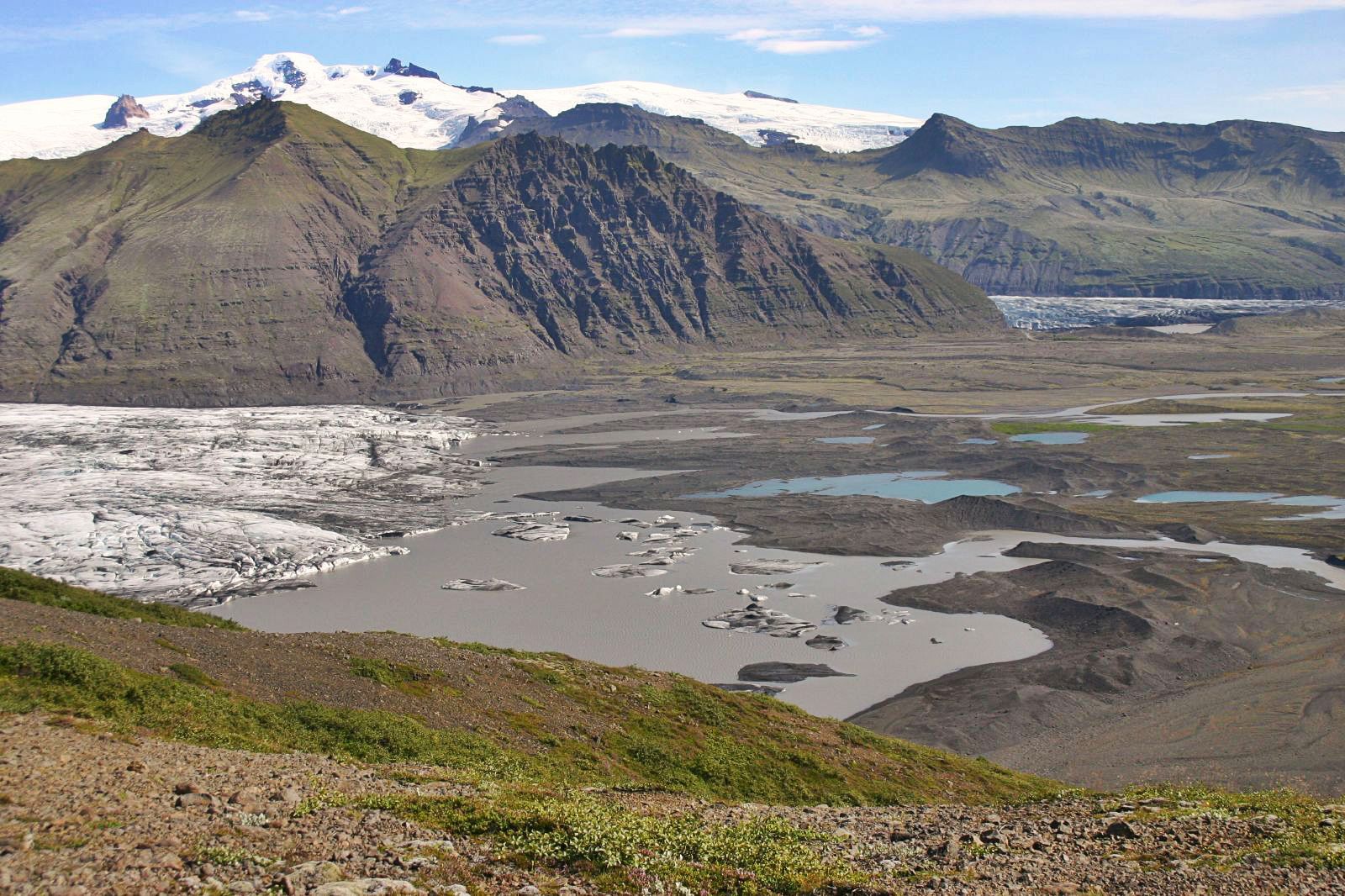
© Justraveling.com, CC BY-SA 4.0 Resized from original. (This derivative is under the same CC BY-SA license.)
World Heritage Research
Discover scientific research and academic studies that deepen our understanding of Vatnajökull National Park - Dynamic Nature of Fire and Ice from its history and significance to its conservation, management, and contemporary challenges.
-
Structural and functional characterization of a hyperthermostable single‐stranded DNA ‐binding protein from a hot spring metagenome
Researchers have identified and characterized a hyperthermostable single-stranded DNA-binding protein (SSB-M5) from a hot spring metagenome in Vatnajökull National Park, Iceland. This small protein, derived from hyperthermophilic Fervidobacterium species, demonstrates remarkable stability and high affinity for single-stranded DNA, even at temperatures up to 100°C. Structural analysis revealed that SSB-M5 forms a tetrameric functional unit, while biochemical assays confirmed its ability to substitute for Escherichia coli SSB in mutant strains. Notably, SSB-M5 exhibits cooperative binding with an EC50 of 141 pM and a Hill coefficient of 2, indicating strong and specific interactions with DNA. Its inclusion in PCR reactions significantly enhances amplification by eliminating non-specific products, highlighting its potential applications in molecular biology and biotechnology.
Werbowy, O., Håkansson, M., Dorawa, S., Stefańska‐Kaźmierczak, A., Svensson, L. A., Al‐Karadaghi, S., Jurczak‐Kurek, A., Kwiatkowska‐Semrau, K., Plotka, M., Fridjonsson, O. H., Hreggvidsson, G. O., Aevarsson, A., Dąbrowski, S., Kaczorowska, A.-K., & Kaczorowski, T. (2026). Structural and functional characterization of a hyperthermostable single‐stranded
View Publication Record | Read PublicationDNA ‐binding protein from a hot spring metagenome. Protein Science, 35(4). Portico. https://doi.org/10.1002/pro.70538 -
Intersecting heritage and tourism trajectories: territorial dynamics of geoheritage in UNESCO-labeled landscapes
UNESCO-labeled landscapes often see the interplay between geoheritage recognition and tourism development shape territorial dynamics, with outcomes varying based on local actors, institutional frameworks, and contextual factors like volcanic eruptions or economic crises. This study reveals that heritage and resource trajectories can unfold in distinct sequences—tourism preceding heritage designation (e.g., Swiss Alps), heritage leading to tourism (e.g., Vatnajökull National Park), or independent/strongly interdependent dynamics (e.g., M'Goun or Katla UNESCO Global Geoparks). The research highlights that while UNESCO labels may not always guarantee optimal geoconservation, they influence how geoheritage is integrated—or excluded—from protected areas, posing future management challenges. By analyzing case studies across the Swiss Alps, Moroccan Atlas, and southern Iceland, the study underscores the need to systematically examine heritage awareness, value hierarchies, and institutional constraints to mitigate tourism pressures on sensitive geomorphological environments.
Bussard, J. (2026). Intersecting heritage and tourism trajectories: territorial dynamics of geoheritage in UNESCO-labeled landscapes. Frontiers in Sustainable Tourism, 5. https://doi.org/10.3389/frsut.2026.1893595
View Publication Record | Read Publication -
Iceland
Iceland's dynamic volcanic landscape, marked by its unique subaerial exposure of the Mid-Atlantic Ridge, offers insights into significant geological phenomena. The study highlights the impact of volcanic eruptions on air traffic, such as the 2010 shutdown caused by ash clouds, and the environmental consequences, including the 'killer fog' of the 1780s. It explores geothermal energy potential, basalt formations, and the effects of sub-glacial eruptions within Vatnajökull National Park, a UNESCO World Heritage site. The research also examines the tectonic plate boundary at Thingvallir National Park and the volcanic activity on Heimaey, where successful efforts were made to halt lava flows. Through field observations and geological analysis, the study provides a comprehensive overview of Iceland's diverse volcanic terrain, its geothermal resources, and its unique geological features.
Prost, G. L. (2025). Iceland. Western Europe’s Natural Wonders, 1–98. https://doi.org/10.1201/9781003435594-1
View Publication Record | Read Publication -
Co-Management of Protected Areas: A Governance System Analysis of Vatnajökull National Park, Iceland
Vatnajökull National Park's co-management system, tailored through political negotiations and park-specific legislation, demonstrates adaptive governance that fosters rural development, inclusivity, and power-sharing. While it has successfully addressed legitimacy concerns and facilitated devolution, challenges persist in delineating responsibilities among actors, leading to conflicts and capacity issues. The study argues that the system is fit for its purpose but requires systematic improvements as Iceland expands its protected area estate, offering valuable insights for global conservation efforts.
Petursson, J. G., & Kristofersson, D. M. (2021). Co-Management of Protected Areas: A Governance System Analysis of Vatnajökull National Park, Iceland. Land, 10(7), 681. https://doi.org/10.3390/land10070681
View Publication Record | Read Publication -
Interpretation in Ásbyrgi: Communicating with National Park Visitors in Iceland
A study on visitor interpretation in Ásbyrgi, part of Vatnajökull National Park, reveals that verbal communication by guides or rangers is the most preferred method for delivering information to tourists. This approach enhances visitor satisfaction while effectively conveying key messages about geology, cultural history, and environmental sustainability. The research, based on observations and interviews with visitors, guides, rangers, and managers, found that most stakeholders were satisfied with the current interpretation methods. However, it also highlighted the need for improved compliance with safety and environmental instructions to ensure sustainable tourism development. These findings provide actionable insights for managing visitor experiences in nature-based destinations, balancing economic growth with ecological preservation.
Burns, G. L., Haraldsdóttir, L., & Gunnarsdóttir, G. Þ. (2021). Interpretation in Ásbyrgi: Communicating with National Park Visitors in Iceland. Sustainability, 13(22), 12592. https://doi.org/10.3390/su132212592
View Publication Record | Read Publication -
Managing Conflicting Attitudes: National Parks in Iceland and Japan
A striking 84% agreement in stakeholder attitudes toward conflict, communication, and consensus was found between Vatnajökull National Park in Iceland and Daisetsuzan National Park in Japan. This convergence suggests that conflict management techniques can transcend cultural and geographical boundaries, provided managers adapt to local social and environmental contexts. The study employed comparative analysis of stakeholder perspectives, revealing that despite minor differences, the core principles of inclusive decision-making remain universally applicable.
Schaller, H., Jónasson, H. I., & Aikoh, T. (2013). MANAGING CONFLICTING ATTITUDES: NATIONAL PARKS IN ICELAND AND JAPAN. Tourismos, Vol. 8 No. 2 (2013). https://doi.org/10.26215/TOURISMOS.V8I2.351
View Publication Record | Read Publication -
Implications of Climate Change on Nature-Based Tourism Demand: A Segmentation Analysis of Glacier Site Visitors in Southeast Iceland
Climate change-induced glacier recession significantly impacts nature-based tourism demand, with visitor responses varying widely depending on the type of environmental change and tourist segment. A study analyzing 565 visitors to Vatnajökull National Park in southeast Iceland found that factors such as accessibility, safety, and amenity—all affected by glacier shrinkage—play crucial roles in shaping visitation patterns. The research combines contingent behavior analysis with multivariate cluster analysis to reveal distinct visitor segments, each responding differently to these changes. These findings underscore the need for proactive planning, education, communication, and product development tailored to visitor segment differences to ensure sustainable tourism amid ongoing glacial transformation.
Welling, J., Árnason, Þ., & Ólafsdóttir, R. (2020). Implications of Climate Change on Nature-Based Tourism Demand: A Segmentation Analysis of Glacier Site Visitors in Southeast Iceland. Sustainability, 12(13), 5338. https://doi.org/10.3390/su12135338
View Publication Record | Read Publication