
World Heritage Identification Number: 1728
World Heritage since: 2025
Category: Natural Heritage
WHE Type: Natural Landscapes & Geographic Features
Transboundary Heritage: No
Endangered Heritage: No
Country: 🇩🇰 Denmark
Continent: Europe
UNESCO World Region: Europe and North America
Map
Møns Klint: A Geological Marvel and Natural Treasure
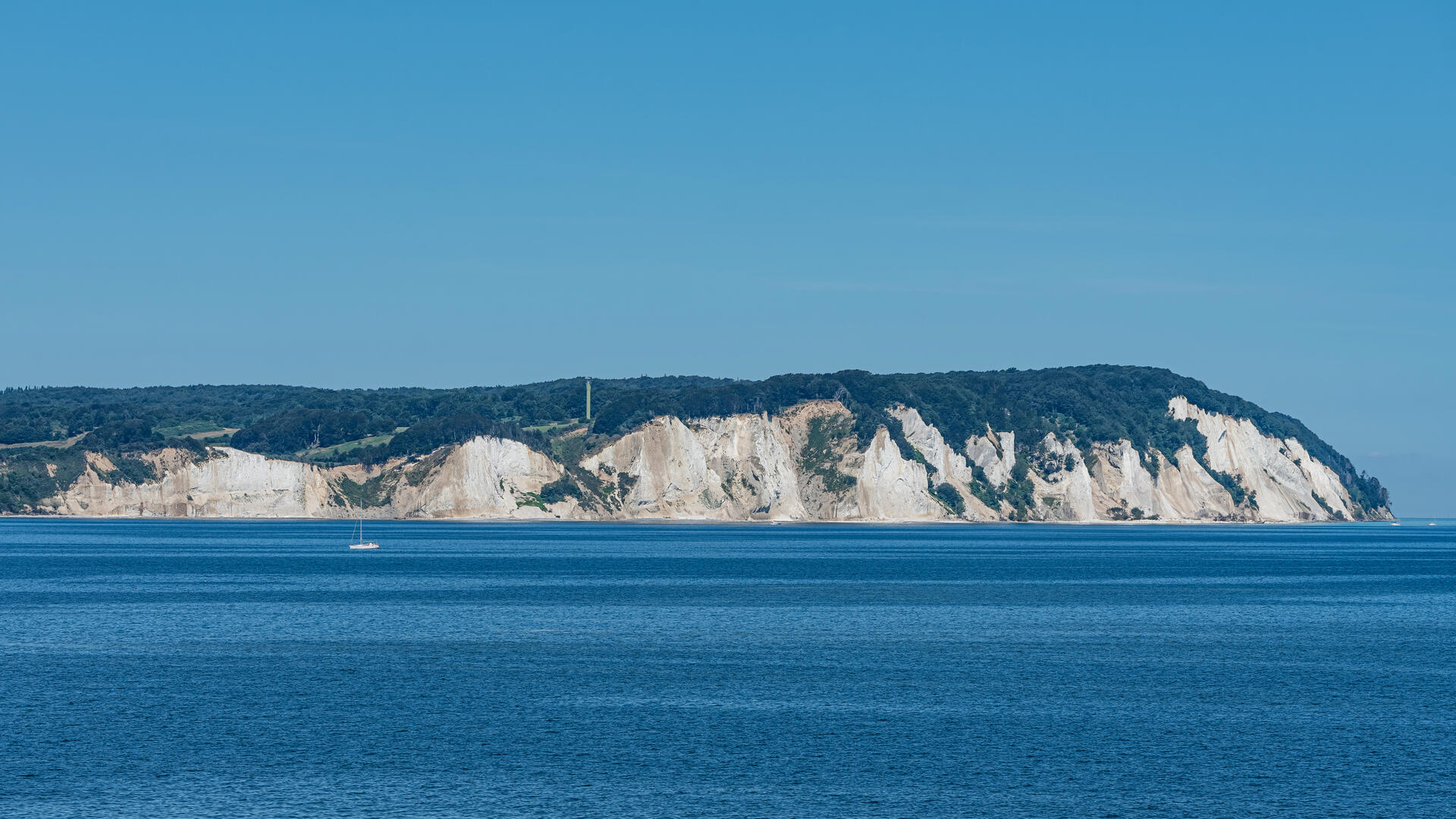
Møns Klint, meaning "Møn Chalk Cliffs" in English, is a stunning geological formation located on the eastern coast of the Danish island of Møn. Inscribed as a UNESCO World Heritage Site in 2025, this 6-kilometer stretch of limestone and chalk cliffs stands as a testament to the power of natural forces shaping our planet over millions of years.
The property encompasses a diverse landscape sculpted by Pleistocene glaciers and post-glacial processes. The dramatic cliffs, reaching heights of up to 128 meters (Dronningestolen), contrast sharply with the rolling hills, kame and kettle topography, and outwash plains that characterize the surrounding area. Cross-sections of the cliffs offer a glimpse into Earth's history, revealing intense folding and faulting of Cretaceous chalk and Quaternary sediments.
One of the most striking features of Møns Klint is its geological diversity. The cliffs serve as a living museum, continually eroding to expose fossils and reshape their structure. This ongoing process offers researchers valuable insights into the region's geological past.
Beyond its geological significance, Møns Klint boasts rich biodiversity. The area supports rare habitats such as calcareous grasslands and beech forests, providing homes for a variety of plant and animal species. Among these are 18 species of orchids and the near-threatened Large Blue butterfly (Phengaris arion). The unique ecosystems found within Møns Klint contribute to its designation as a nature reserve.
The entire island of Møn has also been a UNESCO Biosphere Reserve since 2017, a separate designation that recognizes sustainable development alongside nature protection.
Visitors to Møns Klint can explore well-marked paths suitable for walkers, riders, and cyclists. These trails lead to steps descending to the shore at various points along the cliffs. With approximately 250,000 annual visitors, Møns Klint attracts tourists from around the world who come to witness this natural wonder firsthand.
In addition to its geological and biological importance, Møns Klint holds cultural and symbolic significance in Denmark, having long inspired artists, writers, and scientists. While human activity in the wider Møn area dates back thousands of years, the site’s UNESCO designation is based primarily on its outstanding geological importance. Today, Møns Klint continues to offer a window into the interplay between geology, ecology, and human history.
Overall, Møns Klint stands as a remarkable example of the beauty and complexity inherent in our natural world. Its designation as a UNESCO World Heritage Site recognizes not only its geological and biological value but also its role in fostering a deeper understanding of our planet's past, present, and future. As we continue to learn from and appreciate sites like Møns Klint, we are reminded of the importance of preserving and protecting our planet's natural treasures for generations to come.
UNESCO Description of the World Heritage Site
Featuring a dramatic glaciotectonic landscape shaped by Pleistocene glaciers, the property includes chalk cliffs, rolling hills, kame and kettle topography, and outwash plains. Visible cliff cross-sections reveal intense folding and faulting of Cretaceous chalk and Quaternary sediments. The area supports rare habitats like calcareous grasslands and beech forests, hosting diverse flora and fauna, including 18 species of orchid, and the almost-threatened Large Blue butterfly. Erosion continuously exposes fossils and reshapes the cliffs.
Encyclopedia Record: Møns Klint
Møns Klint is a 6 km stretch of limestone and chalk cliffs along the eastern coast of the Danish island of Møn in the Baltic Sea, and as of July 2025 a World heritage Site. Some of the cliffs fall a sheer 120 m to the sea below. The highest cliff is Dronningestolen, which is 128 m above sea level. The area around Møns Klint consists of woodlands, pastures, ponds and steep hills, including Aborrebjerg which, with a height of 142 m, is one of the highest points in Denmark. The cliffs and adjacent park are now protected as a nature reserve. Møns Klint receives around 250,000 visitors a year. There are clearly marked paths for walkers, riders and cyclists. The path along the cliff tops leads to steps down to the shore in several locations.Additional Site Details
Area: 4,123 hectares
Number of Components: 1
Coordinates: 54.9677777778 , 12.5502777778
World Heritage Research
Discover scientific research and academic studies that deepen our understanding of Møns Klint from its history and significance to its conservation, management, and contemporary challenges.
-
Descriptive text to the Geological map of Denmark, 1:50 000, Møn 1511 I, 1511 IV and 1512 II
Møns Klint, a UNESCO World Heritage Site on the island of Møn, Denmark, showcases a unique glaciotectonic complex formed by the advance and retreat of the Young Baltic Ice during the Weichselian glaciation. This study reveals that the E–W trending composite ridges, including the highest point Aborrebjerg (143 m a.s.l.), are composed of thrust-fault-displaced chalk sheets with significant vertical displacement (up to 150 m). The research also identifies new geological formations, such as the Kobbelgård and Stubberup Have Formations, deposited during the Middle Weichselian. Additionally, it describes the formation of a glacial lobe along Hjelm Bugt and radial spillways like Borre and Maglemose depressions, which later became fjords. The study integrates detailed mapping, stratigraphic analysis, and glaciodynamic interpretations to reconstruct Møn's complex geological history, providing insights into its Quaternary evolution.
Pedersen, S. A. S., & Gravesen, P. (2022). Descriptive text to the Geological map of Denmark, 1:50 000, Møn 1511 I, 1511 IV and 1512 II. GEUS Bulletin, 51. https://doi.org/10.34194/geusb.v51.8336
View Publication Record | Read Publication -
Kortbladsbeskrivelse, Geologisk kort over Danmark, 1:50 000, Møn Dele af 1511 I, 1511 IV og 1512 II
Møns Klint reveals complex glacial and geological dynamics shaped by multiple ice advances during the Weichselian glaciation. The site's distinctive chalk cliffs are part of tectonically uplifted layers, up to 80 meters thick, with underlying Maastrichtian chalk extending to depths of -25 to -40 meters. Research identifies four distinct glacial sequences, including the Møns Klint Glacialdynamical Complex, formed during the Ungbaltic Ice Advance (~17,000 years ago), which reoriented the chalk layers and created radial meltwater channels. Post-glacial transgressions during the Holocene transformed these channels into fjords, later filled with peat deposits as marine forelands expanded. The study integrates geological mapping (1:50,000 scale) with stratigraphic analysis to reconstruct Møn's morphologic evolution, highlighting its significance as a record of Quaternary glaciations and post-glacial landscape changes.
Pedersen, S. A. S., & Gravesen, P. (2021). Kortbladsbeskrivelse, Geologisk kort over Danmark, 1:50 000, Møn Dele af 1511 I, 1511 IV og 1512 II. GEUS Bulletin, 48. https://doi.org/10.34194/geusb.v48.8293
View Publication Record | Read Publication -
Recurrent hybridisation events between Primula vulgaris , P . veris and P . elatior (Primulaceae, Ericales) challenge the species boundaries: using molecular markers to re‐evaluate morphological identifications
Recurrent hybridisation between Primula vulgaris, P. veris, and P. elatior challenges traditional species boundaries at Møns Klint, Denmark. Genetic analysis of 168 specimens revealed that many previously identified hybrids, such as P. × digenea (P. vulgaris × P. elatior) and P. × polyantha (P. veris × P. vulgaris), are later-generation backcrosses rather than first-generation hybrids. Molecular markers also uncovered unexpected ancestry in some specimens, including P. veris genetic material in a P. vulgaris plant, suggesting greater genetic exchange than previously recognised. The study used species-specific SNPs, chloroplast trn L polymorphisms, and simple sequence repeats to re-evaluate morphological identifications, providing insights into hybridisation dynamics that complicate taxonomic distinctions.
Tendal, K., Ørgaard, M., Larsen, B., & Pedersen, C. (2018). Recurrent hybridisation events between Primula vulgaris , P . veris and P . elatior (Primulaceae, Ericales) challenge the species boundaries: using molecular markers to re‐evaluate morphological identifications. Nordic Journal of Botany, 36(9). Portico. https://doi.org/10.1111/njb.01778
View Publication Record | Read Publication -
Thrust-fault architecture of glaciotectonic complexes in Denmark
A glaciotectonic complex affecting comparable rock units to those at Møns Klint was recently recognized in seismic sections from Jammerbugten in the North Sea, providing a unique opportunity for comparative studies of upper and lower structural levels in thin-skinned thrust-fault deformation. The study highlights the importance of the décollement zone, located 50 to 100 meters below sea level, which separates undeformed bedrock from displaced thrust-sheet units. While structures above sea level at Møns Klint are well-documented, those below remain poorly understood and require further documentation despite previous modeling efforts.
Schack Pedersen, S. A., & Boldreel, L. O. (2015). Thrust-fault architecture of glaciotectonic complexes in Denmark. Geological Survey of Denmark and Greenland Bulletin, 33, 17–20. https://doi.org/10.34194/geusb.v33.4479
View Publication Record | Read Publication -
The lower Maastrichtian Hvidskud succession, Møns Klint, Denmark: calcareous nannofossil biostratigraphy, carbon isotope stratigraphy, and bulk and brachiopod oxygen isotopes.
Research at Møns Klint, Denmark, reveals that the lower Maastrichtian Hvidskud succession provides critical insights into early Maastrichtian climate and stratigraphy. The study establishes a precise age model for the succession, dating its base to approximately 70.9 million years ago and spanning over 680 thousand years. This includes detailed calcareous nannofossil biostratigraphy and carbon isotope stratigraphy, correlating with brachiopod zonation and global geochronological tie-points. The findings suggest that the Danish Chalk Sea experienced bottom water temperatures of 13.6 to 14.3°C during this period, offering a snapshot of early Maastrichtian cooling. The well-exposed Hvidskud succession serves as a key locality for stratigraphic correlation in northwestern Europe, enhancing our understanding of Cretaceous paleoenvironmental conditions.
Jelby, M. E., Thibault, N., Surlyk, F., Ullmann, C. V., Harlou, R., & Korte, C. (2014). The lower Maastrichtian Hvidskud succession, Møns Klint, Denmark: calcareous nannofossil biostratigraphy, carbon isotope stratigraphy, and bulk and brachiopod oxygen isotopes. Bulletin of the Geological Society of Denmark, 62, 89–104. https://doi.org/10.37570/bgsd-2014-62-05
View Publication Record | Read Publication
