
World Heritage Identification Number: 1643
World Heritage since: 2021
Category: Cultural Heritage
WHE Type: Buildings & Architectural Ensembles
Transboundary Heritage: No
Endangered Heritage: No
Country: 🇸🇮 Slovenia
Continent: Europe
UNESCO World Region: Europe and North America
Map
Transforming Ljubljana: Jože Plečnik's Human-Centered Urban Design
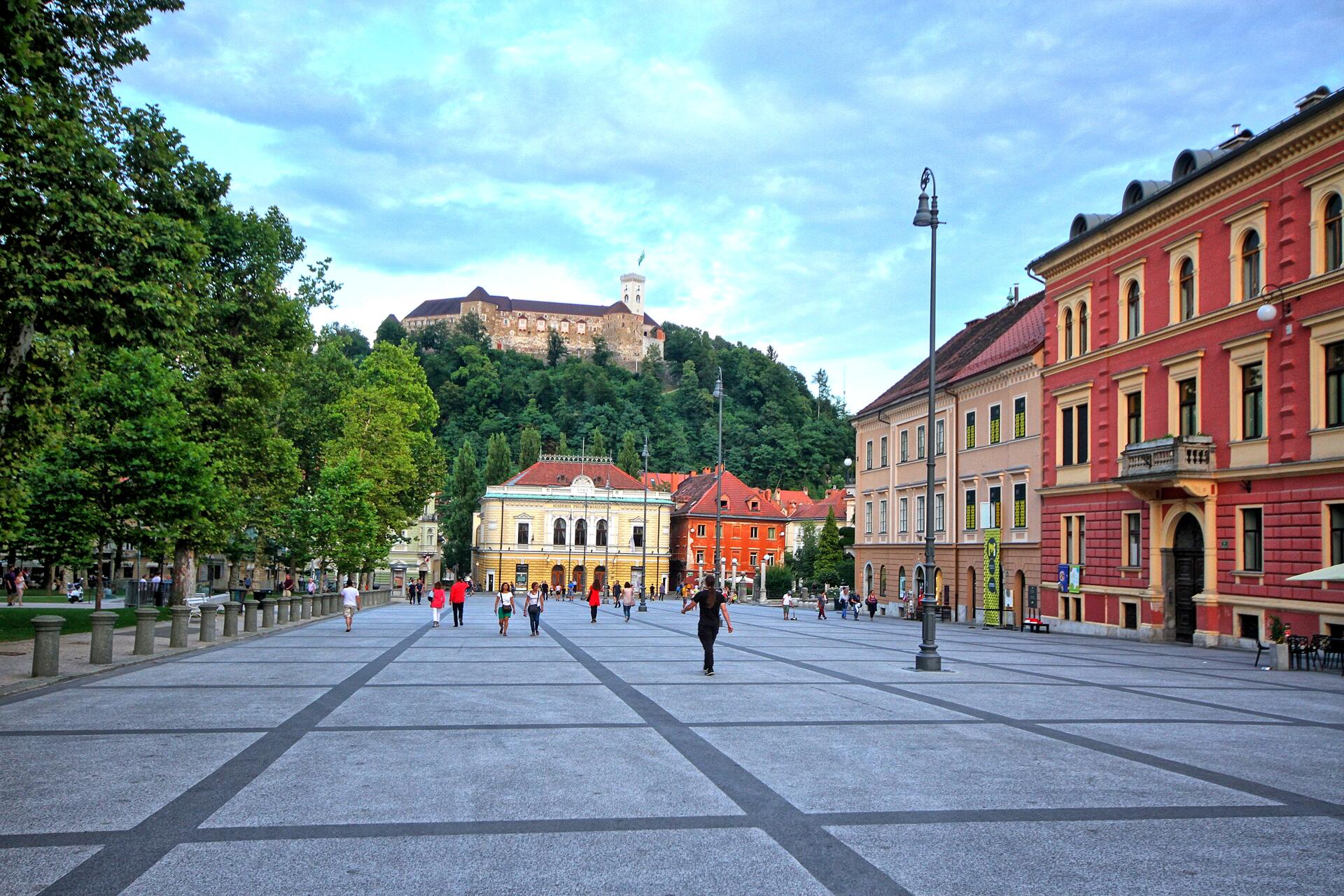
In the heart of Slovenia lies the vibrant city of Ljubljana, a testament to the visionary work of architect Jože Plečnik. Inscribed as a UNESCO World Heritage Site in 2021, the works of Plečnik in Ljubljana showcase an exceptional example of human-centered urban design that significantly transformed the city's identity.
More to come…UNESCO Description of the World Heritage Site
The works Jože Plečnik carried in Ljubljana between World War I and World War II present an example of a human centred urban design that successively changed the identity of the city following the dissolution of the Austro-Hungarian Empire, when it changed from a provincial city into the symbolic capital of the Slovenian people. The architect Jože Plečnik contributed to this transformation with his personal, profoundly human vision for the city, based on an architectural dialogue with the older city while serving the needs of emerging modern 20th century society. The property consists of a series of public spaces (squares, parks, streets, promenades, bridges) and public institutions (national library, churches, markets, funerary complex) that were sensitively integrated into the pre-existing urban, natural and cultural context and contributed to the city’s new identity. This highly contextual and human-scale urbanistic approach, as well as Plečnik’s distinctive architectural idiom, stand apart from the other predominant modernist principles of his time. It is an exceptional case of creating public spaces, buildings and green areas according to the vision of a single architect within a limited time, the limited space of an existing city, and with relatively limited resources.
UNESCO Justification of the World Heritage Site
Criterion (iv): The interventions designed by the architect Jože Plečnik throughout the city of Ljubljana in the short period between the two World Wars combine to become an outstanding example of human-centred urban renewal for the purpose of nation building after the demise of the Austro-Hungarian Empire. They are based on a harmonic relationship with the context of the space and its natural possibilities. The city is not built anew but improved with small- or large-scale interventions – new architectural ensembles, buildings and urban accents. The relationship with the past is established in various ways, from adapting the urban network and incorporating existing structures through architectural reminiscences and by establishing new cityscapes. The new urban space is not limited to a specific use but has various functions and the whole is thus imbued with new meanings.
Encyclopedia Record: The works of Jože Plečnik in Ljubljana – Human Centred Urban Design
The works of Jože Plečnik in Ljubljana – Human Centred Urban Design is a UNESCO World Heritage Site in Ljubljana, Slovenia, listed in 2021. The site encompasses selected the most prominent works of Slovenian architect Jože Plečnik in Ljubljana with their original function. During the interwar period, Plečnik worked to transform Ljubljana from a provincial city to the capital of the Slovenian nation by creating a series of public spaces and public institutions and integrating them into the pre-existing urban fabric. Sites include the St. Michael's Church in Črna Vas, and the following sites in Ljubljana: the promenade along the embankments of the Ljubljanica River and the bridges crossing it; the "Green promenade": Vegova Street with the National and University Library from French Revolution Square to Congress Square and Star Park, Trnovo Bridge, Roman Walls in Mirje, the Church of St. Francis of Assisi, and the All Saints Garden in Žale Cemetery.Additional Site Details
Area: 19.138 hectares
Number of Components: 7
Coordinates: 46.0433333333 , 14.5022222222
World Heritage Research
Discover scientific research and academic studies that deepen our understanding of The works of Jože Plečnik in Ljubljana – Human Centred Urban Design from its history and significance to its conservation, management, and contemporary challenges.
-
Alois Riegl’s spatial conception of Salzburg and its afterlife in France Stele’s Ljubljana
Alois Riegl’s essay on Salzburg marks a pivotal shift in art history by treating urban space as an integrated historical and artistic form. His approach reveals cities like Salzburg as dynamic spaces where artistic expressions emerge from the interplay of style, perception, and historical context, challenging traditional notions of center-province relationships. This relational model influenced the Viennese School and was later adapted by France Stele to reinterpret Ljubljana post-Monarchy dissolution, transforming it into a cultural-political vision. The study highlights how Riegl’s spatial conception evolved from analytical methodology to a broader urban narrative, bridging art history and political discourse.
Alois Riegl’s Spatial Conception of Salzburg and Its Afterlife in France Stele’s Ljubljana. (2026). [JD]. The Edgar Wind Journal, 10, 158–180. https://doi.org/10.53245/EWJ-000064
View Publication Record | Read Publication -
3D Reconstruction of Unrealised Monumental Heritage and Its Impact on Gallery Experience
A 3D reconstruction of Jože Plečnik's unrealised Jan Žižka monument, created using stereolithography (SLA) and fused deposition modelling (FDM), achieved high similarity scores for architectural elements (1.97/5) and statues (1.81/5) in participant testing, demonstrating its effectiveness in preserving and interpreting Plečnik's architectural style. The study, conducted by the Plečnik House gallery, employed interpretative approaches, 3D modelling, and exhibition analysis to evaluate audience perception, revealing that while props met expectations (1.61), clothing received the lowest score (1.40). This research highlights the potential of digital reconstructions in enhancing understanding of monumental heritage and its cultural impact.
Ahtik, J., Škerjanc, A., Gabrijelčič Tomc, H., & Kočevar, T. N. (2025). 3D Reconstruction of Unrealised Monumental Heritage and Its Impact on Gallery Experience. Buildings, 15(15), 2632. https://doi.org/10.3390/buildings15152632
View Publication Record | Read Publication -
Modernist architecture as part of contemporary urban identity: Plečnik and Ravnikar in Ljubljana, and Grabrijan and Neidhardt in Sarajevo
Modernist architecture significantly shapes contemporary urban identity, particularly in post-Yugoslav cities like Ljubljana and Sarajevo. A comparative analysis reveals how key architects—Jože Plečnik and Edvard Ravnikar in Ljubljana, and Dušan Grabrijan and Juraj Neidhardt in Sarajevo—contributed to the urban fabric during the 20th century, reflecting shared socialist legacies while diverging after the 1990s. The study highlights modernism's role in sustainability, resilience, and evolving cultural identity, offering insights into how architectural heritage influences urban development and societal perceptions.
Zagora, N., Mujkić, S., Kahrović-Handžić, L., & Pašić, E. (2025). Modernist architecture as part of contemporary urban identity: Plečnik and Ravnikar in Ljubljana, and Grabrijan and Neidhardt in Sarajevo. Urbani Izziv, 36(2), 122–135. https://doi.org/10.5379/urbani-izziv-en-2025-36-02-04
View Publication Record | Read Publication -
Origins of Modernity: Plečnik and Grabrijan
This study reveals the enduring influence of Jože Plečnik's human-centred urban design on Slovenian modernity, particularly through the lens of his disciple Dušan Grabrijan. It highlights how Plečnik's 'flexible classicism'—marked by inventiveness, material experimentation, and a deep connection to local crafts—challenged industrialization and social change in post-WWII Yugoslavia. The research analyzes Grabrijan's writings, including the posthumous book Plečnik and His School, which critically contextualizes Plečnik's work while exploring his graduates' attempts to reconcile modernist architecture with Balkan cultural diversity. A key focus is the Ivan Cankar Memorial in Ljubljana's Žale Cemetery, a tripartite structure reflecting Plečnik's design principles and Grabrijan's innovative approach.
Koselj, N. (2024). Origins of Modernity: Plečnik and Grabrijan. Docomomo Journal, (72), 32–39. https://doi.org/10.52200/docomomo.72.04
View Publication Record | Read Publication -
Letters from Paris and Architect Dušan Grabrijan's Archive
The archive of architect Dušan Grabrijan at the Museum of Architecture and Design (MAO) in Ljubljana reveals significant insights into the influence of Le Corbusier’s studio on Slovenian and Yugoslavian architectural modernization during the 1930s. Key correspondence between Grabrijan, Juraj Neidhardt, and Milan Sever highlights the intellectual exchange among architects, particularly during Grabrijan's time in Sarajevo (1930-1945), where he observed parallels between Bosnian architecture and modernist design. The archive, spanning sketches, letters, lecture notes, and photographs, documents Grabrijan’s academic journey from studying under Jože Plečnik to his later professorship in Ljubljana (1945-1952). These materials illuminate architectural connections across Paris, Sarajevo, Ljubljana, Zagreb, and Belgrade, offering a rare glimpse into the intellectual networks shaping modern architecture in the region. The study underscores the enduring impact of Plečnik’s teachings and the transnational exchange that defined 20th-century architectural thought.
Zupančič, B. (2024). Letters from Paris and Architect Dušan Grabrijan’s Archive. Docomomo Journal, (72), 7–15. https://doi.org/10.52200/docomomo.72.01
View Publication Record | Read Publication -
The erection of a royal monument as a city planning opportunity: the monument to King Alexander I and Plečnik’s South Square
Jože Plečnik's proposed Alexander's Propylaea and South Square for Ljubljana represented a bold urban design solution to address multiple city planning challenges, yet faced significant public opposition. This study reveals how Plečnik's 1937 project aimed to integrate a royal monument with the creation of a new public space, Južni trg (South Square), behind it. Despite its potential to reshape Congress Square and improve urban connectivity, the plan was never realized due to societal resistance. The research analyzes the circumstances surrounding Plečnik's proposal, its implications for Ljubljana's urban development, and its lasting influence on the city's architecture and planning. Conducted within broader studies on Slovenian art and bourgeois commissions, this work provides insights into the intersection of political symbolism, public engagement, and urban design in interwar Europe.
Lazarini, F. (2024). The erection of a royal monument as a city planning opportunity: the monument to King Alexander I and Plečnik’s South Square. Art and the State in Modern Central Europe (18th – 21st Century): Conference Proceedings, 409–420. https://doi.org/10.17234/9789533792170.29
View Publication Record | Read Publication -
Data Mining of Visitors’ Spatial Movement Patterns Using Flickr Geotagged Photos: The Case of Dispersed Plečnik’s Architectural Heritage in Ljubljana
Visitors to Ljubljana’s UNESCO-listed Plečnik architectural heritage exhibit distinct spatial behavior, with landmarks in the historic center integrating into broader tourist networks while more remote sites remain undervisited and isolated. One-day tourists, after exploring central attractions, rarely venture further, missing out on dispersed heritage elements. This pattern highlights challenges in ensuring a comprehensive visitor experience and forming 'cumulative attractions.' The study leveraged Flickr geotagged photos to analyze movement patterns using Big Data techniques, revealing how spatial dispersion complicates the integration of architectural heritage into tourist behavior. These findings offer insights for urban planners and heritage managers aiming to optimize visitor engagement with dispersed UNESCO sites.
Sedmak, G., Paliska, D., & Brezovec, A. (2023). Data Mining of Visitors’ Spatial Movement Patterns Using Flickr Geotagged Photos: The Case of Dispersed Plečnik’s Architectural Heritage in Ljubljana. Academica Turistica, 49–62. https://doi.org/10.26493/2335-4194.16.49-62
View Publication Record | Read Publication
