World Heritage Identification Number: 84
World Heritage since: 1979
Category: Cultural Heritage
WHE Type: Religious Sites & Sacred Architecture
Transboundary Heritage: No
Endangered Heritage: No
Country: 🇫🇷 France
Continent: Europe
UNESCO World Region: Europe and North America
Map
Vézelay, Church and Hill: A Masterpiece of Burgundian Romanesque Art and Architecture
The Vézelay, Church and Hill, located in the small town of Vézelay in the Yonne department of eastern central France, is a remarkable example of Romanesque art and architecture that has stood the test of time for over nine centuries. Inscribed as a UNESCO World Heritage Site in 1979, this historic site boasts a rich history, significant cultural importance, and exceptional architectural beauty.
More to come…UNESCO Description of the World Heritage Site
Shortly after its foundation in the 9th century, the Benedictine abbey of Vézelay acquired the relics of St Mary Magdalene and since then it has been an important place of pilgrimage. St Bernard preached the Second Crusade there in 1146 and Richard the Lion-Hearted and Philip II Augustus met there to leave for the Third Crusade in 1190. With its sculpted capitals and portal, the Madeleine of Vézelay – a 12th-century monastic church – is a masterpiece of Burgundian Romanesque art and architecture.
UNESCO Justification of the World Heritage Site
Criterion (i): The church of St Mary Magdalene of Vézelay is a masterpiece of Burgundian Romanesque art. The central nave (1120-1140), effectively punctuated by its two-tone arch ribs, is adorned with a series of capitals unique in style and variety of subjects. Its carved portal placed between the nave and narthex, with, notably, the tympanum of the “Mission of the Apostles, makes it one of the major monuments of Western Romanesque art.
Criterion (vi): In the 12th century, the hill of Vézelay was a choice location where medieval Christian spirituality, reaching a sort of paroxysm, gave rise to various and specific expressions, from prayer and chanson de geste to the Crusades.
Encyclopedia Record: Vézelay Abbey
Vézelay Abbey is a Benedictine and Cluniac monastery in Vézelay in the east-central French department of Yonne. It was constructed between 1120 and 1150. The Benedictine abbey church, now the Basilica of Sainte-Marie-Madeleine, with its complex program of imagery in sculpted capitals and portals, is one of the great masterpieces of Burgundian Romanesque art and architecture. Sacked by the Huguenots in 1569, the building suffered neglect in the 17th and the 18th centuries and some further damage during the period of the French Revolution.Additional Site Details
Area: 183 hectares
Number of Components: 2
(vi) — Directly associated with events or living traditions
Coordinates: 47.46638889 , 3.748333333
Image
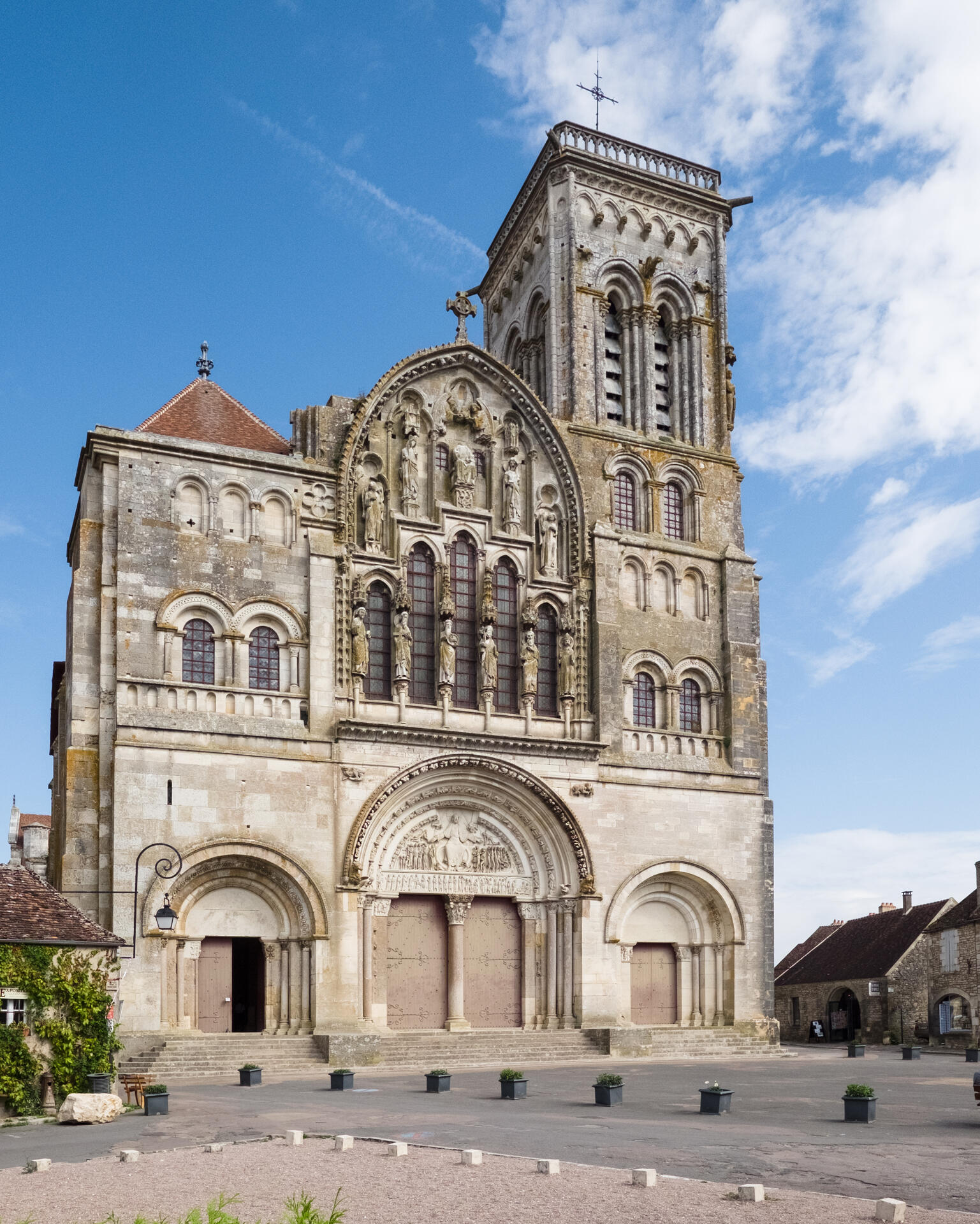
© DKrieger, CC BY-SA 3.0 Resized from original. (This derivative is under the same CC BY-SA license.)
World Heritage Research
Discover scientific research and academic studies that deepen our understanding of Vézelay, Church and Hill from its history and significance to its conservation, management, and contemporary challenges.
-
Politics from Law or Law as Politics? Hugh of Poitiers’s Chronica and the Politics of ius in the Mid-twelfth Century
A twelfth-century legal conflict over Vézelay Abbey, documented by monk Hugh of Poitiers, reveals that the concept of ius ('law, right') was intrinsically political. This study demonstrates that such conflicts were not merely about jurisprudential norms but about defining a just societal order. By analyzing Hugh's Chronica, written between 1140s and 1160s, the research challenges modern distinctions between legal and political aims in jurisdictional disputes of the mid-twelfth century. The findings underscore that competing understandings of ius shaped contemporary legal actors' arguments, forcing a reevaluation of how law and politics intertwined during this period.
Taylor, A. (2025). Politics from Law or Law as Politics? Hugh of Poitiers’s Chronica and the Politics of ius in the Mid-twelfth Century. The Journal of Legal History, 46(1), 148–171. https://doi.org/10.1080/01440365.2025.2456283
View Publication Record | Read Publication -
Pygmalion’s Power: Romanesque Sculpture, the Senses, and Religious Experience by Thomas E. A. Dale
Romanesque sculpture, particularly in sites like Vézelay and Moissac, was not solely a revival of classical art but reflected a profound shift toward spiritual embodiment and affective piety during the late 11th to 12th centuries. Thomas E. A. Dale challenges traditional narratives that attribute its resurgence to a desire for Roman authority, instead emphasizing its role in religious experience through sensory engagement, ritual veneration, and liturgical drama. The study employs cultural anthropology, liturgical studies, and historiographical analysis to reinterpret familiar works—such as the Madonna and Child, crucifixes, and monsters—revealing their affective qualities and connections to devotional practices. Dale's interdisciplinary approach, drawing on the work of scholars like Mary Carruthers and Caroline Walker Bynum, provides fresh insights into how these sculptures evoked religious emotion and spiritual meaning.
Collard, J. (2022). Pygmalion’s Power: Romanesque Sculpture, the Senses, and Religious Experience by Thomas E. A. Dale. Parergon, 39(1), 233–234. https://doi.org/10.1353/pgn.2022.0020
View Publication Record | Read Publication -
Vézelay
Vézelay, an ancient hill city in Burgundian France, stands out for its historical and religious significance. The site is renowned for its 11th-century abbey, Sainte-Marie-Madeleine de Vézelay, which served as a pivotal starting point for the 'Via Lemovicense,' one of the four major pilgrimage routes to Santiago de Compostela in Spain. Additionally, it is notable as the location from where Saint Bernard of Clairvaux preached the Second Crusade on Easter Sunday in 1046. This publication highlights Vézelay's role in shaping medieval pilgrimage and religious movements, offering insights into its cultural and historical importance.
Dunn, M. (2022). Vézelay. Vézelay. https://doi.org/10.4324/9780415791182-rmeo13-1
View Publication Record | Read Publication -
“All you need is Faith”: Sainte Foy,Furta Sacra, and Saint Mary Magdalene
Pilgrimage to female saints' shrines, such as those of Sainte Foy and Saint Mary Magdalene, has persisted for over a millennium, predating their inclusion on the Way of Saint James. These sites in Conques and Vézelay, respectively, attract pilgrims through a blend of monastic intrigue, sacred theft (furta sacra), and myth-making. While female pilgrimage to Compostela remains prominent, these shrines represent an earlier and distinct tradition of devotion, rooted in the Roman Empire but redefined during medieval Europe's peak pilgrimage era. The study highlights their enduring cultural significance despite shifting religious landscapes.
Signori, L. F. (2022). “All you need is Faith”: Sainte Foy,Furta Sacra, and Saint Mary Magdalene. Women and Pilgrimage, 61–77. https://doi.org/10.1079/9781789249392.0006
View Publication Record | Read Publication -
Images des Juifs à Vézelay : entre condamnation et conversion
At Vézelay, the sculpted images of Jews reflect a unique duality—simultaneously condemning and offering redemption. This ambivalence, likely influenced by Pierre de Montboissier, challenges the Western Christian notion of 'Otherness' that equated non-Christians with infidels. The study reveals how the abbey’s iconography at Sainte-Marie-Madeleine presents Jews as part of a broader redeemable community, akin to pagans, if they embrace conversion. This oscillation between blame and salvation is embedded in the Romanesque stonework, illustrating the tension between communal identity (oratores, laboratores, bellatores) and individual agency in medieval society.
Huys, V. (2013). Images des Juifs à Vézelay : entre condamnation et conversion. FKW // Zeitschrift Für Geschlechterforschung Und Visuelle Kultur, No. 54 (2013): VISUAL OTHERING. 1100–1200. https://doi.org/10.57871/FKW5420136
View Publication Record | Read Publication -
Innovation and Spiritual Value in Medieval Monastic Art: The Case of the Main Narthex Portal at Vézelay
Medieval monastic art at the Cluniac abbey of Vézelay around 1100 CE demonstrated a unique blend of tradition and innovation, drawing inspiration from Anglo-Saxon manuscript illuminations and biblical texts to create a portal that stood out both aesthetically and intellectually. This study reveals that the creators of the main narthex portal at Vézelay engaged in a triangular process of creation, synthesizing earlier artistic influences with new interpretations to justify its place within a monastic setting. By analyzing the portal's relationship to Anglo-Saxon imagery and scriptural sources, researchers uncovered how this approach aimed to captivate audiences on multiple levels while honoring established traditions.
Low, P. (2012). Innovation and Spiritual Value in Medieval Monastic Art: The Case of the Main Narthex Portal at Vézelay. Journal of Medieval and Early Modern Studies, 42(3), 657–698. https://doi.org/10.1215/10829636-1720616
View Publication Record | Read Publication -
The Abbey Church at Vézelay and the Cult of Mary Magdalene: “invitation to a journey of discovery”
A distinguished collection of essays, honoring architectural historian Paul Crossley, sheds new light on the Abbey Church at Vézelay and its significance within the medieval cult of Mary Magdalene. The volume integrates recent discoveries, fresh interpretations, and critical debates, offering profound insights into the cultural and religious landscape of the Middle Ages. By analyzing the church's architecture, liturgy, and symbolic elements, scholars from the U.S. and Europe provide a nuanced understanding of its role in medieval devotion and memory. This work serves as both a tribute to Crossley's scholarly breadth and a valuable resource for contemporary medieval studies.
Gajewski, A. (2011). The Abbey Church at Vézelay and the Cult of Mary Magdalene: “invitation to a journey of discovery”. Architecture, Liturgy and Identity, 221–240. https://doi.org/10.1484/m.sga-eb.1.100143
View Publication Record | Read Publication