
World Heritage Identification Number: 675
World Heritage since: 1993
Category: Cultural Heritage
WHE Type: Archaeological Sites
Transboundary Heritage: No
Endangered Heritage: No
Country: 🇸🇻 El Salvador
Continent: Americas
UNESCO World Region: Latin America and the Caribbean
Map
The Pre-Hispanic Farming Community of Joya de Cerén: A Time Capsule from Ancient America
The Pre-Hispanic Farming Community of Joya de Cerén: A Time Capsule from Ancient America
More to come…UNESCO Description of the World Heritage Site
Joya de Cerén was a pre-Hispanic farming community that, like Pompeii and Herculaneum in Italy, was buried under an eruption of the Laguna Caldera volcano c. AD 600. Because of the exceptional condition of the remains, they provide an insight into the daily lives of the Central American populations who worked the land at that time.
UNESCO Justification of the World Heritage Site
Criterion (iii): Joya de Cerén archaeological site is a unique testimony of the daily lives of ordinary people. This site is a remarkable by virtue of the completeness of the evidence that it provides of everyday life in Mesoamerican farming community of the seventh century A.D, which is without parallel in this cultural region.
Criterion (iv): The rapid ash fall from Loma Caldera volcano, and the sudden abandonment of the village, created exceptional circumstances that preserved architecture, organic materials and different artefacts. The archaeological site is a unique window into the past that allows for the interpretation of the interactions between the ancient settlers and their environment. The preserved earthen architecture remains, along with the rest of the material culture, forms a unique context that illustrates daily life of a prehispanic communities during the Late Classic period.
Encyclopedia Record: Joya de Cerén
Joya de Cerén is an archaeological site in La Libertad Department, El Salvador, featuring a pre-Columbian Maya farming village. The ancient Maya site of Joya de Cerén is located in the Zapotitán Valley, 36 kilometers northwest of San Salvador, El Salvador. It is often referred to as the "Pompeii of the Americas", in comparison to the famed Ancient Roman ruins.Additional Site Details
Area: 3,200 hectares
Number of Components: 1
(iv) — Outstanding example of a type of building or landscape
Coordinates: 13.8275 , -89.36916667
Image
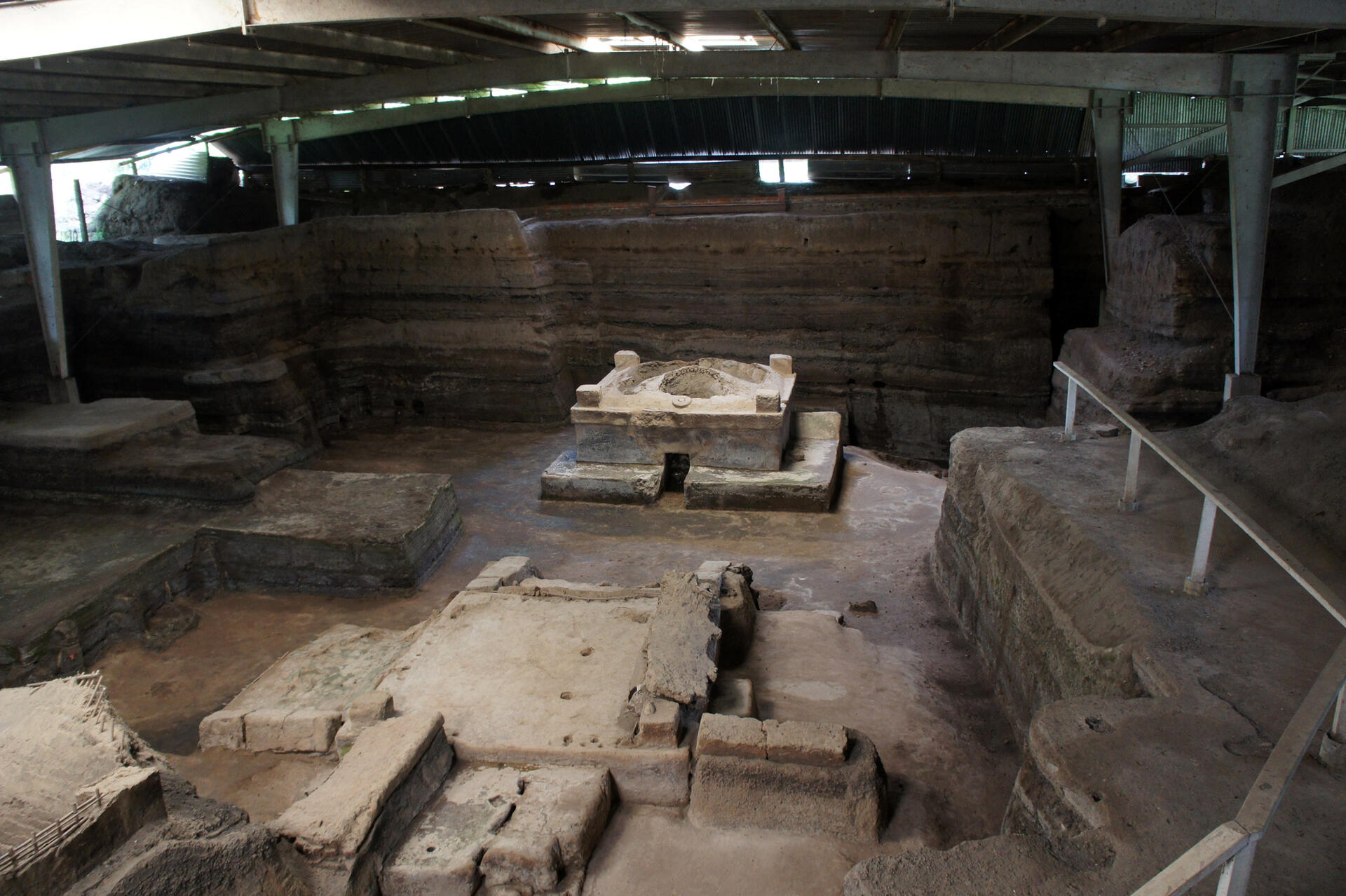
© Mariordo (Mario Roberto Duran Ortiz), CC BY-SA 3.0 Resized from original. (This derivative is under the same CC BY-SA license.)
World Heritage Research
Discover scientific research and academic studies that deepen our understanding of Joya de Cerén Archaeological Site from its history and significance to its conservation, management, and contemporary challenges.
-
The Soundscape in the Replica of the Cerén Temazcal
A unique acoustic phenomenon within the Joya de Cerén temazcal, a 7th-century Maya sweatbath, reveals that its earthen dome morphology sustains low-frequency sounds (64 Hz) while dampening higher frequencies. This resonance, which amplifies male voices but not those of females or children, suggests the structure was acoustically engineered for specific ritual and social functions, such as divination and curing. The study analyzed sound recordings from a precise replica built in 2012, providing new insights into how ancient Maya communities experienced performance spaces and the role of sound in their lived experiences.
Sheets, P., & Mahoney, R. (2021). THE SOUNDSCAPE IN THE REPLICA OF THE CERÉN TEMAZCAL. Ancient Mesoamerica, 33(1), 36–50. https://doi.org/10.1017/s0956536120000383
View Publication Record | Read Publication -
Landscape management and polyculture in the ancient gardens and fields at Joya de Cerén, El Salvador
Exceptional preservation of the Late Classic Maya village Joya de Cerén, buried by the Loma Caldera eruption around 660 CE, offers a unique window into ancient Mesoamerican agricultural practices. Research reveals that villagers employed polyculture farming, combining fruit trees, annual and root crops, fiber plants, and weedy species in productive house-lot gardens and extensive outfields. This diversified approach ensured a nutritionally rich diet, as evidenced by the recovery of maize, manioc, squash, common beans, and other economically useful species through intensive paleoethnobotanical methods. The study underscores the sophisticated landscape management strategies used by ancient inhabitants to maximize food production and sustainability.
Slotten, V., Lentz, D., & Sheets, P. (2020). Landscape management and polyculture in the ancient gardens and fields at Joya de Cerén, El Salvador. Journal of Anthropological Archaeology, 59, 101191. https://doi.org/10.1016/j.jaa.2020.101191
View Publication Record | Read Publication -
Reconstrucción de la agricultura prehispánica en El Salvador previo a la erupción volcánica, a través del análisis de suelos
Research at the Joya de Cerén Archaeological Site in El Salvador has uncovered exceptionally well-preserved evidence of pre-Hispanic agricultural practices, including furrows from maize fields dating to the Late Classic Period. Analysis of soil carbon isotopes (δ13C) revealed that C4 plants, such as maize, were cultivated in the region before the volcanic eruption of Ilopango. Similar findings were observed at other sites like Antiguo Cuscatlan and Monseñor Oscar Arnulfo Romero Boulevard, where grooves under volcanic ash layers provided clues to past agricultural activities. The study highlights the potential of soil analysis to reconstruct ancient farming practices when direct plant remains are absent.
Ito, N., Watanabe, T., & Kimura, M. (2018). Reconstruction of pre-Hispanic agriculture in El Salvador prior to volcanic eruption, through soil analysis. Revista de Museología “Kóot”, (9), 26–36. https://doi.org/10.5377/koot.v0i9.5903
View Publication Record | Read Publication -
Almacenamiento prehispánico de una aldea maya: análisis de material cerámico procedente de Joya de Cerén, El Salvador
A Mayan village buried by volcanic ash around 650 A.D. at Joya de Cerén, El Salvador, reveals new insights into prehispanic storage and supply systems. Analysis of ceramic materials suggests sophisticated organizational strategies for agricultural production, challenging previous assumptions about the capabilities of indigenous communities in the region. The study, conducted on UNESCO World Heritage Site remains, provides a closer look at daily life, social structures, and religious practices through material culture. By examining pottery linked to storage and resource management, researchers propose new paradigms for understanding human activities and societal organization among the Maya and other indigenous peoples of El Salvador.
Toledo, M., Aguilar, S., Lozano, G., & Sermeño, L. (2017). Prehispanic storage system of a mayan town: an analysis of ceramic material from Joya de Cerén, El Salvador. Entorno, (64), 28–40. https://doi.org/10.5377/entorno.v0i64.6058
View Publication Record | Read Publication -
Case study: Seismic resistant constructive systems in El Salvador
A case study highlights the seismic resilience of traditional construction techniques, particularly the improved bahareque system derived from ancient Joya de Cerén methods. This approach demonstrates how vernacular architecture can be adapted to modern seismic standards, offering a sustainable and effective solution for housing in El Salvador. The research evaluates the performance of adobe, bahareque, and reinforced brick masonry (mixto) systems under seismic conditions, emphasizing the potential of reviving historical techniques to enhance structural stability.
Gomes, F., Correia, M. R., & Nuñez, R. D. (2015). Case study: Seismic resistant constructive systems in El Salvador. Seismic Retrofitting: Learning from Vernacular Architecture, 111–112. https://doi.org/10.1201/b18856-19
View Publication Record | Read Publication
