World Heritage Identification Number: 362
World Heritage since: 1986
Category: Cultural Heritage
WHE Type: Historic Cities & Urban Areas
Transboundary Heritage: No
Endangered Heritage: No
Country: 🇱🇾 Libya
Continent: Africa
UNESCO World Region: Arab States
Map
The Old Town of Ghadamès: A Timeless Oasis Pearl in the Heart of the Sahara
The Old Town of Ghadamès, nestled within the vast expanse of the Sahara Desert, is a testament to human resilience and ingenuity. Inscribed as a UNESCO World Heritage Site in 1986, this ancient city stands as a beacon of cultural preservation, showcasing a unique blend of pre-Saharan traditions and architectural innovations.
More to come…UNESCO Description of the World Heritage Site
Ghadamès, known as 'the pearl of the desert', stands in an oasis. It is one of the oldest pre-Saharan cities and an outstanding example of a traditional settlement. Its domestic architecture is characterized by a vertical division of functions: the ground floor used to store supplies; then another floor for the family, overhanging covered alleys that create what is almost an underground network of passageways; and, at the top, open-air terraces reserved for the women.
UNESCO Justification of the World Heritage Site
Criterion (v): Ghadamès is an outstanding settlement in the Saharan pre-desert renowned for its exceptional built heritage, erected thanks to long-lasting traditional practices resulting from the particular demands of the harsh climate. For at least 2,000 years, the city has played an important role in the trans-Saharan trade network. It has been a crossroads for the major cultures of the African continent and the Mediterranean basin, while also developing its own unique architecture and traditions related to its historic origins and subsequent interactions. The dwellings are outstanding in their design, combining form and function to create comfortable living spaces which allow gender segregation and privacy as well as communication beyond the household, in addition to protection from the desert winds and the thermal fluctuations typical of the desert climate. The balance between the inhabitants and the environment has been fundamental to the development of the city’s unique urban character, but is also an important factor in its vulnerability to human and climatic change.
Encyclopedia Record: Ghadames
Ghadames or Ghadamis is an oasis town in the Nalut District of the Tripolitania region in northwestern Libya.Additional Site Details
Area: 287.59 hectares
Number of Components: 1
Coordinates: 30.13333333 , 9.5
Image
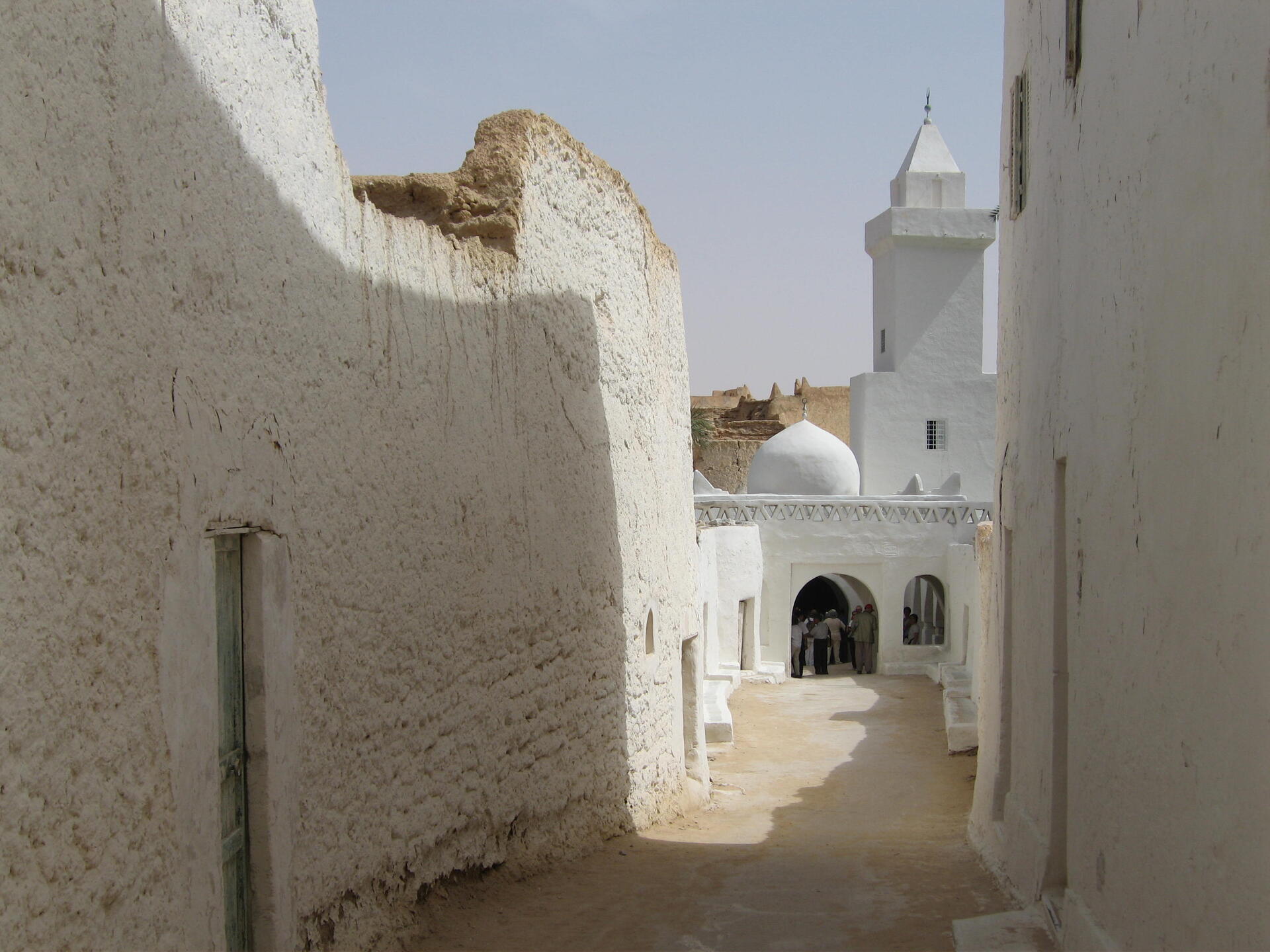
No machine-readable author provided. Teogomez assumed (based on copyright claims)., Public domain
World Heritage Research
Discover scientific research and academic studies that deepen our understanding of Old Town of Ghadamès from its history and significance to its conservation, management, and contemporary challenges.
-
A Comparative Study of Traditional and Contemporary Houses in Ghadames from a Sustainability Perspective
Traditional houses in Ghadamès, Libya, demonstrate exceptional sustainability through passive design strategies that enhance thermal comfort and minimize energy consumption. These structures utilize internal courtyards, thick walls, compact urban forms, and natural ventilation to adapt effectively to hot-arid climates. In contrast, contemporary houses rely heavily on mechanical cooling systems and industrial materials with high embodied energy, leading to higher operational energy demands. This comparative study highlights the potential of integrating climate-responsive traditional design principles into modern architecture to improve environmental performance and promote sustainable urban development in Libya.
Bugaldaen, A., & Alghabaile, S. (2026). دراسة مقارنة بين المنازل التقليدية والمعاصرة في مدينة غدامس من منظور الاستدامة. Journal of the Faculty of Arts and Media – Misurata University, 21(21), 88–73. https://doi.org/10.36602/famj.2026.21.3
View Publication Record | Read Publication -
Managing the Unseen: Cumulative Human Risks and Heritage Governance in Ghadames, Libya
Ghadames, Libya faces significant long-term threats to its cultural heritage due to systemic neglect and fragmented governance. Research reveals that cumulative human risks—such as weak conservation policies, centralized management, and reactive measures like temporary restorations—gradually erode the city's tangible heritage, including Roman ruins, an Ottoman fortress, and traditional mud villages. Unlike direct damage, these threats stem from indirect factors, leading to irreversible harm if unaddressed. The study proposes a sustainable model for heritage protection in Libya, emphasizing community-based governance, long-term policy reform, and participatory risk management. By analyzing official documents and interviews with local stakeholders, the research highlights the need to treat human risks as ongoing processes rather than isolated events to ensure the preservation of Libyan cultural landscapes for future generations.
Seila, F., Selim, G., & Newisar, M. (2026). Managing the Unseen: Cumulative Human Risks and Heritage Governance in Ghadames, Libya. Heritage, 9(4), 139. https://doi.org/10.3390/heritage9040139
View Publication Record | Read Publication -
Patrimoni Architettonici Mediterranei. Un caso limite: la città-oasi di Ghadames (Libia)
Ghadamès, a UNESCO World Heritage Site in Libya's Fezzan region, exemplifies the extreme expression of Mediterranean architectural heritage. Unlike typical Mediterranean cities, Ghadamès' urban fabric is defined by compactness and minimal open spaces, driven not only by climate but also by the need to preserve agricultural land for food production in this water-scarce oasis environment. The city's architecture further distinguishes itself through its innovative reuse of archaeological spolia, demonstrating a high level of attention to both public and private space quality. This study highlights Ghadamès as a critical case study, illustrating how Mediterranean architectural principles can adapt to extreme environmental constraints while sustaining cultural continuity.
Micara, L. (2025). Patrimoni Architettonici Mediterranei. Un caso limite: la città-oasi di Ghadames (Libia). PROCEEDINGS of the International Conference on Fortifications of the Mediterranean Coast FORTMED 2025. Vol. 19, 625–632. https://doi.org/10.4995/fortmed2025.2025.20305
View Publication Record | Read Publication -
Resiliency of Cultural Heritage Buildings: Lessons Learned from Old City of Ghadames
Cultural heritage buildings demonstrate resilience through social use, adapting to modernity and social change while mitigating risks such as environmental threats and neglect. The Old City of Ghadamès serves as a case study, illustrating how communal gatherings and religious ceremonies contribute to the preservation and adaptability of historic spaces. This research highlights the critical role of community engagement in sustaining cultural heritage, offering valuable insights for conservation strategies in evolving urban landscapes.
ALI HAMED, A. H., Al-ODAINI, A., NON, J., INAMDAR, N.,. (2025). RESILIENCY OF CULTURAL HERITAGE BUILDINGS: LESSONS LEARNED FROM OLD CITY OF GHADAMES. Journal of Sustainability Science and Management, 20(9), 1908–1932. https://doi.org/10.46754/jssm.2025.09.010
View Publication Record | Read Publication -
A Comparative Study of Soundscape Perception in Historic and Contemporary Urban Areas of Ghadames
Residents of Ghadames, Libya, perceive the historic old city as significantly quieter and more acoustically comfortable compared to the modern urban area, despite no overall difference in acoustic comfort. A survey of 32 local residents revealed a strong preference for leisure activities in the historic sector, highlighting its reputation for tranquility. Weather conditions were also found to influence acoustic experiences. These findings offer valuable insights for urban planning and heritage management, emphasizing the need to preserve unique acoustic identities in culturally significant cities undergoing modernization.
Aburawis, A. A., Al-Ameen, O. A., Agael, F. M.,. (2025). A Comparative Study of Soundscape Perception in Historic and Contemporary Urban Areas of Ghadames. Journal of Technology Research, 3(Special Issue), 421–432. https://doi.org/10.26629/jtr.2025.41
View Publication Record | Read Publication -
Mapping attributes and managing heritage sites: the case of the Old Town of Ghadames-Libya
A systematic methodology for identifying and analyzing heritage site attributes has been developed, emphasizing their impact on value, authenticity, integrity, and management. Applied to the Old Town of Ghadames, Libya—a UNESCO World Heritage Site placed in danger due to conflict—this approach updates the site's attributes to inform better preservation strategies. The study highlights the need for holistic assessments to guide interpretation, management, and cultural significance preservation, offering a replicable framework adaptable by local heritage professionals. This methodology aims to minimize conflict-induced damage, supporting efforts for delisting sites from UNESCO's In-Danger List.
Alkhalaf, H., Elhabashi, A., Hesham, Y., Hiba, A., Omaar, A., Walda, H., & Wootton, W. T. (2024). Mapping attributes and managing heritage sites: the case of the Old Town of Ghadames-Libya. Journal of Cultural Heritage Management and Sustainable Development. https://doi.org/10.1108/jchmsd-11-2023-0186
View Publication Record | Read Publication -
Politico-Theological Debates in Ghadames between the 1770s and the 1850s from a Global Perspective
Ghadames, strategically positioned between Morocco and the Ottoman Empire, served as a hub for politico-theological debates from the 1750s to the 1850s. The city's scholars adapted their stances in response to shifting regional power dynamics, leaving behind a rich corpus of written materials—chronicles, biographies, and letters—that reflect this intellectual engagement. Discourse analysis reveals persistent yet varied arguments, offering insights into the complex interplay between political authority and theological discourse during this period.
Duymus, K. (2024). Politico-Theological Debates in Ghadames between the 1770s and the 1850s from a Global Perspective. Afriques, 15. https://doi.org/10.4000/12xta
View Publication Record | Read Publication