World Heritage Identification Number: 169
World Heritage since: 1981
Category: Cultural Heritage
WHE Type: Buildings & Architectural Ensembles
Transboundary Heritage: No
Endangered Heritage: No
Country: 🇩🇪 Germany
Continent: Europe
UNESCO World Region: Europe and North America
Map
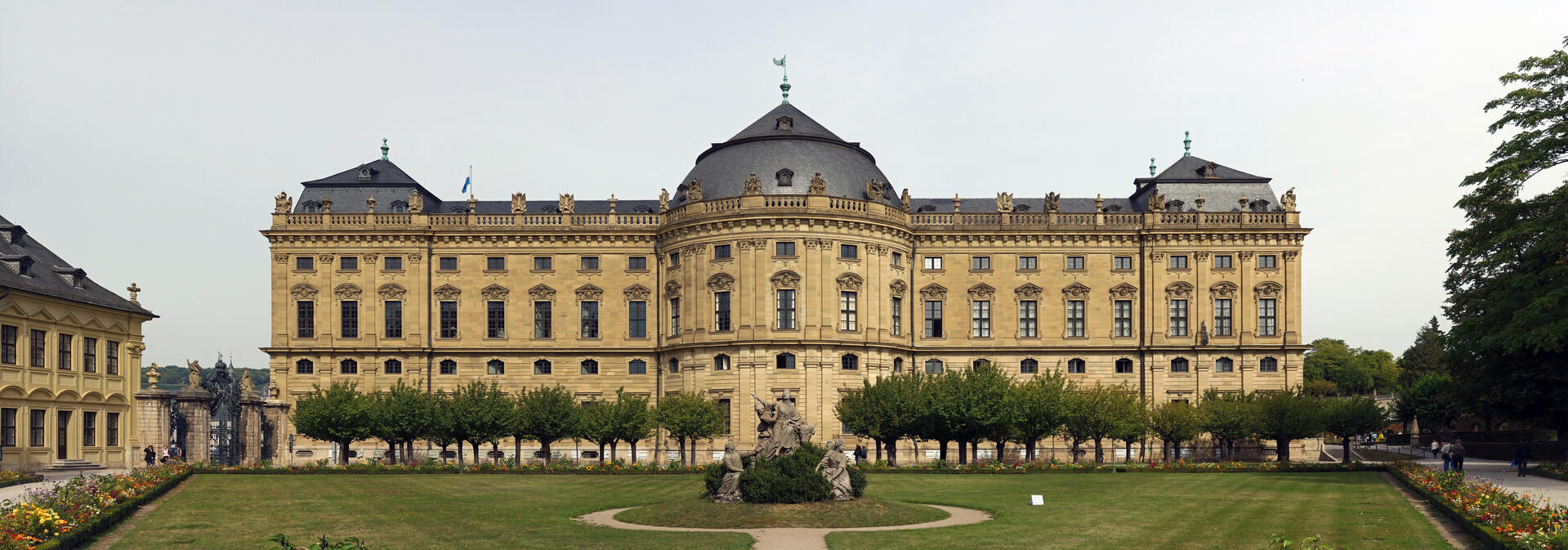
Würzburg Residence with the Court Gardens and Residence Square: A Grand Baroque Palace in Germany
The Würzburg Residence, located in the city of Würzburg, Germany, stands as a testament to the grandeur of the Baroque period. Inscribed as a UNESCO World Heritage Site in 1981, this magnificent palace is not only one of the largest and most beautiful in Germany but also boasts of being surrounded by exquisite gardens that add to its overall charm.
More to come…UNESCO Description of the World Heritage Site
This magnificent Baroque palace – one of the largest and most beautiful in Germany and surrounded by wonderful gardens – was created under the patronage of the prince-bishops Lothar Franz and Friedrich Carl von Schönborn. It was built and decorated in the 18th century by an international team of architects, painters (including Tiepolo), sculptors and stucco-workers, led by Balthasar Neumann.
UNESCO Justification of the World Heritage Site
Criterion (i): The Würzburg Residence is at once the most homogeneous and extraordinary of the Baroque palaces. It is an autonomous work of art in European Baroque style illustrated by its structure and décor elements. The Residence represents a unique artistic realisation as a result of its ambitious programme, the originality of creative spirit, and the international character of its workshop. Perhaps no monument from the same period is able to claim such a concurrence of talent.
Criterion (iv): The Residence is a document of European culture. The structure is a joint achievement of the most significant European architects, sculptors, and painters of the 18th century from France (particularly Paris), Italy (particularly Venice), Austria (particularly Vienna), and Germany.
Encyclopedia Record: Würzburg Residence
The Würzburg Residence is a palace in Würzburg, Germany. Johann Lukas von Hildebrandt and Maximilian von Welsch, representatives of the Austrian/Southern German Baroque style, were involved in the construction, as well as Robert de Cotte and Germain Boffrand, who were followers of the French style. Balthasar Neumann, court architect of the Bishop of Würzburg, was the principal architect of the Residence, which was commissioned by the Prince-Bishop of Würzburg Johann Philipp Franz von Schönborn and his brother Friedrich Carl von Schönborn in 1720, and completed in 1744. The Venetian painter Giovanni Battista Tiepolo, assisted by his son, Domenico, painted frescoes in the building.Additional Site Details
Area: 14.77 hectares
Number of Components: 2
(iv) — Outstanding example of a type of building or landscape
Coordinates: 49.79278 , 9.93889
World Heritage Research
Discover scientific research and academic studies that deepen our understanding of Würzburg Residence with the Court Gardens and Residence Square from its history and significance to its conservation, management, and contemporary challenges.
-
Afterword: Expansive yet Particularised Moments
A critical reassessment of Giovanni Tiepolo's ceiling fresco (1750–53) in the Würzburg Residence reveals two enduring eighteenth-century interpretations that challenge reductive views of cosmopolitan conviviality. These interpretations emphasize situatedness, spatio-temporal particularities, and limitations—finding relevance for contemporary cosmopolitan philosophy and practice. The study employs close analysis of the fresco's historical context to propose modifications in how cosmopolitanism is understood and applied today.
Karafili Steiner, E. (2025). Afterword: Expansive yet Particularised Moments. Contesting Cosmopolitan Moments in the Long Eighteenth Century, 197–201. https://doi.org/10.3366/edinburgh/9781399524957.003.0007
View Publication Record | Read Publication -
Chapter 5. University of Würzburg (1965–1973)
Würzburg, a historic town situated at a strategic river crossing and commercial hub between Nuremberg and Frankfurt, has been recognized for its mild climate conducive to wine production and its rich architectural heritage. The city's significance as a former prince-bishopric seat spans over 1,000 years, with notable Romanesque, Baroque, and Rococo structures that have been rebuilt after severe destruction during World War II. Despite the devastating air-raid in 1945, which caused an 80% destruction rate due to a firestorm, Würzburg's cultural landmarks, including its cathedral and residence, have been restored and now stand as prominent UNESCO World Heritage Sites. The study highlights the resilience of the city's architectural heritage, drawing parallels with Dresden, another city that suffered similarly but has also undergone extensive restoration efforts.
Schmidbaur, H. (2024). Chapter 5. University of Würzburg (1965–1973). From Chemical Craftsmanship to the Art of Gilding Atoms, 85–110. https://doi.org/10.47261/1559-5
View Publication Record | Read Publication -
America Exists!
This chapter explores the complex and evolving perception of America through the lens of a German individual's lifetime experiences, from childhood memories of post-World War II Germany to the ambivalent views shaped by historical events like the Vietnam War. It highlights how the idealized image of America, symbolized by Tiepolo's fresco in the Würzburg Residence—a UNESCO World Heritage Site bombed during WWII—was rescued and preserved by an American officer, reflecting a deep cultural fascination with the concept of freedom and limitless possibilities. The text argues that this projection of 'America' as a land of miracles has faded in contemporary times, suggesting that Europe must now realize its own version of these ideals through mutual cooperation rather than narcissistic heroism. The analysis draws on historical and philosophical perspectives, including Hannah Arendt's interpretations of America's contradictions.
Rasche, J. (2020). America Exists! Cultural Complexes and the Soul of America, 89–97. https://doi.org/10.4324/9780429295690-5
View Publication Record | Read Publication -
Robotic Mapping of Cultural Heritage Sites
Robotic mapping using the mobile robot Irma3D demonstrates significant advancements in automating 3D modeling of cultural heritage sites, including the Würzburg Residence. Equipped with a camera and laser scanner, the robot streamlines data acquisition and registration processes, addressing challenges posed by massive datasets. The study highlights its effectiveness through testing at two renowned sites: Ostia Antica and the Würzburg Residence, showcasing its potential to revolutionize archaeological documentation.
Borrmann, D., Heß, R., Houshiar, H. R., Eck, D., Schilling, K., & Nüchter, A. (2015). ROBOTIC MAPPING OF CULTURAL HERITAGE SITES. The International Archives of the Photogrammetry, Remote Sensing and Spatial Information Sciences, XL-5/W4, 9–16. https://doi.org/10.5194/isprsarchives-xl-5-w4-9-2015
View Publication Record | Read Publication -
Evaluation of Methods for Robotic Mapping of Cultural Heritage Sites
Robotic mapping using the mobile robot Irma3D demonstrates significant potential for automating 3D modeling of cultural heritage sites, including data acquisition and registration. The study evaluated methods for automatic 3D color reconstructions at the Würzburg Residence, showcasing how advanced sensor technology—such as photo cameras and laser scanners—can efficiently process large datasets while preserving intricate details. This approach addresses key challenges in archaeological studies by streamlining workflows and enhancing precision in heritage documentation.
Borrmann, D., Hess, R., Eck, D., Houshiar, H., Nüchter, A., & Schilling, K. (2015). Evaluation of Methods for Robotic Mapping of Cultural Heritage Sites. IFAC-PapersOnLine, 48(10), 105–110. https://doi.org/10.1016/j.ifacol.2015.08.116
View Publication Record | Read Publication