World Heritage Identification Number: 1103
World Heritage since: 2003
Category: Cultural Heritage
WHE Type: Buildings & Architectural Ensembles
Transboundary Heritage: No
Endangered Heritage: No
Country: 🇰🇿 Kazakhstan
Continent: Asia
UNESCO World Region: Asia and the Pacific
Map
The Mausoleum of Khoja Ahmed Yasawi: A Timurid Masterpiece in Southern Kazakhstan
The Mausoleum of Khoja Ahmed Yasawi, located in the historic city of Turkestan in southern Kazakhstan, stands as a testament to the rich cultural heritage of Central Asia. This architectural marvel, inscribed as a UNESCO World Heritage Site in 2003, offers a unique blend of Persian, Turkish, and Mongolian influences that characterize the Timurid period.
More to come…UNESCO Description of the World Heritage Site
The Mausoleum of Khoja Ahmed Yasawi, in the town of Yasi, now Turkestan, was built at the time of Timur (Tamerlane), from 1389 to 1405. In this partly unfinished building, Persian master builders experimented with architectural and structural solutions later used in the construction of Samarkand, the capital of the Timurid Empire. Today, it is one of the largest and best-preserved constructions of the Timurid period.
UNESCO Justification of the World Heritage Site
Criterion (i): The Mausoleum of Khoja Ahmed Yasawi is an outstanding achievement in the Timurid architecture, and it has significantly contributed to the development of Islamic religious architecture.
Criterion (iii): The mausoleum and its property represent an exceptional testimony to the culture of the Central Asian region, and to the development of building technology.
Criterion (iv): The Mausoleum of Khoja Ahmed Yasawi was a prototype for the development of a major building type in the Timurid period, becoming a significant reference in the history of Timurid architecture.
Encyclopedia Record: Mausoleum of Khoja Ahmed Yasawi
The Mausoleum of Khawaja Ahmed Yasawi is a mausoleum in the city of Turkestan, in southern Kazakhstan. The structure was commissioned in 1389 by Timur, who ruled the area as part of the expansive Timurid Empire, to replace a smaller 12th-century mausoleum of the famous Turkic poet and Sufi mystic, Khoja Ahmed Yasawi (1093–1166). However, construction was halted with the death of Timur in 1405.Additional Site Details
Area: 0.55 hectares
Number of Components: 1
(iii) — Unique or exceptional testimony to a cultural tradition
(iv) — Outstanding example of a type of building or landscape
Coordinates: 43.2976944444 , 68.2710555556
Image
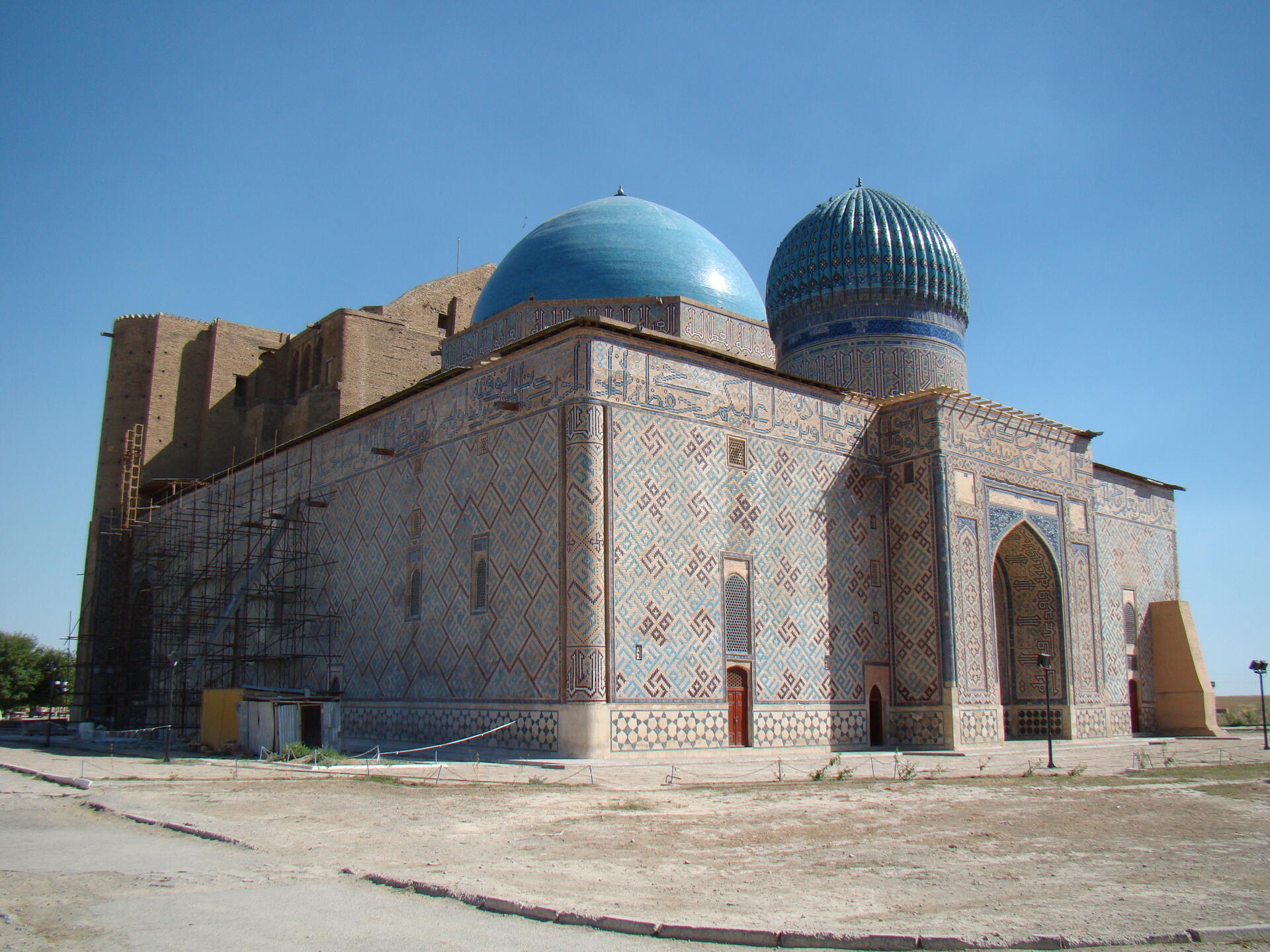
© Yuriy75, CC BY-SA 3.0 Resized from original. (This derivative is under the same CC BY-SA license.)
World Heritage Research
Discover scientific research and academic studies that deepen our understanding of Mausoleum of Khoja Ahmed Yasawi from its history and significance to its conservation, management, and contemporary challenges.
-
The Soviet Paradox: Simultaneous Acts of Preserving and Destroying the Mausoleum of Khoja Ahmed Yasawi
Soviet authorities simultaneously preserved and undermined the religious significance of the Mausoleum of Khoja Ahmed Yasawi, a revered Sufi site, through contradictory measures. While they aimed to convert it into an atheist museum as part of their secularization efforts, prolonged restoration delays and the absence of explicit atheist labeling prevented full ideological imposition. This paradoxical approach is revealed through newly uncovered archival documents, offering insight into how Soviet policies sought to erase religious reverence while maintaining cultural heritage.
Zholdassuly, T., & Benhür, Ç. (2026). THE SOVIET PARADOX: SIMULTANEOUS ACTS OF PRESERVING AND DESTROYING THE MAUSOLEUM OF KHOJA AHMED YASAWI. Türk Kültürü Ve Hacı Bektaş Veli Araştırma Dergisi, (117), 121–140. https://doi.org/10.60163/tkhcbva.1836261
View Publication Record | Read Publication -
The Mausoleum of Khoja Akhmed Yasawi in the Research of the Imperial Period (XIX c.)
Imperial-era research on the Mausoleum of Khoja Ahmed Yasawi, a Central Asian cultural heritage site, reveals how 19th-century studies intertwined scholarly inquiry with colonial objectives. The analysis highlights previously overlooked aspects of historiography, including imperial officials' roles in documenting and preserving the monument through reports, drawings, and travel notes. Using historical-genetic, source-critical, and comparative-historical methods, the study traces evolving research focuses over time, uncovering the intersection of science, authority, and ideology in shaping understandings of this significant monument.
(Ed.). (2026). The Mausoleum of Khoja Akhmed Yasawi in the Research of the Imperial Period (XIX c.). Bylye Gody, 21(2). https://doi.org/10.13187/bg.2026.2.805
View Publication Record | Read Publication -
Cultural Space and Urban Semiotics of Turkistan City: Socio-cultural Transformation in the Context of Urbanisation
Turkistan's urban landscape is shaped by three interconnected symbolic dimensions—Sacred Centres, Modern Signifiers, and Spatial Narratives—that collectively construct the city’s contemporary identity. The Mausoleum of Khoja Ahmed Yasawi serves as a primary symbolic anchor, while modern urban development integrates narratives of spirituality, cultural continuity, heritage, and modernization. This study reveals how cultural symbols actively participate in urban transformation, contributing to research on urban semiotics and heritage-based urbanization. An interdisciplinary qualitative approach, combining urban semiotics, discourse analysis, and visual analysis, was employed to examine policy documents, development strategies, tourism materials, architectural projects, visual representations, and urban design elements from 2018 to 2025.
ONGALBAIKYZY, R., & DINASHEVA, L. (2026). CULTURAL SPACE AND URBAN SEMIOTICS OF TURKISTAN CITY: SOCIO-CULTURAL TRANSFORMATION IN THE CONTEXT OF URBANISATION. Jete – Jоurnal of Philosophy Religious Аnd Cultural Studies, 155(2), 219–231. https://doi.org/10.32523/3080-1281-2026-155-2-219-231
View Publication Record | Read Publication -
Cultural and geographic drivers of tourism cluster development in the Turkestan region of Kazakhstan
A tourism cluster in Kazakhstan's Turkestan region, centered around the Mausoleum of Khoja Ahmed Yasawi—a key attraction drawing 61% of tourist interest—can significantly boost infrastructure, economic growth, and international visitor flows between Turkic countries. The study identified critical needs: upgrading infrastructure (40%), enhancing service quality (27%), and strengthening marketing efforts (17%). Using SWOT analysis and interviews, researchers mapped cultural-geographic opportunities and developed a structural model for cluster formation, emphasizing the region's potential for cultural, medical, and health tourism.
Tokbergenova, U. (2026). Cultural and geographic drivers of tourism cluster development in the Turkestan region of Kazakhstan. Kazakh International Journal of Geography and Environment, 1(1). https://doi.org/10.51889/kijge.2026.1.1.001
View Publication Record | Read Publication -
Vernacular Spatial Logic and Islamic Sacred Semantics in Kazakh Architecture
Medieval Kazakh sacred architecture was part of a complex, interconnected system known as 'geosacral corridors,' integrating devotional practices, trade routes, and natural landscapes. These corridors functioned as nodes of spiritual authority, cultural memory, pilgrimage, and commercial exchange, revealing that sacred sites were not isolated but strategically positioned to enhance social and economic mobility. The study, focusing on sites like the Mausoleum of Khoja Ahmed Yasawi, employed methods such as sacred geography, landscape archaeology, and comparative architectural analysis to demonstrate how architecture expressed a synthesis of Sufi traditions, local saint veneration, and broader Islamic frameworks. Future heritage research is recommended to incorporate pilgrimage routes, landscape relationships, and regional mobility networks for comprehensive documentation and conservation.
Zhussup, M. (2026). Vernacular Spatial Logic and Islamic Sacred Semantics in Kazakh Architecture. An-Najah University Journal for Research - A (Natural Sciences), 9999(9999). https://doi.org/10.35552/anujr.a.a2893
View Publication Record | Read Publication -
Representing Kazakhstan’s historical and cultural heritage in historical retrospective: A case study of an exhibition project
An immersive exhibition project at the National Museum of Kazakhstan leverages advanced digital technologies to showcase the historical and cultural heritage of the Turkic peoples, emphasizing their statehood's continuity and uniqueness. The study highlights emblematic artifacts—ranging from Bronze Age relics like the Saka 'Golden Man' headdress to Timurid-era lamps from the Mausoleum of Khoja Ahmed Yasawi—and demonstrates how such exhibits can serve as active agents of cultural exchange in the digital era. By adopting a thematic and chronological approach, the project illustrates Kazakhstan's rich history, from the Scythians and Huns to the Kazakh Khanate, while promoting international collaboration, drawing parallels with similar initiatives at the Louvre, Guimet Museum, and Hermitage.
Ibrayeva, A., Temirkhanova, A., & Zhunussov, K. (2025). Representing Kazakhstan’s historical and cultural heritage in historical retrospective: A case study of an exhibition project. Turkic Studies Journal, 7(3), 53–75. https://doi.org/10.32523/2664-5157-2025-3-53-75
View Publication Record | Read Publication -
Architectural concept for the Khoja Ahmed Yasawi Mausoleum in Turkestan
Research on the Mausoleum of Khoja Ahmed Yasawi in Turkestan reveals its pivotal role as both a historical and scientific landmark, shaping the development of architectural studies in Kazakhstan. The study highlights the mausoleum's significance beyond religious and cultural heritage, positioning it as a central hub for theoretical-scientific exploration in Central Asia. Analyzing restoration efforts from the early 20th century to the present, the research evaluates contributions from key scholars like A.A. Semenov, S.K. Orlov, and B.T. Tuyaqbaeva, comparing the strengths and weaknesses of Soviet-era scientific expeditions and post-independence policies for cultural preservation. Using methods such as historical-comparative, structural-architectural, archaeological, and documentary analysis, the study provides actionable insights for preserving and restoring heritage sites, with applications in tourism, urban planning, digital documentation, and restoration science.
Malibekov, Z. (2025). Architectural concept for the Khoja Ahmed Yasawi Mausoleum in Turkestan. Рroblems of Engineering and Professional Education, 78(3), 7–17. https://doi.org/10.32523/2220-685x-2025-78-3-7-17
View Publication Record | Read Publication